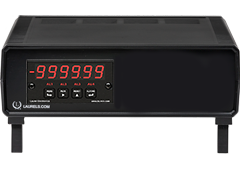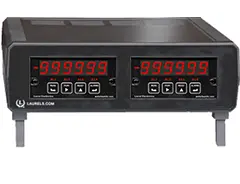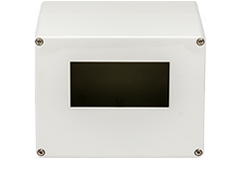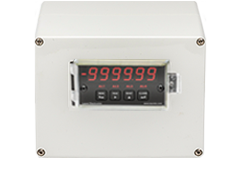
New Front Panel USB-C Port Coming Soon!
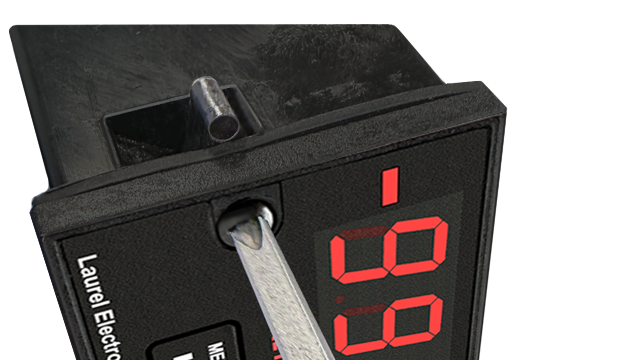
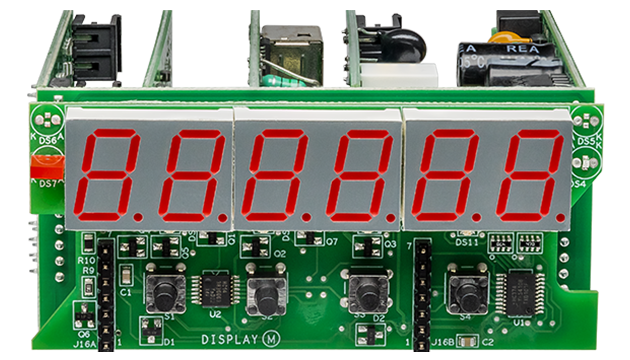

Easy USB-C Programming: Configure Laureate digital panel meters through the front-panel USB-C port with Laurel’s free Instrument Setup Software for Windows. Meters with a data interface board can also be programmed through that interface. The software shows only the settings that apply to your installed option boards, and configurations can be saved to the meter, a PC, a file server, or a USB thumb drive. Laurel’s free Instrument Setup Software can also be used for light-duty data collection.
All signal conditioner board ranges are factory-calibrated, with calibration factors for each range securely stored in an onboard EEPROM. These factors can be scaled via software to accommodate external shunts, enabling field replacement of signal conditioner boards without necessitating recalibration of the associated digital panel meters. For optimal accuracy, factory recalibration is recommended annually. All Laurel Electronics instruments undergo factory calibration using the industry-leading Fluke calibrators, which are recalibrated yearly and certified traceable to national standards, ensuring the highest level of precision and reliability.
The Laureate Phase Angle & Power Factor Meter utilizes the Laureate Extended counter main board and the FR dual-channel signal conditioner board, which accepts AC signals from 12 mV p-p to 250 Vrms.
Peak and valley values are automatically captured. These may be displayed via a front panel pushbutton command or control signal at the rear connector, or be transmitted as serial data.
Two rear panel control Inputs (CMOS/TTL levels, logic 0 = tied to digital ground, logic 1 = open) or dry contacts that can be set to control / activate 14 meter commands.
An (isolated) 5, 10, 12, or 24 Vdc excitation output is standard to power transducers or two-wire transmitters. Ratiometric operation, which automatically compensates for changes in the applied excitation, is jumper selectable for applications, such as bridges, where the signal to be measured is proportional to the excitation level.
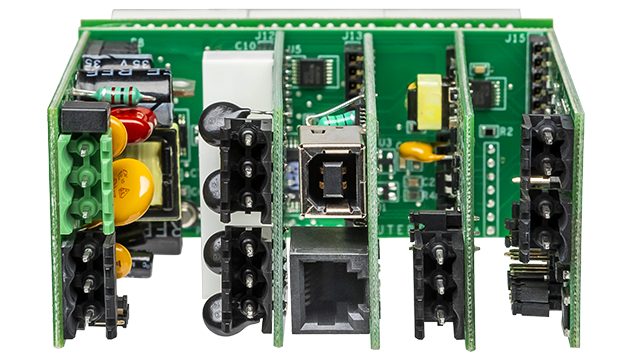
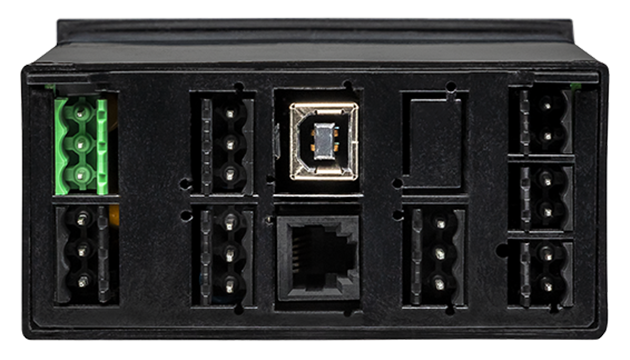
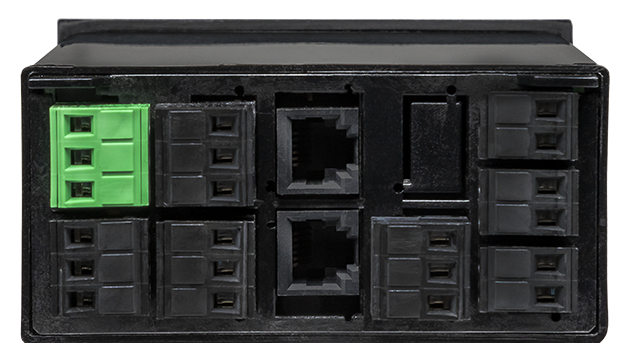
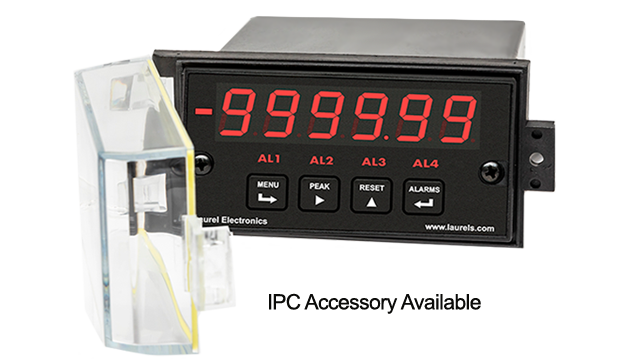
All boards are isolated from meter and power grounds. Optional Plug-in-Play boards for communications and control include Ethernet, WiFi, serial communication boards, dual or quad relay boards, and an analog output board. Laureates may be powered from 85-264 Vac or optionally from 12-32 Vac or 10-48 Vdc. The display is available with bright red or green 0.56" (14.2mm) high LED digits. The 1/8 DIN case meets NEMA 4X (IP65) specifications from the front when panel mounted. Any setup functions and front panel keys can be locked out for simplified usage and security. A built-in 5, 10, 12, or 24 Vdc excitation supply can power transducers, eliminating the need for an external power supply. All power and signal connections are via UL / VDE / CSA rated screw clamp plugs.
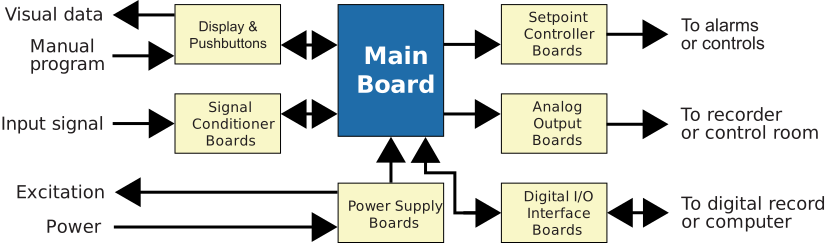
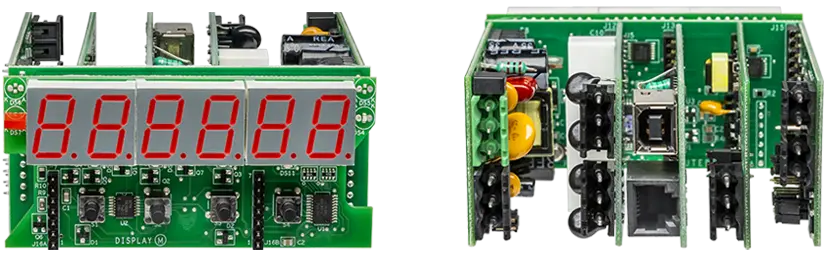
The design of the Laureate™ Series is modular for maximum flexibility at minimum cost. All boards are isolated from meter and power grounds. The base configuration for a panel meter or counter consists of a main module (with computer and plug-in display boards), a power supply board, and a signal conditioner board. Optional plug-in-play boards include an isolated setpoint controller board, an isolated analog output board, and an isolated digital interface board. Modular design and a choice of plug-in options allow the Laureate to be customized for a broad range of applications from simple monitoring to control and computer interface. There can be up to five plug-in boards in a 1/8 DIN Laureate.
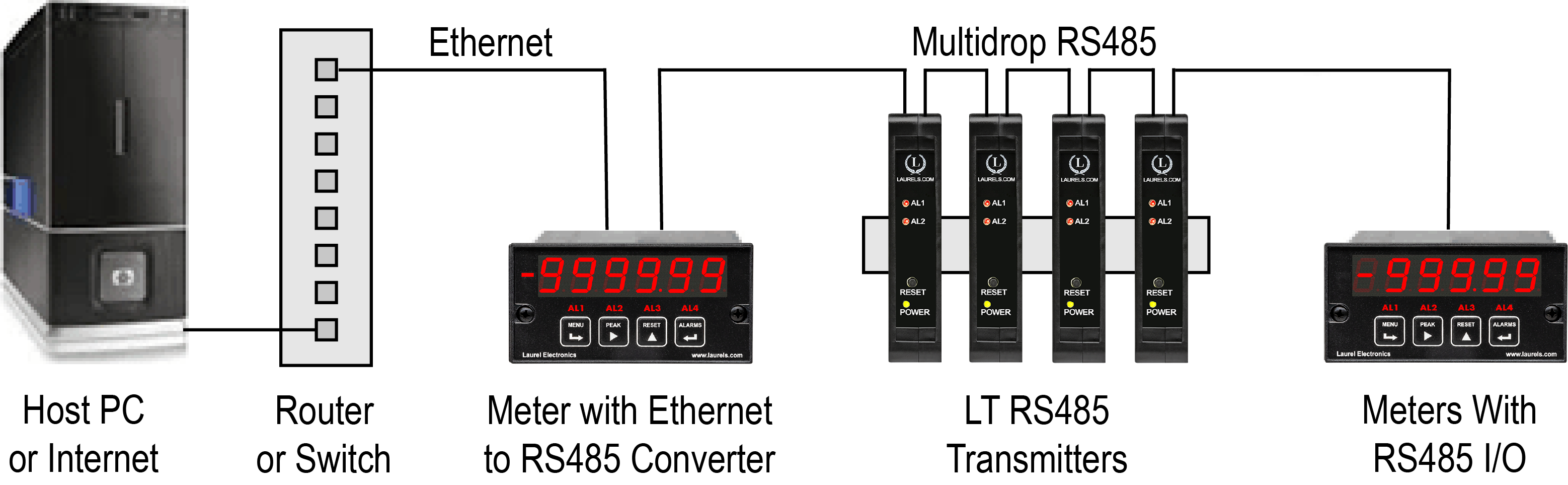
Up to 30 Laureate Digital Panel Meters and/or LT Transmitters can be configured for RS485 and daisy-chained to an LT Transmitter using Laurel’s High Speed Ethernet-to-RS485 converter board for seamless LAN integration. Alternatively, Laurel LTE series Ethernet transmitters can connect directly to a LAN via an Ethernet cable. Setup for both configurations is streamlined using Laurel’s free Instrument Setup Software, which simplifies node discovery and transmitter configuration.
Laureate Digital Panel Meters can be equipped with Laurel communication boards to support various interfaces and protocols. These include serial interfaces with ASCII or Modbus RTU protocols, and Ethernet interfaces with web access, ASCII, or Modbus TCP/IP protocols, ensuring versatile connectivity for your commercial applications.
| Phase Angle Mode | |
|---|---|
| Item Displayed | Phase angle difference between two waves of same period |
| Display Units | 1°, 0.1°, 0.01° |
| Frequency Range | 0.005 Hz to 10 kHz |
| Resolution | 0.01°, 1 Hz to 100 Hz; 0.1° at 1 kHz; 1° at 10 kHz |
| Accuracy | 0.05° at 50 or 60 Hz |
| Maximum Timing Interval | 200 sec |
| Power Factor Mode | |
| Item Displayed | Power factor between two sine waves of same period |
| Display Units | 1.000 to 0.000 |
| Polarity | Negative sign indicates negative phase angle |
| Frequency Range | 0.005 Hz to 10 kHz |
| Accuracy | 0.1% at power line frequencies |
| Update Rate | |
| Timing Interval | Gate time + 30 ms+ 0-2 signal periods |
| Gate Time | Selectable 10 ms to 199.99 s |
| Time Before Zero Out | Selectable 10 ms to 199.99 s (to indicate loss of signal) |
| Display | |
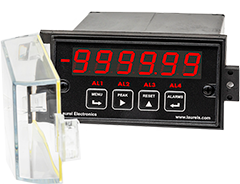
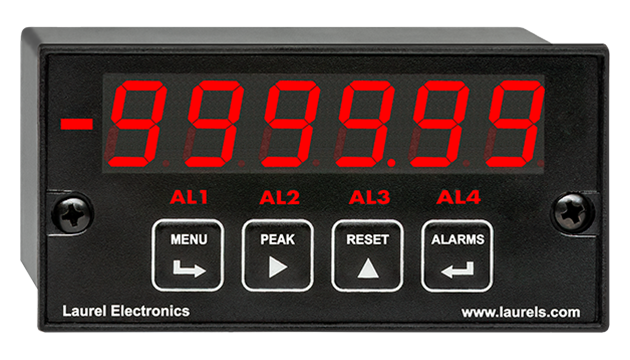
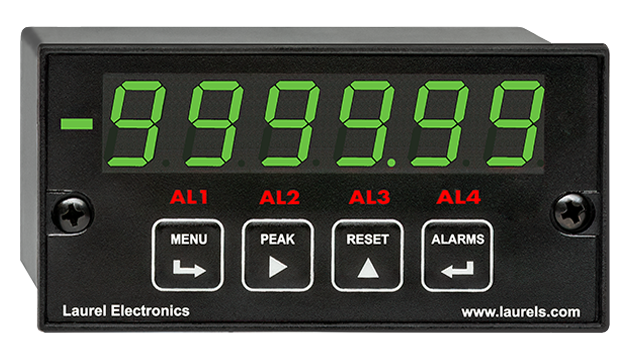
| Readout | 6 LED digits, 7-segment, 14.2 mm (.56"), red or green. |
| Range | -999,999 to +999,999 |
| Indicators | Minus sign, 4 red LED lamps |
| Front-Panel Port | USB-C (programming & data) |
| Protocols | Laurel Custom ASCII (serial), Modbus RTU (serial), Modbus TCP (Ethernet or WiFi) |
| Digital addresses | 247 (Modbus), 31 (Laurel Custom ASCII) |
| Isolation | 250V rms working, 2.3 kV rms per 1 min test |
| Inputs | |
| Signal ranges | Nine AC signal ranges from 12 mVp-p to 250 Vac |
| Signal ground | Common ground for channels A & B |
| Noise filter | 1 MHz, 30 kHz, 250 Hz (jumper selectable) + digital filter |
| Recalibration: All ranges are calibrated at the factory. Recalibration is recommended every 12 months. | |
| Power Supply Boards (one required) | |
| Voltage, standard | 85-264 Vac or 90-300 Vdc |
| Voltage, optional | 12-32 Vac or 10-48 Vdc |
| Frequency | DC or 47-63 Hz |
| Power consumption (typical, base meter) | 1.2W @ 120 Vac, 1.5W @ 240 Vac, 1.3W @ 10 Vdc, 1.4W @ 20 Vdc, 1.55W @ 30 Vdc, 1.8W @ 40 Vdc, 2.15W @ 48 Vdc |
| Power Isolation | 250V rms working, 2.3 kV rms per 1 min test |
| Excitation Output (standard) | |
| 5 Vdc | 5 Vdc ± 5%, 100 mA (jumper selectable) |
| 10 Vdc | 10 Vdc ± 5%, 120 mA (jumper selectable) |
| 12 Vdc | 12 Vdc ± 5%, 100 mA (jumper selectable) |
| 24 Vdc | 24 Vdc ± 5%, 50 mA (jumper selectable) |
| Output Isolation | 50 Vdc from signal ground |
| Analog Output Boards (one optional) | |
| Output levels | 4-20 mA, 0-20 mA, 0-10V, -10 to +10V (jumper selectable) |
| 4-20 mA, 0-20 mA, 0-10V (dual-output option) | |
| Current compliance | 2 mA at 10V ( > 5 kΩ load) |
| Voltage compliance | 12V at 20 mA (< 600 Ω load) |
| Scaling | Zero and full scale adjustable from -99999 to +99999 |
| Resolution | 16 bits (0.0015% of full scale) |
| Isolation | 250V rms working, 2.3 kV rms per 1 min test |
| Relay Output Boards (one optional) | |
| Dual magnetic relays | 2 Form C, 10A max, 440Vac or 125Vdc max, 2500VA or 300W |
| Quad magnetic relays | 4 Form A (NO), 10A max, 440Vac or 125Vdc max, 2500VA or 300W |
| Dual solid state relays | 2 Form A (NO), AC or DC, 0V - 400V, 120Ma, 35Ohms (max at On-State) |
| Quad solid state relays | 4 Form A (NO), AC or DC, 0V - 400V, 120Ma, 35Ohms (max at On-State) |
| Relay commons | Isolated commons for dual relays or each pair of quad relays |
| Relay isolation | 250V rms working, 2.3 kV rms per 1 minute test |
| Relay latching modes | Latching or non-latching |
| Relay active modes | Active on or off, active high or low |
| Hysteresis modes | QA passband mode, split hysteresis, span hysteresis |
| Communication Boards (one optional) | |
| Board selections | RS232, RS485 with dual RJ11 connectors, RS485 with dual RJ45 connectors, USB, Ethernet, USB-to-RS485 gateway, Ethernet-to-RS485 gateway, WiFi with built-in antenna plus USB & RS485, WiFi with external antenna plus USB & RS485 |
| Protocols | Laurel Custom ASCII (serial), Modbus RTU (serial), Modbus TCP (Ethernet or WiFi) |
| Digital addresses | 247 (Modbus), 31 (Laurel ASCII), |
| Isolation | 250V rms working, 2.3 kV rms per 1 min test |
| Environmental | |
| Operating temperature | -40°C to 70°C (-40°F to 158°F) |
| Storage temperature. | -40°C to 85°C (-40°F to 185°F) |
| Relative humidity | 95% at 40°C, non-condensing |
| Protection | NEMA-4X (IP-65) when panel mounted |
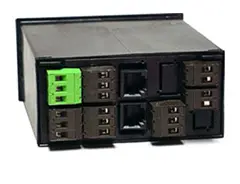
| Electrical Connections | |
 |
|
| Mechanical | |
| Enclosure | 1/8 DIN, high impact plastic, UL 94V-0, color: black |
| Mounting | 1/8 DIN panel cutout required: 3.622" x 1.772" (92 mm x 45 mm). |
| Dimensions | 4.68" x 2.45" x 5.64" (119 mm x 62 mm x 143 mm) (W x H x D) |
| Maximum panel thickness | 4.5 mm (0.18") |
| Tightening Torque - Connectors | Screw terminal connectors: 5 lb-in (0.56 Nm) |
| Tightening Torque - Pawls | Digital Panel Meter Case Pawls: 5 lb-in (0.56 Nm) |
| Weight of base meter | 210 g (7.4 oz) typical (DPM, counter, timer, 6-digit remote display) |
| Weight of option boards | 30 g (1.0 oz) typical per board (analog output, relay output, communications) |
| General | |
| Programming Methods | Four front panel buttons or via Laurel's free Instrument Setup Software, which runs on a PC under MS Windows. |
| Security | Lockout options include using the front panel buttons, the free Instrument Setup Software, or a hardware jumper. |
| Warranty | 3 years parts & labor |
| Recalibration: All ranges are calibrated at the factory. Recalibration is recommended every 12 months. | |
|
|
| 1/8 DIN Digital Panel Meters | DIN Rail Transmitters |
Free Downloadable Windows-based Instrument Setup (IS) software (Data Interface Board Required) for use with our programmable Digital Panel Meters, Scale Meters, Counters, Timers, Remote Displays, and Transmitters, are an easy method to set up Laureate 1/8 DIN digital panel meters, counters, timers, remote displays, and DIN-rail transmitters, as explained in the Instrument Setup Software Manual. Laureate 1/8 DIN instruments can also be set up from the front panel, as explained in their respective Owners Manuals. Instrument Setup software is of benefit whether or not the PC is connected to the instrument.
Set User Account Control (UAC) of MS Windows to "Never notifiy me" so that Instrument Setup Software can create directories. The UAC change screen can be reached as follows:
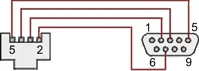
RJ11-to-DB9 cable with rear view of DB9 connector to PC
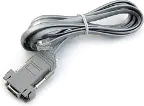
RS232 cable, meter to PC, P/N CBL01
Laureate 1/8 DIN Laureate instruments must be equipped with a serial communications board and be connected to the computer via a serial communications cable. The connection can be via RS232, RS485, USB or Ethernet. Following setup, the serial communications board may be removed from the instrument if desired. The wiring of the RS232 cable is illustrated above with end views of the two connectors.
Laureate LT Series transmitters come standard with a 3-wire serial interface, which can be jumpered for RS232 or RS485.
Laureate LTE Series transmitters come standard with an Ethernet interface.
Click on any of the reduced screens below for a full-size screen view, then click on the Back button of your browser to return to this page. The screens examples below are for a fully-loaded Series 2 Digital Panel Meter (DPM), which is connected to the PC via RS232. If the meter is a Series 1 meter (pre-2007), this is sensed by the software, and somewhat different screens are brought up. Please see Series 1 setup screens.


From the Main Menu, click on Readings if your PC is connected to the meter. A pull-down menu then offers three choices: List, Plot and Graph.


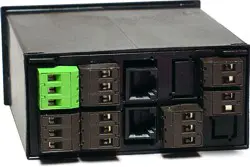


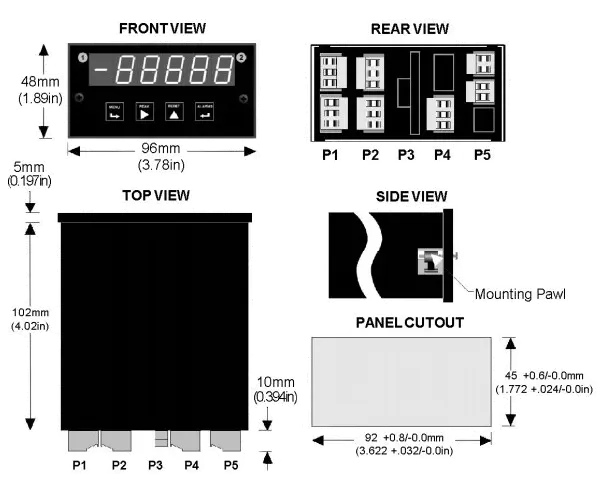
Maximum panel thickness: 4.5 mm (0.18")
Weight of base meter: 210 g (7.4 oz) typical (DPM, counter, timer, 6-digit remote display)
Weight of option boards: 30 g (1.0 oz) typical per board (analog output, relay output, communications)
Tightening Torque - Connectors: Screw terminal connectors: 5 lb-in (0.56 Nm)
Tightening Torque - Pawls: Digital Panel Meter Case Pawls: 5 lb-in (0.56 Nm)
Dimensioned CAD assembly drawings in EPRT, STEP, x_t. dwg, pdf file formats: Laureate-meter-case.zip (zipping prevents browser from opening CAD files as text files).
 Slide the meter into a 45 x 92 mm 1/8 DIN panel cutout. Ensure that the provided gasket is in place between the front of the panel and the back of the meter bezel.
The meter is secured by two pawls, each held by a screw, as illustrated. Turning each screw counterclockwise extends the pawl outward from the case and behind the panel. Turning each screw clockwise further tightens it against the panel to secure the meter.
Slide the meter into a 45 x 92 mm 1/8 DIN panel cutout. Ensure that the provided gasket is in place between the front of the panel and the back of the meter bezel.
The meter is secured by two pawls, each held by a screw, as illustrated. Turning each screw counterclockwise extends the pawl outward from the case and behind the panel. Turning each screw clockwise further tightens it against the panel to secure the meter.
Turning each screw counterclockwise loosens the pawl and retracts it into its well. This position allows installed meter to be removed from their panel, or new meters to be installed in a panel. Do not remove the screws from their pawls. Doing so would cause the screw and pawl to fall off and likely get lost. Do not overtighten so as not to damage the plastic parts.
| Optimizing Meter Inputs for Phase Angle & Power Factor Measurement |
|---|
|
Phase angle and power factor measurement with the Laureate™ Phase Angle & Power Factor Meter require that two signals of identical periods be applied to Channels A and B. For best accuracy, both signals should have the same amplitude, the signal amplitude should be larger than 1V, and the trigger level should be minimized by selecting the ±12 mV jumper position. The meter times zero crossings to 0.1 µs resolution over a user-selectable gate time from 10 ms to 199.99 s. By selecting the minimum gate time of 10 ms, the meter update rate will be approximately 20/s for 50/60 Hz AC line frequency. Improved accuracy will be obtained by making the gate time long enough so that multiple cycles are averaged. Both signals applied to the meter should be mutually isolated by transformer coupling, so that they can then share the same ground in the meter. The current signal is typically obtained from a current transformer (CT). This should ideally be a CT with a voltage output or a current output in the mA range, which can then be converted to a voltage higher than 1V across an external dropping resistor without excessive heat generation. |
| Using Laureate Meters and Counters to Synchronize Motor Generators |
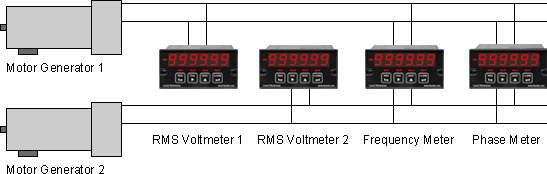
Synchronization of two motor generators requires that the two frequencies be identical, that the lines be in phase, and that the line voltages be close to each other. In this illustration, a single Laureate dual channel counter measures both frequencies to six-figure accuracy in a few line cycles. Another Laureate dual channel counter measures phase angle to 0.1° resolution. Two Laureate AC RMS Voltmeters, which offer ranges of 200.00 V and 600.0 V, are used to display the two RMS voltages to 0.1% accuracy. |
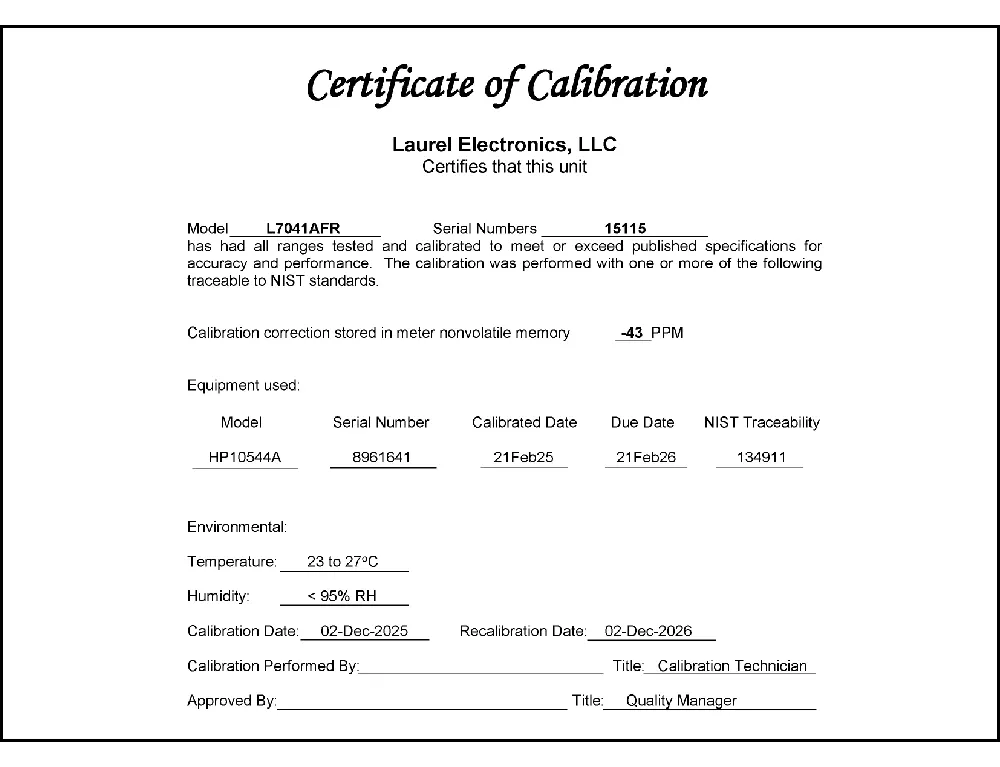
CAL-Digital
Certificate of Calibration
$65.00DLS-XLOG2
XLog2 Data logging Software
$495.00IPC
Digital Panel Meter Splashproof Cover
$55.00CASE1
Digital Panel Meter Benchtop Case1
$150.00CASE2
Digital Panel Meter Benchtop Case2
$150.00BOX1
DPM Enclosure Nema-4x Box1
$180.00BOX2
DPM Enclosure Nema-4x BOX2
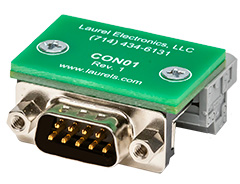
$230.00CON01
CON01 Connector
$75.00CBL6
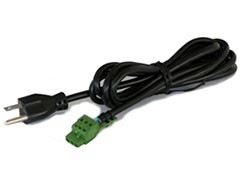
6-foot Power Cable
$41.00CBL12
12-foot Power Cable
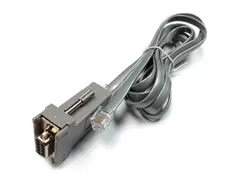
$47.00CBL01
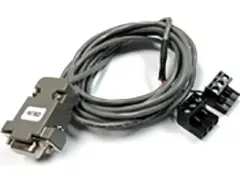
RS232 Cable for Meters
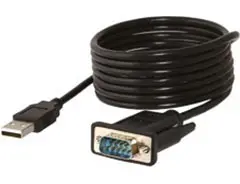
$35.00CBL02
USB-to-RS232 Adapter Cable
$47.00CBL04
RS232 Cable for LT Transmitters
$47.00CBL05
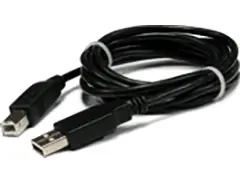
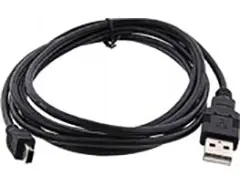
USB Data Cable for Meters
$47.00CBL06
USB-to-RS485 Adapter Cable
$47.00CBL07
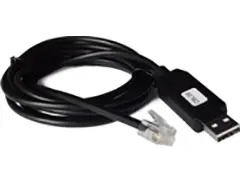
USB Programming & Data Cable
$47.00CBL08
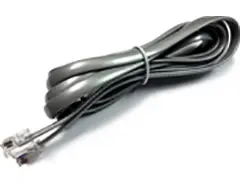
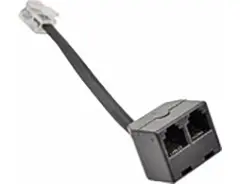
RS485 Splitter Cable
$33.00In industrial and commercial electrical systems, monitoring and controlling various parameters is crucial for efficient operation. Among these parameters, AC phase angle and power factor are key indicators of the electrical system's health and efficiency. 1/8 DIN Digital Panel Meters are compact and versatile tools that help in monitoring these critical parameters.
DIN stands for "Deutsches Institut für Normung," which is the German Institute for Standardization. DIN standards are widely used across the world to specify dimensions and formats for industrial products. In the context of Digital Panel Meters, DIN sizes refer to the dimensions of the Digital Panel Meters' front panels. 1/8 DIN Digital Panel Meters have front panel sizes of 96 mm x 48 mm, making them popular choices for space-constrained applications.
The AC phase angle is a measure of the phase difference between the voltage and current in an AC electrical system. It is an essential parameter because it directly affects the power factor, which is a measure of how effectively electrical power is being used.
When the voltage and current are in phase (i.e., the phase angle is zero), the power factor is at its maximum (usually 1 or 100%), meaning all the electrical power is being effectively converted into useful work. However, if there is a phase difference, not all the power is used effectively, which can lead to inefficiencies and increased operational costs.
The power factor is a dimensionless number between 0 and 1 that indicates how effectively electrical power is being used in a system. A power factor of 1 means all the power is being used effectively, while a lower power factor indicates inefficiency, where some power is wasted as reactive power.
Power factor can be lagging or leading, depending on whether the current lags or leads the voltage. A lagging power factor (current lags voltage) is common in systems with inductive loads like motors and transformers, while a leading power factor (current leads voltage) is found in systems with capacitive loads.
Maintaining a high power factor is essential for reducing energy consumption and lowering electricity costs. Utilities often charge additional fees for low power factors, making it critical to monitor and correct the power factor in industrial settings.
1/8 DIN Digital Panel Meters for AC phase angle and AC power factor are designed to provide accurate real-time measurements of these parameters. These compact Digital Panel Meters are typically installed on control panels or switchboards, offering clear digital displays that allow operators to monitor the system's performance at a glance.
1/8 DIN Digital Panel Meters for AC phase angle and AC power factor are widely used in various applications, including:
1/8 DIN Digital Panel Meters for AC phase angle and AC power factor are specialized instruments used to monitor and display key electrical parameters in various industrial and commercial settings. These compact devices are essential for maintaining power quality, optimizing energy consumption, and ensuring the safe operation of electrical systems.
In industrial automation, precision in monitoring and controlling electrical parameters is crucial. 1/8 DIN Digital Panel Meters are often used in control panels to measure the phase angle and power factor of AC motors, generators, and other equipment. By monitoring these parameters, engineers can optimize the efficiency of machines, reduce energy consumption, and minimize downtime due to electrical faults.
Power generation facilities, such as thermal, hydroelectric, and wind power plants, rely on accurate measurements of phase angle and power factor to ensure that electrical energy is being generated and distributed efficiently. These Digital Panel Meters are installed in control rooms and substation panels to provide real-time data, which helps in adjusting generator outputs, synchronizing phases, and maintaining grid stability.
In commercial buildings and industrial complexes, energy management systems are implemented to monitor and control energy usage. 1/8 DIN Digital Panel Meters are critical components in these systems, providing data on phase angle and power factor, which are essential for load balancing, reducing power losses, and avoiding penalties from utility companies for poor power factor.
UPS systems are used in data centers, hospitals, and other critical facilities to provide reliable power supplies during outages. Monitoring the AC phase angle and power factor using Digital Panel Meters helps in maintaining the quality of power supplied by the UPS, ensuring that sensitive equipment operates smoothly without interruptions.
Heating, ventilation, and air conditioning (HVAC) systems are significant consumers of electrical power in buildings. By using 1/8 DIN Digital Panel Meters, facility managers can monitor the power factor and phase angle of these systems, optimizing their operation to reduce energy consumption and enhance performance.
In renewable energy systems, such as solar photovoltaic (PV) and wind energy systems, maintaining the correct phase angle and power factor is essential for efficient power conversion and grid integration. Digital Panel Meters are used to monitor these parameters, ensuring that the energy generated is efficiently converted and utilized.
In electrical testing and research laboratories, precise measurement of electrical parameters is required for experiments, product development, and quality control. 1/8 DIN Digital Panel Meters provide accurate readings of phase angle and power factor, making them essential tools for engineers and researchers working on electrical equipment and systems.
1/8 DIN Digital Panel Meters for AC phase angle and AC power factor are versatile instruments that play vital roles in various applications, from industrial automation to power generation and energy management. By providing accurate and real-time data on critical electrical parameters, these Digital Panel Meters help in optimizing energy efficiency, ensuring system reliability, and reducing operational costs in a wide range of industries.
Phase angle is the actual angular difference between the voltage and current waveforms, measured in degrees. Power factor is the cosine of that phase angle, expressed as a dimensionless number between 0 and 1. The two describe the same underlying relationship, but power factor is the more directly actionable number for evaluating how efficiently power is being used.
A lagging power factor means current lags behind voltage, which is typical of inductive loads like motors and transformers. A leading power factor means current leads voltage, typical of capacitive loads or over-corrected power factor correction systems. Most industrial facilities normally see a lagging power factor unless capacitor banks are involved.
These meters typically require both voltage and current inputs (via a PT and CT, respectively) on the same phase, since phase angle and power factor are calculated from the timing relationship between the two waveforms — a mismatch between which voltage and current signals are paired together will produce an inaccurate reading.
Many models support three-phase monitoring, either displaying an overall system power factor or individual per-phase readings, which is useful for identifying whether a power factor problem is system-wide or isolated to one phase.
These meters commonly support programmable relay outputs that can trigger when power factor drops below a defined threshold, an analog retransmission output, and serial communications such as RS-232 or RS-485, allowing the meter to alert operators or feed data to a power factor correction system or SCADA platform.
On models with the appropriate output configuration, the meter's power factor reading can be used to trigger relay stages that switch capacitor banks in or out as needed to maintain a target power factor, though the specific control logic and staging depend on the capacitor bank system being used.
Many models in this category are multifunctional and can display voltage, current, and frequency alongside phase angle and power factor on the same hardware platform, providing a more complete electrical monitoring picture from a single meter.
Utilities often charge additional fees when a facility's power factor falls below a required threshold, since a low power factor means the utility must supply more current than the actual useful power delivered. Continuous power factor monitoring lets facility staff catch a declining power factor and correct it (often via capacitor banks) before it triggers a billing penalty.
Accuracy depends on the specific model, but these meters are generally designed for high precision since even a small phase measurement error translates into a meaningfully different power factor reading. Accuracy also depends on properly matched and correctly wired CTs and PTs, since incorrect input wiring introduces error independent of the meter's own precision.
Yes, isolated input and output configurations are commonly used in power monitoring applications to protect the measurement circuit and connected equipment from ground loops or transients, which is especially important given the higher voltage and current levels typically involved in AC power monitoring compared to low-level sensor signals.
This is one of the most commonly reported power metering issues, and it's frequently traced to incorrect CT-to-voltage phase matching or reversed CT polarity rather than an actual system problem — for example, if the current transformer for one phase is paired with the voltage input of a different phase, the meter calculates a phase angle that doesn't represent the real load, producing a skewed or negative power factor reading on that phase. Carefully tracing and re-verifying that each CT is matched to its correct corresponding voltage phase, with consistent polarity, typically resolves this.
This has been documented in real commissioning cases, and the conclusion reached was a CT or PT phase mismatch on one of the two meters rather than either meter being faulty — since both instruments were reading the same physical load but producing opposite-signed results, the practical diagnostic approach was comparing voltage and current phasor angles reported by each meter against expected values to identify which one had a wiring error.
One documented diagnostic technique is a consistency check: temporarily connecting all voltage inputs to the same phase and clamping all current transformers onto that same phase's conductor, then comparing the resulting readings across what should now be three identical channels. If the readings don't closely match each other under this test, it points to an installation or wiring problem rather than an actual load imbalance.
This is a documented and specific symptom pattern — active power calculations use the cosine of the phase angle, which gives the same result whether the angle is measured as positive or negative, so a CT polarity error can go unnoticed in the kW reading. Reactive power calculations use the sine of the phase angle, which does flip sign under a 180-degree phase inversion, so a wiring error that's invisible in active power can still show up clearly as an inverted reactive power reading.
This discrepancy is commonly explained by the two instruments using different measurement methods rather than either being wrong — a true-RMS power meter calculates the actual heating-equivalent value of a distorted current waveform, while a standard (non-true-RMS) handheld multimeter may read differently on the same non-sinusoidal load, with the difference growing larger as the waveform becomes more distorted.
A power factor that won't settle near a stable value is frequently reported alongside CT installation problems — specifically an incorrectly located CT, a CT clamped on the wrong phase conductor, or a CT installed in the wrong physical orientation (reversed polarity). Checking CT location, phase assignment, and orientation against the meter manufacturer's installation documentation is the standard first troubleshooting step for this symptom.
Yes — this has been specifically documented as a subtle failure mode: if a CT for one phase is paired with the voltage signal from a different phase, the resulting phase angle calculation is skewed in a way that can produce an inflated (rather than an obviously nonsensical) reactive energy reading, making it easy to mistake for a genuine power quality issue like poor power factor or harmonics rather than a wiring error.
Some power meters include a software-selectable CT polarity reversal feature specifically for this situation, allowing a technician to electronically flip the sensed polarity of a misinstalled CT rather than needing to physically access and re-terminate the CT wiring, which is especially useful when CTs are located inside locked or hard-to-access switchgear.