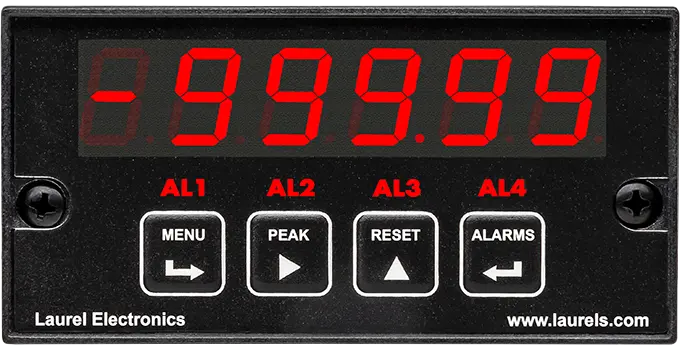
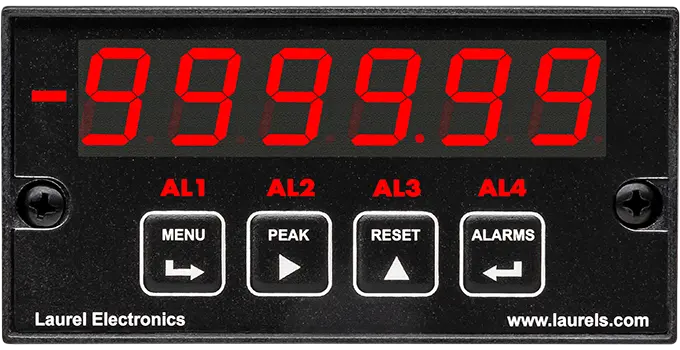
Programmable Digital Panel Meters, Electronic Counters, and Industrial Timers
Understanding How 1/8 DIN Digital Panel Meters Function
- Signal Input and Measurement:
The core function of 1/8 DIN Digital Panel Meters is to acquire and measure input signals from various sources. These Digital Panel Meters interface with circuits, sensors, and transducers via dedicated input terminals. The Digital Panel Meters are factory-calibrated to ensure precise conversion of input signals into accurate digital representations.
- Digital Signal Conversion:
After receiving signals, the Digital Panel Meters employ internal analog-to-digital converters (ADC) to transform analog waveforms into digital data. This conversion process is fundamental, enabling the Digital Panel Meters to display measured values on their digital screens.
- Real-Time Data Display:
The digitized values are then processed and presented on the Digital Panel Meters' screens. These displays, typically LED or LCD-based, show parameter readings in real-time. This capability allows operators to continuously monitor system parameters and respond to changing conditions.
- Enhanced Functionality:
Modern 1/8 DIN Digital Panel Meters incorporate advanced features including programmable alarms, data acquisition, and digital communication protocols (RS-232, RS-485, Modbus) for seamless integration into comprehensive monitoring and control architectures. These capabilities expand the versatility of the Digital Panel Meters across diverse applications.
Primary Applications of 1/8 DIN Digital Panel Meters
1/8 DIN Digital Panel Meters serve critical roles in numerous industrial and commercial settings thanks to their dependability and user-friendly design. Key application areas where these Digital Panel Meters excel include:
- Manufacturing Automation and Process Control
In manufacturing automation, precise monitoring of electrical parameters is essential for safe and efficient machinery operation. Digital Panel Meters track voltage, current, temperature, and additional parameters in motors, drives, actuators, and sensor networks. By delivering accurate real-time data, these Digital Panel Meters prevent parameter deviations that could compromise equipment or halt operations. Digital Panel Meters integrate seamlessly into control systems to enable remote monitoring and automated responses.
- Electrical Power Generation and Distribution Networks
Digital Panel Meters play vital roles in power facilities, monitoring electrical parameters across generators, transformers, and distribution infrastructure. Maintaining parameter stability is crucial for ensuring dependable power delivery and safeguarding equipment. Digital Panel Meters enable operators to track parameters continuously and implement real-time corrections to avoid fluctuations that might trigger outages or equipment damage.
- Solar and Wind Energy Installations
The growing adoption of renewable energy has driven demand for dependable monitoring solutions. Digital Panel Meters are deployed in solar and wind systems to track DC voltage and current from photovoltaic panels and wind turbine generators. Precise monitoring is vital for maximizing system performance and ensuring efficient energy conversion and storage. Digital Panel Meters track system output, guaranteeing peak operational efficiency.
- Electric Vehicle and Transportation Systems
In automotive and transportation applications, Digital Panel Meters are critical for monitoring battery voltage, current draw, and temperature parameters. These Digital Panel Meters are utilized in electric vehicles, rail systems, and transportation infrastructure to verify proper battery charging and electrical system functionality. Real-time monitoring prevents overcharging and related issues. Digital Panel Meters also support research and development of emerging transportation technologies.
- Research Laboratories and Testing Facilities
In laboratory and research settings, measurement precision is non-negotiable. Digital Panel Meters are deployed in experimental configurations, testing apparatus, and calibration systems to deliver precise parameter readings. Scientists depend on these Digital Panel Meters to collect dependable data essential for hypothesis validation, material characterization, and technology development. The precision and consistency of Digital Panel Meters make them indispensable in scientific investigation.
- Climate Control and Building Management Systems
Building climate control systems depend on stable electrical performance for effective operation. Digital Panel Meters monitor voltage, current, and temperature delivered to system components including fans, pumps, and control modules. By maintaining proper parameters, Digital Panel Meters enhance system efficiency, minimize energy usage, and prolong equipment service life. Digital Panel Meters can integrate with building-wide systems for comprehensive monitoring.
- Maritime and Aviation Applications
In maritime and aviation sectors where electrical system reliability is safety-critical, Digital Panel Meters perform essential functions. On vessels, aircraft, and spacecraft, these Digital Panel Meters track voltage, current, and temperature of onboard electrical systems. Whether supporting navigation, communications, or life support, maintaining parameter stability is paramount. Digital Panel Meters deliver immediate feedback for rapid issue resolution.
Summary
1/8 DIN Digital Panel Meters represent versatile measurement instruments deployed across extensive industry segments. Their capacity to deliver precise, real-time parameter monitoring makes them invaluable where electrical performance directly impacts safety, operational efficiency, and system reliability. From manufacturing automation through renewable energy systems, transportation infrastructure, and beyond, these Digital Panel Meters ensure electrical systems maintain safe and optimal operating parameters. As industrial technology advances, demand for accurate and dependable monitoring continues expanding, reinforcing the essential role of Digital Panel Meters in contemporary industry.
Industrial Analog Digital Panel Meters for DC Current Measurement
Overview of 1/8 DIN Digital Panel Meters for DC Current Applications
1/8 DIN Digital Panel Meters represent specialized electronic measurement instruments designed for monitoring and displaying direct current (DC) electrical parameters. The "1/8 DIN" specification denotes the standardized dimensions of these Digital Panel Meters. DIN references "Deutsches Institut für Normung," the German standardization authority, which establishes the physical specifications for these devices. Specifically, 1/8 DIN Digital Panel Meters typically measure approximately 96 x 48 mm (3.78 x 1.89 inches), providing compact yet highly functional solutions for panel-mounted installations.
Operational Principles of DC Current Digital Panel Meters
Digital Panel Meters configured for DC current measurement function by establishing direct interfaces with DC electrical circuits to quantify and display current flow. Here's the typical operational sequence:
-
Current Signal Detection: The Digital Panel Meters connect to circuits requiring current measurement. Connections are established either directly or through current sensing devices or shunt resistors that scale high currents to measurable levels appropriate for the Digital Panel Meters.
- Signal Preparation: Input current signals typically require conditioning for optimal measurement. This process may involve scaling large currents via shunts or amplifying small currents. The Digital Panel Meters may also implement filtering to eliminate electrical noise and stabilize signals for measurement accuracy.
- Digital Signal Conversion: After proper conditioning, the Digital Panel Meters convert analog signals (representing DC current) into digital format using Analog-to-Digital Converters (ADC). These digital values undergo processing by the Digital Panel Meters' internal microprocessors.
- Visual Display Output: The processed digital values appear on the Digital Panel Meters' display screens, typically LED or LCD technology. Display values are normally shown in amperes (A), milliamperes (mA), or other appropriate units based on application requirements.
- Advanced Capabilities: Contemporary 1/8 DIN Digital Panel Meters incorporate enhanced features including programmable alarms, relay controls, data recording, and serial communication interfaces such as RS-485 for integration with supervisory control and data acquisition (SCADA) platforms.
Application Areas for DC Current Digital Panel Meters
Across industrial, commercial, and scientific environments, precise electrical signal monitoring is fundamental for maintaining efficient and safe operations. Digital Panel Meters designed for DC current measurement deliver accurate and dependable readings, proving invaluable across numerous applications.
- Factory Automation Systems
In automated manufacturing environments, Digital Panel Meters monitor and regulate current flow through machinery and equipment. These Digital Panel Meters verify equipment operates within designated current parameters, preventing overcurrent situations that could cause equipment failure or damage. They prove particularly valuable in control panels and instrumentation installations where space constraints exist but measurement accuracy remains critical.
- Electrical Power Distribution Systems
Within power distribution networks, these Digital Panel Meters measure circuit current. They are fundamental for monitoring transformer performance, circuit breaker operation, and distribution equipment functionality. By delivering real-time current data, they assist operators in identifying and resolving issues including circuit overloading or abnormal current variations, thereby ensuring power distribution system reliability and efficiency.
- Scientific Research and Laboratory Settings
In research and laboratory environments, precise DC current measurement is frequently necessary for experimental work and equipment calibration. The compact dimensions of Digital Panel Meters make them well-suited for laboratory installations where space is constrained but accuracy is paramount. Researchers utilize these Digital Panel Meters to monitor current in experimental configurations, ensuring results maintain accuracy and reliability.
- Facility Energy Management
Energy management systems gain significant benefits from Digital Panel Meters integration as they deliver comprehensive insights into current consumption trends. These Digital Panel Meters monitor energy utilization in real time, facilitating improved energy resource management and pinpointing opportunities for efficiency enhancement. This capability can yield substantial cost reductions and decreased energy consumption.
- Climate Control Systems
Heating, Ventilation, and Air Conditioning (HVAC) installations depend on precise current measurement to maintain optimal performance. Digital Panel Meters monitor current in HVAC system components, including motor drives and compressor units. By tracking current parameters, these Digital Panel Meters aid in diagnosing problems and sustaining efficiency and reliability of climate control systems.
- EV Charging Infrastructure
With electric vehicle proliferation, monitoring charging current has gained critical importance. Digital Panel Meters are deployed in electric vehicle (EV) charging stations to measure and display current delivered to vehicles. This ensures charging operations proceed correctly and assists in troubleshooting potential issues.
- Aerospace and Maritime Systems
In aerospace and maritime applications, where dependability and precision are mandatory, Digital Panel Meters deliver essential DC current measurements. These Digital Panel Meters are implemented in various onboard systems to monitor electrical currents and ensure safe and efficient equipment operation.
Conclusion
1/8 DIN Digital Panel Meters for DC current measurement represent versatile instruments deployed across broad application ranges. Their compact form factor doesn't compromise functionality, making them optimal for environments with space limitations yet demanding accurate measurement. Whether in factory automation, power distribution, laboratories, energy management, climate control, EV charging, or critical aerospace and maritime applications, these Digital Panel Meters deliver dependable performance supporting safe and efficient operations.
Industrial Analog Digital Panel Meters for Load Cell, Strain Gauge & Microvolt Signals
Introduction to 1/8 DIN Digital Panel Meters for Precision Measurements
In precision measurement and data collection applications, 1/8 DIN Digital Panel Meters serve as critical instruments for displaying and monitoring diverse electrical signals. Engineered specifically to interface with load cells, strain gauges, and microvolt-level signals, these devices are irreplaceable in industrial, laboratory, and scientific applications.
Compact Design of 1/8 DIN Digital Panel Meters
The "1/8 DIN" designation refers to the standardized dimensions of these Digital Panel Meters, designed to fit panel cutouts measuring 1/8th of standard DIN enclosure sizes. This compact form factor makes them optimal choices for applications with space constraints yet requiring precise measurements.
Digital Panel Meters in this size category are engineered for operational simplicity and measurement accuracy. They transform analog signals from sensors into readable digital formats, delivering clear and precise measurements. Their compact architecture ensures integration into control panels or instrumentation assemblies without excessive space requirements.
Operating Principles of Precision Digital Panel Meters
Digital Panel Meters function by acquiring analog signals from sensors or transducers including load cells, strain gauges, or microvolt signal sources. Here's the operational sequence:
- Signal Reception:
The Digital Panel Meters acquire analog input signals from connected sensing devices. Load cells, strain gauges, and measurement devices output signals across varying ranges and formats.
- Signal Optimization:
Analog signals undergo conditioning to ensure they fall within the Digital Panel Meters' operating parameters. This may include amplification, filtering, or conversion to guarantee accuracy.
- Digital Data Conversion:
Conditioned analog signals undergo conversion to digital format using Analog-to-Digital Converters (ADC). This conversion is fundamental for achieving the high precision demanded in measurements.
- Display and Communication:
Digital signals are processed by the Digital Panel Meters' internal electronics and presented on their digital screens. Many Digital Panel Meters provide supplementary output capabilities, including analog outputs, relay controls, or communication interfaces for integration with additional systems.
- Calibration and Setup:
The Digital Panel Meters can undergo calibration to ensure accuracy and be configured for specific measurement requirements, including establishing measurement ranges, units, and scaling parameters.
Applications and Deployment of Precision Digital Panel Meters
- Load Cell Applications:
In industrial and laboratory settings, load cells measure force, weight, or pressure. Digital Panel Meters provide compact yet highly precise means to display and monitor these measurements, ensuring accurate control and feedback.
- Strain Measurement Systems:
Strain gauges quantify deformation or strain in objects. Digital Panel Meters monitor these measurements, which is critical in structural monitoring, material characterization, and mechanical analysis applications.
- Ultra-Low Voltage Measurements:
For applications demanding ultra-sensitive measurements, such as scientific investigation and precision instrumentation, Digital Panel Meters can measure microvolt-level signals. This capability is essential for detecting and quantifying extremely small electrical signals with high precision.
- Industrial Weighing Installations
Digital Panel Meters are widely deployed in industrial weighing systems. Load cells convert force to electrical signals, and the Digital Panel Meters process low-level signals, amplify them, and display weights in real-time. These Digital Panel Meters are prevalent in manufacturing, agriculture, and logistics where accurate weight measurements are fundamental.
- Materials Testing Laboratories
In research laboratories and materials testing facilities, strain gauges measure material deformation under loading. Digital Panel Meters accurately capture and display these small changes, enabling researchers to analyze material characteristics.
- Process Automation and Control
In automation and process control settings, precise measurement and feedback are essential. Load cells and strain gauges are incorporated into automated systems to monitor forces, weights, and tensions. Digital Panel Meters provide operators with clear, immediate feedback for rapid adjustments.
- Defense and Aerospace Industries
Defense and aerospace sectors demand exceptional precision and reliability. Load cells and strain gauges are regularly employed to test component structural integrity. Digital Panel Meters measure and display sensor outputs, ensuring data accuracy and availability.
- Power Generation Facilities
In power generation sectors, strain gauges and load cells monitor mechanical forces in turbines, generators, and equipment. Digital Panel Meters capture and display this data. Accurate measurement is fundamental for maintaining equipment efficiency and preventing failures.
- Healthcare Devices and Monitoring
Precision is critical in healthcare devices and monitoring systems. Load cells and strain gauges are utilized in patient monitoring equipment, prosthetic devices, and surgical instruments. Digital Panel Meters display low-voltage signals from these sensors, providing medical professionals with accurate feedback.
Summary
1/8 DIN Digital Panel Meters represent versatile and essential instruments across industries utilizing load cells, strain gauges, and microvolt sensors. From industrial weighing systems and automation through aerospace and healthcare applications, these compact Digital Panel Meters deliver precise and reliable measurement, ensuring critical processes and systems operate efficiently and safely.
Industrial Analog Digital Panel Meters for True RMS AC Voltage and Current
Understanding True RMS Measurement Technology
1/8 DIN Digital Panel Meters with True RMS technology accurately measure AC voltage and current independent of waveform distortion. Unlike averaging instruments, these Digital Panel Meters calculate true heating equivalents of AC signals, delivering accurate readings for sinusoidal and non-sinusoidal waveforms alike.
Importance of True RMS Capability
Contemporary electrical systems incorporate variable frequency drives, switching power supplies, and electronic loads generating distorted waveforms. True RMS Digital Panel Meters accurately measure voltage and current under these conditions where conventional instruments would provide erroneous readings.
Application Areas
- Variable Frequency Drive Systems: Measuring output voltage and current from VFDs controlling motors and pumps in industrial applications.
- Power System Quality: Monitoring voltage and current in systems experiencing harmonic distortion from electronic loads and non-linear equipment.
- Standby Power Generation: Tracking output voltage and current from generators and inverters in emergency backup power installations.
- Manufacturing Automation: These Digital Panel Meters integrate into control panels monitoring AC voltage and current supplied to production equipment. True RMS measurement is critical as industrial equipment often presents non-linear loading.
- Renewable Power Systems: Solar inverters and wind turbines generate non-sinusoidal waveforms. Digital Panel Meters with True RMS ensure accurate parameter monitoring.
- Climate Control Installations: These systems require precise voltage and current control. True RMS Digital Panel Meters monitor AC supplied to motor drives and compressor units.
- Testing Laboratories: Where experiments demand exact voltage and current measurements, Digital Panel Meters with True RMS capabilities prove indispensable.
- Facility Energy Management: Facilities employ Digital Panel Meters to monitor current across multiple phases, helping identify energy inefficiencies.
- Motor Control Applications: Digital Panel Meters monitor current drawn by motor systems, helping prevent overcurrent situations and ensuring motors operate efficiently.
Industrial Analog Digital Panel Meters for Temperature Monitoring
Thermocouple-Based Digital Panel Meters
Digital Panel Meters engineered for thermocouple inputs measure temperature by converting thermocouple millivolt signals into temperature values. These Digital Panel Meters accommodate multiple thermocouple varieties (J, K, T, E, R, S, N) for diverse temperature ranges and applications.
RTD-Based Digital Panel Meters
Resistance Temperature Detector (RTD) Digital Panel Meters measure temperature based on resistance variations of platinum, nickel, or copper sensing elements. These Digital Panel Meters deliver enhanced accuracy and stability versus thermocouples, particularly in -200°C to +850°C ranges.
Temperature Measurement Applications
- Industrial Process Control: Monitoring furnace, oven, and reactor temperatures in manufacturing operations.
- Climate Control Systems: Measuring ambient temperature in heating and cooling installations.
- Food Production: Monitoring cooking, pasteurization, and cold storage temperatures.
- Scientific Equipment: Precision temperature control in incubators, ovens, and controlled environment chambers.
- Pharmaceutical Production: Critical temperature monitoring in pharmaceutical manufacturing and storage environments.
- Polymer Processing: Controlling extruder and molding temperatures in plastics manufacturing.
Industrial Analog Digital Panel Meters for Frequency, Rate, Period, and Batch Operations
Frequency and Rate Monitoring
Digital Panel Meters for frequency, rate, and period monitoring display frequency of AC signals or pulse sequences. These Digital Panel Meters transform frequency into engineering units for applications including speed monitoring, flow rate computation, and production counting.
Frequency and Rate Applications
- Motor Speed Display: Showing motor RPM from encoder or tachometer pulse inputs.
- Conveyor Speed Control: Monitoring belt velocity in material handling installations.
- Production Speed Calculation: Computing production velocity from sensor pulses in manufacturing operations.
- Flow Rate Display: Converting pulse signals from flow meters into flow rate readouts.
- Grid Frequency Monitoring: Monitoring AC power frequency for quality assurance and synchronization.
Batch Control Digital Panel Meters
Batch control Digital Panel Meters manage dispensing operations by accumulating pulses or integrating analog signals until predetermined quantities are achieved. These Digital Panel Meters automatically terminate filling operations when target values are reached, guaranteeing precise batch quantities.
Batch Control Applications
- Liquid Dispensing: Controlling accurate volumes in bottling and packaging operations.
- Chemical Addition: Dispensing precise quantities of additives in treatment and processing applications.
- Recipe Batching: Measuring formula components in food and pharmaceutical production.
- Fuel Transfer: Controlling predetermined quantities in fuel distribution and loading operations.
- Material Dispensing: Controlling precise amounts of raw materials dispensed in manufacturing operations.
Conclusion
1/8 DIN Digital Panel Meters represent versatile, dependable instruments fundamental for measurement and control across virtually all industries. Their compact dimensions, precision, and comprehensive feature sets make these Digital Panel Meters indispensable instruments for monitoring voltage, current, temperature, weight, frequency, and process variables in industrial automation, power systems, laboratories, manufacturing, and facility management applications. As industries advance toward enhanced automation, energy efficiency, and data-driven operations, these proven Digital Panel Meters will remain critical components in modern measurement and control systems worldwide.
Less Information.