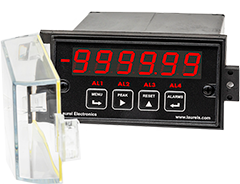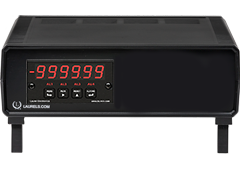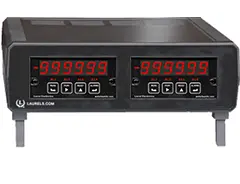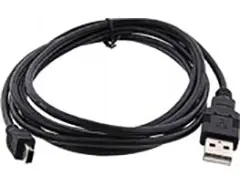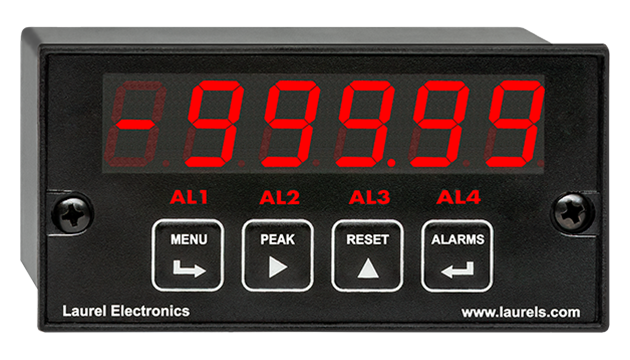
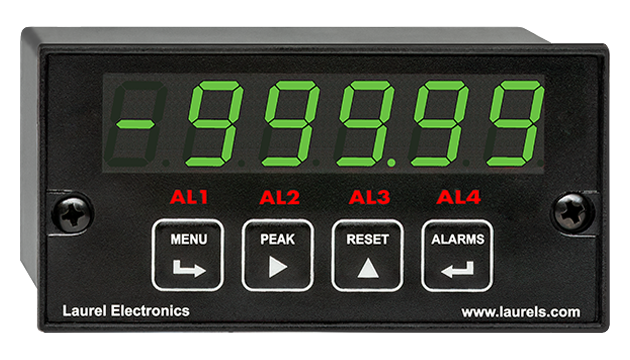
New Front Panel USB-C Port Coming Soon!
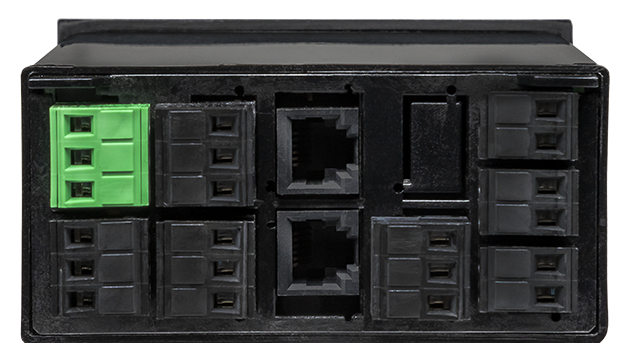
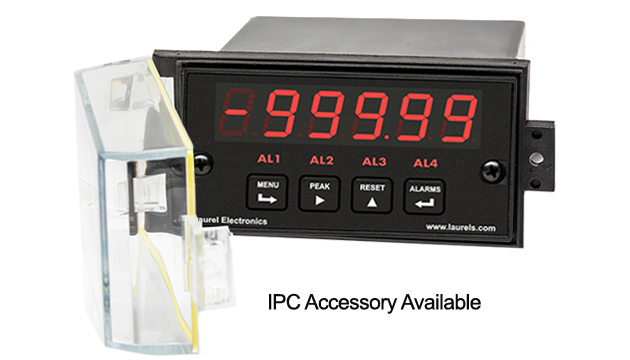
The meter can be set to absolute and ratiometric (or potentiometer follower) mode by making a software selection. In this mode, the meter tracks a ratio of the applied excitation voltage and is unaffected by changes in the excitation voltage. Ratiometric measurements provide an exceptional accuracy of 0.01% of reading ± 2 counts. This capability is used with the meter's 5V or 10V excitation output for load cells and Wheatstone bridges, and with the meter's 5V excitation output for potentiometers which track wiper position.
All signal conditioner board ranges are factory-calibrated, with calibration factors for each range securely stored in an onboard EEPROM. These factors can be scaled via software to accommodate external shunts, enabling field replacement of signal conditioner boards without necessitating recalibration of the associated digital panel meters. For optimal accuracy, factory recalibration is recommended annually. All Laurel Electronics instruments undergo factory calibration using the industry-leading Fluke calibrators, which are recalibrated yearly and certified traceable to national standards, ensuring the highest level of precision and reliability.
The optional extended Laureate computer board enhances Laureate Digital Panel Meters by displaying rates derived from successive readings and enabling highly accurate custom curve linearization. For example, it can calculate liquid volume or flow rate in a horizontal cylindrical tank using levels from a 4-20 mA transmitter. Setup is straightforward: users input up to 180 data points into a spreadsheet or text file, and the computer calculates spline-fit segments, which are then downloaded to the meter for precise operation.
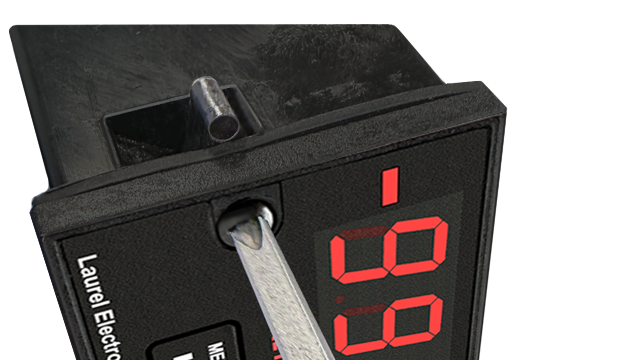
Easy USB-C Programming: Configure Laureate digital panel meters through the front-panel USB-C port with Laurel’s free Instrument Setup Software for Windows. Meters with a data interface board can also be programmed through that interface. The software shows only the settings that apply to your installed option boards, and configurations can be saved to the meter, a PC, a file server, or a USB thumb drive. Laurel’s free Instrument Setup Software can also be used for light-duty data collection.
Scaling is from -99,999 to +99,999 (five full digits) with any decimal point to display readings in engineering units, such as PSI. Three scaling methods are user selectable: scale and offset, two-point method, and system-level calibration using actual transducer signals.
High read rate of up to 50 or 60 conversions per second, the Laureate™ Digital Panel Meters use a Concurrent Slope (US Pat. 5,262,780) analog-to-digital conversion to integrate signals over a full power line cycle (50 Hz or 60 Hz). This read rate enables peak and valley capture, real-time computer interfacing, and control applications. Peak and valley values are automatically captured and can be viewed using Laurel’s free Instrument Setup Software (compatible with Windows PCs) or transmitted as serial data.
Two tare functions: auto-tare and manual tare. In auto-tare, an input line is grounded by an external pushbutton. In manual tare, the tare value can be entered manually via a control input pushbutton or using Laurel's free Instrument Setup Software.
Peak and valley values are automatically captured. These may be displayed via a front panel pushbutton command or control signal at the rear connector, or be transmitted as serial data.
Two rear panel control Inputs (CMOS/TTL levels, logic 0 = tied to digital ground, logic 1 = open) or dry contacts that can be set to control / activate 14 meter commands.
An (isolated) 5, 10, 12, or 24 Vdc excitation output is standard to power transducers or two-wire transmitters. Ratiometric operation, which automatically compensates for changes in the applied excitation, is jumper selectable for applications, such as bridges, where the signal to be measured is proportional to the excitation level.
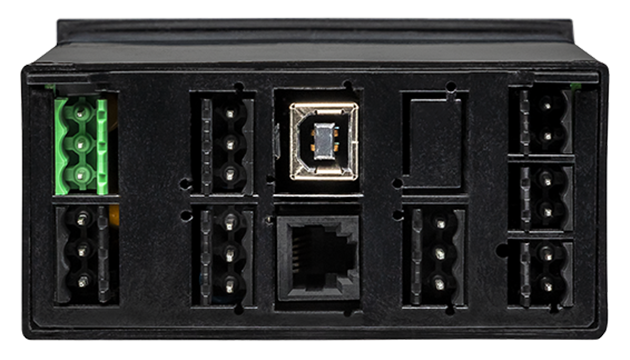
All boards are isolated from meter and power grounds. Optional Plug-in-Play boards for communications and control include Ethernet, WiFi, serial communication boards, dual or quad relay boards, and an analog output board. Laureates may be powered from 85-264 Vac or optionally from 12-32 Vac or 10-48 Vdc. The display is available with bright red or green 0.56" (14.2mm) high LED digits. The 1/8 DIN case meets NEMA 4X (IP65) specifications from the front when panel mounted. Any setup functions and front panel keys can be locked out for simplified usage and security. A built-in 5, 10, 12, or 24 Vdc excitation supply can power transducers, eliminating the need for an external power supply. All power and signal connections are via UL / VDE / CSA rated screw clamp plugs.
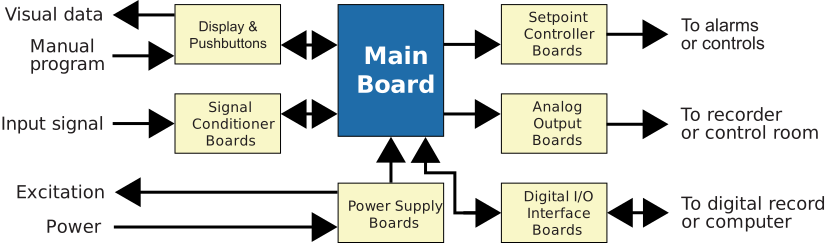
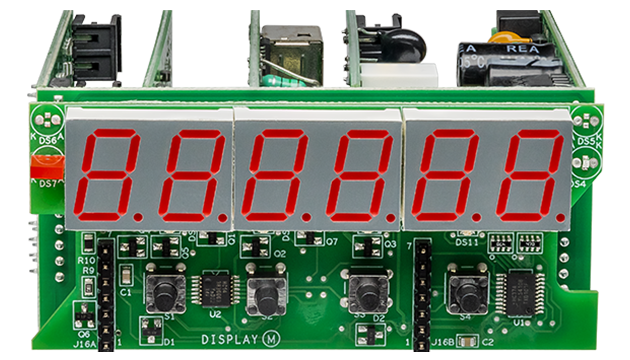
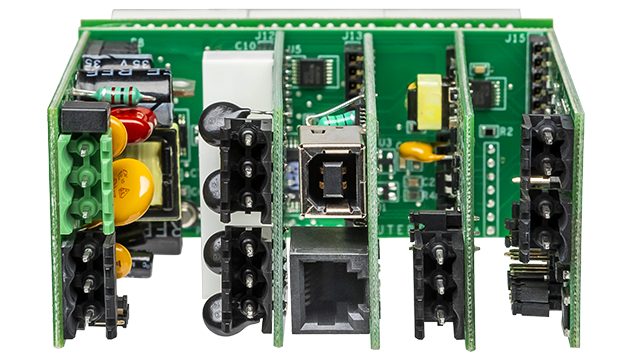
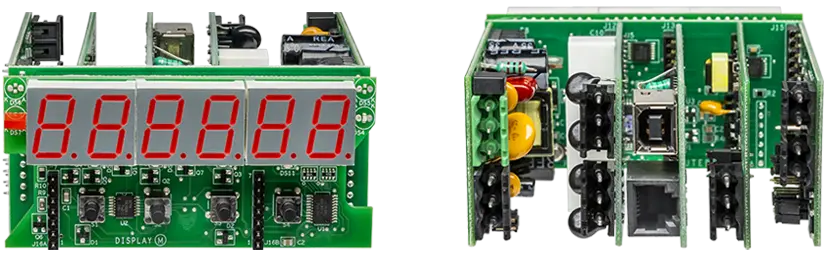
The design of the Laureate™ Series is modular for maximum flexibility at minimum cost. All boards are isolated from meter and power grounds. The base configuration for a panel meter or counter consists of a main module (with computer and plug-in display boards), a power supply board, and a signal conditioner board. Optional plug-in-play boards include an isolated setpoint controller board, an isolated analog output board, and an isolated digital interface board. Modular design and a choice of plug-in options allow the Laureate to be customized for a broad range of applications from simple monitoring to control and computer interface. There can be up to five plug-in boards in a 1/8 DIN Laureate.
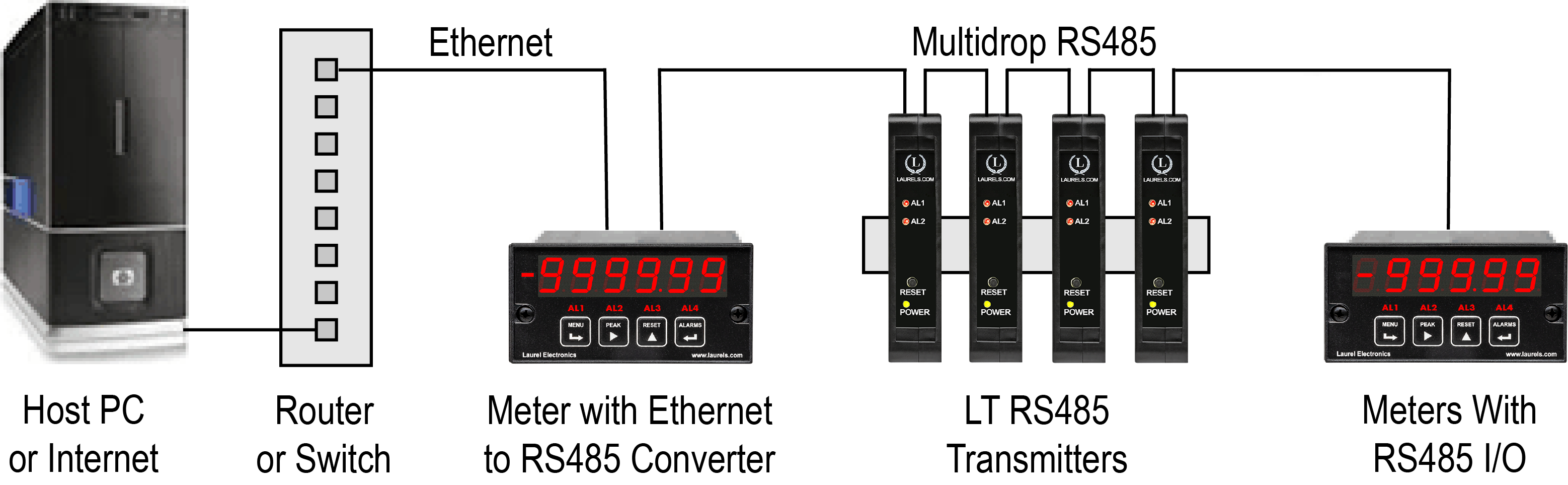
Up to 30 Laureate Digital Panel Meters and/or LT Transmitters can be configured for RS485 and daisy-chained to an LT Transmitter using Laurel’s High Speed Ethernet-to-RS485 converter board for seamless LAN integration. Alternatively, Laurel LTE series Ethernet transmitters can connect directly to a LAN via an Ethernet cable. Setup for both configurations is streamlined using Laurel’s free Instrument Setup Software, which simplifies node discovery and transmitter configuration.
Laureate Digital Panel Meters can be equipped with Laurel communication boards to support various interfaces and protocols. These include serial interfaces with ASCII or Modbus RTU protocols, and Ethernet interfaces with web access, ASCII, or Modbus TCP/IP protocols, ensuring versatile connectivity for your commercial applications.
| DC Voltage Range | Resolution | Input Resistance | Error at 25°C |
|---|---|---|---|
| ±200.00 | 10 µV | 1 GΩ | 0.01% of FS ± 2 cts |
| ±2.0000 | 100 µV | 1 GΩ | 0.01% of FS ± 2 cts |
| ±20.000 | 1 mV | 10 MΩ | 0.01% of FS ± 2 cts |
| ±200.00 | 10 mV | 10 MΩ | 0.01% of FS ± 2 cts |
| ±300.00 | 0.1 V | 10 MΩ | 0.01% of FS ± 2 cts |
| ±600.00* | 0.1 V | 10 MΩ | ± 0.4 V |
| * ±600.00V range not ETL certified. | |||
| Recalibration: All ranges are calibrated at the factory. Recalibration is recommended every 12 months. | |||
| DC Current Range | Resolution | Input Resistance | Error at 25°C |
|---|---|---|---|
| ±2.0000 mA | 0.1 µA | 100 Ω | 0.01% FS ± 2 cts |
| ±20.000 mA | 1.0 µA | 10 Ω | 0.01% FS ± 2 cts |
| ±200.00 mA | 10 µA | 1 Ω | 0.01% FS ± 2 cts |
| ±5.000 A | 1 mA | 0.01Ω | ± 10 mA |
| Display | |
|---|---|
| Readout | 5 LED digits, 7-segment, 14.2 mm (.56"), red or green. |
| Range | -99999 to 99999 or -99990 to 99990 (count by 10) |
| Indicators | Minus sign, 4 red LED lamps |
| Front-Panel Port | USB-C (programming & data) |
| Protocols | Laurel Custom ASCII (serial), Modbus RTU (serial), Modbus TCP (Ethernet or WiFi) |
| Digital addresses | 247 (Modbus), 31 (Laurel Custom ASCII) |
| Isolation | 250V rms working, 2.3 kV rms per 1 min test |
| A-to-D Conversion | |
| Technique | Concurrent Slope™ (Pat 5,262,780) |
| A-to-D rate | 60/s at 60 Hz, 50/s at 50 Hz |
| Output update rate | 56/s at 60 Hz, 47/s at 50 Hz |
| Display update rate | 3.5/s at 60 Hz, 3/s at 50 Hz |
| Reading Accuracy | |
| Error at 25°C | 0.01% of full scale ± 2 counts (except 5A range) for absolute measurements. 0.01% of reading ± 2 counts for ratiometric measurements. |
| Span tempco | 0.003% of reading/°C |
| Zero tempco | 0.1 count/°C |
| Noise Rejection | |
| CMR, DC to 60 Hz | 130 dB |
| NMR at 50/60 Hz | 90 dB with min filtering |
| Maximum Signal | |
| Max applied voltage | 600 Vac for 20, 200 and 300 V ranges, 125 Vac for other ranges |
| Overcurrent protection |
25x for 2 mA, 8x for 20 mA, 2.5x for 200 mA, 1x for 5 A |
| Power | |
| Voltage, standard | 85-264 Vac or 90-300 Vdc |
| Voltage, optional | 12-32 Vac or 10-48 Vdc |
| Frequency | DC or 47-63 Hz |
| Power consumption (typical, base meter) | 1.2W @ 120 Vac, 1.5W @ 240 Vac, 1.3W @ 10 Vdc, 1.4W @ 20 Vdc, 1.55W @ 30 Vdc, 1.8W @ 40 Vdc, 2.15W @ 48 Vdc |
| Power Isolation | 250V rms working, 2.3 kV rms per 1 min test |
| Excitation Output (standard) | |
| 5 Vdc | 5 Vdc ± 5%, 100 mA (jumper selectable) |
| 10 Vdc | 10 Vdc ± 5%, 120 mA (jumper selectable) |
| 12 Vdc | 12 Vdc ± 5%, 100 mA (jumper selectable) |
| 24 Vdc | 24 Vdc ± 5%, 50 mA (jumper selectable) |
| Output Isolation | 50 Vdc from signal ground |
| Ratiometric operation | 5 Vdc or 10 Vdc for bridge circuits, 5 Vdc for potentiometers |
| Analog Output Board (optional) | |
| Output levels | 4-20 mA, 0-20 mA, 0-10V, -10 to +10V (jumper selectable) |
| Current compliance | 2 mA at 10V ( > 5 kΩ load) |
| Voltage compliance | 12V at 20 mA (< 600 Ω load) |
| Scaling | Zero and full scale adjustable from -99999 to +99999 |
| Resolution | 16 bits (0.0015% of full scale) |
| Step function response | 80 ms to 99% of final value (typ) |
| Isolation | 250V rms working, 2.3 kV rms per 1 min test |
| Relay Output Boards (optional) | |
| Relay types | 2 Form C contact relays or 4 Form A contact relays (NO) 2 or 4 Form A, AC/DC solid state relays (NO) |
| Current tatings | 8A at 250 Vac or 24 Vdc for contact relays 120 mA at 140 Vac or 180 Vdc for solid state relays |
| Output common | Isolated commons for dual relays or each pair of quad relays |
| Isolation | 250V rms working, 2.3 kV rms per 1 min tes |
| Communication Boards (optional) | |
| Board Selections | L232 (RS232), L485 (RS485, dual RJ11 connectors), LMOD (RS485, dual RJ45 connectors, not for new design), LUSB (USB-C), LUSB485 (USB-C-to-RS485 gateway), LNET (Ethernet), LNET485 (Ethernet-to-RS485 gateway), LNET1 (Ethernet + USB-C), LNET1485 (Ethernet + RS485 slave or gateway), LWIFI (WiFi + USB-C) internal antenna, LWIFIX (WiFi + USB-C) external antenna, LWIFI485 (WiFi + USB-C + RS485 slave or gateway) internal antenna, LWIFIX485 (WiFi + USB-C + RS485 slave or gateway) external antenna |
| Protocols | Laurel Custom ASCII (serial), Modbus RTU (serial), Modbus TCP (Ethernet or WiFi) |
| Digital addresses | 247 (Modbus), 31 (Laurel ASCII), |
| Isolation | 250V rms working, 2.3 kV rms per 1 min test |
| Signal Connections | |
 |
|
| Environmental | |
| Operating temperature | -40°C to 70°C (-40°F to 158°F) |
| Storage temperature. | -40°C to 85°C (-40°F to 185°F) |
| Relative humidity | 95% at 40°C, non-condensing |
| Protection | NEMA-4X (IP-65) when panel mounted |
| Mechanical | |
| Enclosure | 1/8 DIN, high impact plastic, UL 94V-0, color: black |
| Mounting | 1/8 DIN panel cutout required: 3.622" x 1.772" (92 mm x 45 mm). |
| Dimensions | 4.68" x 2.45" x 5.64" (119 mm x 62 mm x 143 mm) (W x H x D) |
| Maximum panel thickness | 4.5 mm (0.18") |
| Tightening Torque - Connectors | Screw terminal connectors: 5 lb-in (0.56 Nm) |
| Tightening Torque - Pawls | Digital Panel Meter Case Pawls: 5 lb-in (0.56 Nm) |
| Weight of base meter | 210 g (7.4 oz) typical (DPM, counter, timer, 6-digit remote display) |
| Weight of option boards | 30 g (1.0 oz) typical per board (analog output, relay output, communications) |
| General | |
| Programming Methods | Four front panel buttons or via Laurel's free Instrument Setup Software, which runs on a PC under MS Windows. |
| Security | Lockout options include using the front panel buttons, the free Instrument Setup Software, or a hardware jumper. |
| Warranty | 3 years parts & labor |
| Recalibration: All ranges are calibrated at the factory. Recalibration is recommended every 12 months. | |
|
|
| 1/8 DIN Digital Panel Meters | DIN Rail Transmitters |
Free Downloadable Windows-based Instrument Setup (IS) software (Data Interface Board Required) for use with our programmable Digital Panel Meters, Scale Meters, Counters, Timers, Remote Displays, and Transmitters, are an easy method to set up Laureate 1/8 DIN digital panel meters, counters, timers, remote displays, and DIN-rail transmitters, as explained in the Instrument Setup Software Manual. Laureate 1/8 DIN instruments can also be set up from the front panel, as explained in their respective Owners Manuals. Instrument Setup software is of benefit whether or not the PC is connected to the instrument.
Set User Account Control (UAC) of MS Windows to "Never notifiy me" so that Instrument Setup Software can create directories. The UAC change screen can be reached as follows:
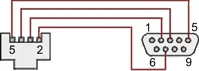
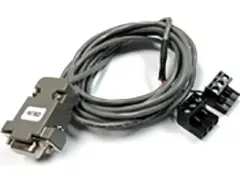
RJ11-to-DB9 cable with rear view of DB9 connector to PC
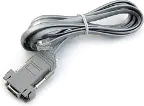
RS232 cable, meter to PC, P/N CBL01
Laureate 1/8 DIN Laureate instruments must be equipped with a serial communications board and be connected to the computer via a serial communications cable. The connection can be via RS232, RS485, USB or Ethernet. Following setup, the serial communications board may be removed from the instrument if desired. The wiring of the RS232 cable is illustrated above with end views of the two connectors.
Laureate LT Series transmitters come standard with a 3-wire serial interface, which can be jumpered for RS232 or RS485.
Laureate LTE Series transmitters come standard with an Ethernet interface.
Click on any of the reduced screens below for a full-size screen view, then click on the Back button of your browser to return to this page. The screens examples below are for a fully-loaded Series 2 Digital Panel Meter (DPM), which is connected to the PC via RS232. If the meter is a Series 1 meter (pre-2007), this is sensed by the software, and somewhat different screens are brought up. Please see Series 1 setup screens.


From the Main Menu, click on Readings if your PC is connected to the meter. A pull-down menu then offers three choices: List, Plot and Graph.


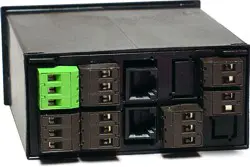


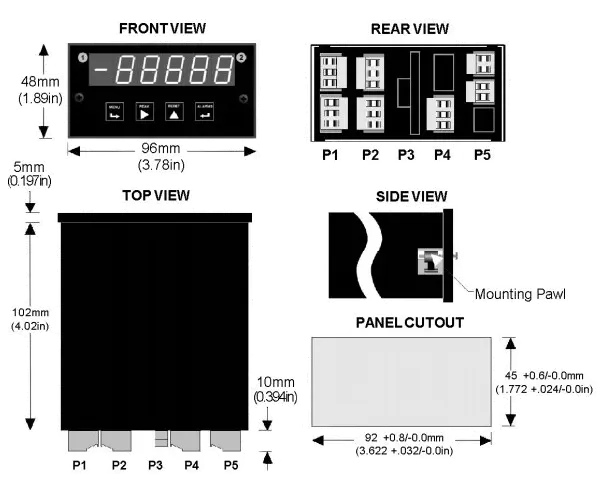
Maximum panel thickness: 4.5 mm (0.18")
Weight of base meter: 210 g (7.4 oz) typical (DPM, counter, timer, 6-digit remote display)
Weight of option boards: 30 g (1.0 oz) typical per board (analog output, relay output, communications)
Tightening Torque - Connectors: Screw terminal connectors: 5 lb-in (0.56 Nm)
Tightening Torque - Pawls: Digital Panel Meter Case Pawls: 5 lb-in (0.56 Nm)
Dimensioned CAD assembly drawings in EPRT, STEP, x_t. dwg, pdf file formats: Laureate-meter-case.zip (zipping prevents browser from opening CAD files as text files).
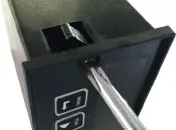 Slide the meter into a 45 x 92 mm 1/8 DIN panel cutout. Ensure that the provided gasket is in place between the front of the panel and the back of the meter bezel.
The meter is secured by two pawls, each held by a screw, as illustrated. Turning each screw counterclockwise extends the pawl outward from the case and behind the panel. Turning each screw clockwise further tightens it against the panel to secure the meter.
Slide the meter into a 45 x 92 mm 1/8 DIN panel cutout. Ensure that the provided gasket is in place between the front of the panel and the back of the meter bezel.
The meter is secured by two pawls, each held by a screw, as illustrated. Turning each screw counterclockwise extends the pawl outward from the case and behind the panel. Turning each screw clockwise further tightens it against the panel to secure the meter.
Turning each screw counterclockwise loosens the pawl and retracts it into its well. This position allows installed meter to be removed from their panel, or new meters to be installed in a panel. Do not remove the screws from their pawls. Doing so would cause the screw and pawl to fall off and likely get lost. Do not overtighten so as not to damage the plastic parts.
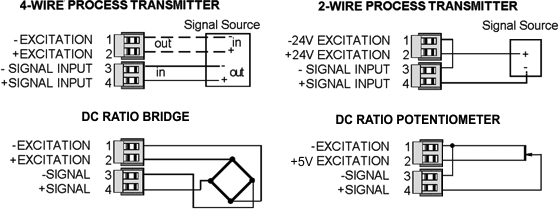
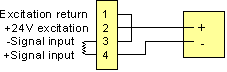
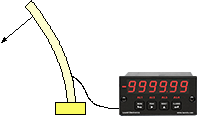
In this application shown, the signal from a sliding contact voltage divider can be converted to engineering units such as position, level or percentage. By operating in a ratiometric mode, the meter automatically removes any effects caused by variations in the excitation supply. Connect excitation return to signal return, and jumper the excitation output to 5 Vdc.
  |
 |
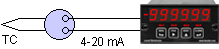
Powering two-wire transmittersThe isolated 24 Vdc, 50 mA excitation output, which is standard with all Laureate meters, is ideal for powering two-wire, 4-20 mA transmitters. The same two wires are used to apply voltage and carry the output current. Inside the meter, the 4-20 mA current is dropped across a 10 ohm resistor and sets up a 40-200 mV voltage, which is then sensed by the meter and scaled to engineering units.
|
Testing with peak detectionDestructive testing is an ideal application for the Laureate strain meter. Peak readings are automatically captured at rates up to 60 per second, while the display updates at a legible 3.5 readings per second. The peak reading can be recalled at the push of a button or be transmitted via RS-232 or RS-485. The meter provides isolated 10 Vdc power for up to four (4) the strain gauges and can be scaled to read out directly in engineering units from -99,999 to +99,999.
|
 |
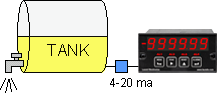 |
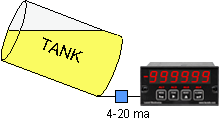
Custom curve linearizationThe Laureate DC meter with the Extended main board option allows exceptionally accurate custom curve linearization. For setup, up to 180 data points can be entered into a spreadsheet. The system then creates multiple non-linear spline-fit segments, which provide much better accuracy than linear segments. Illustrated, is the readout of volume of irregularly shaped tanks based on measured liquid level or pressure. Altimeters and thermistors are further applications.
|
Rate from successive readingsThe Extended computer board allows the display of rate based on successive readings, for instance flow rate based on changes in liquid level or static pressure in a tank. In the above illustration, the meter displays the rate in gallons at which a horizontal tank is being emptied. The input to the meter can be nonlinear, since only the linearized readings are compared for the determination of rate.
|
CAL-Analog
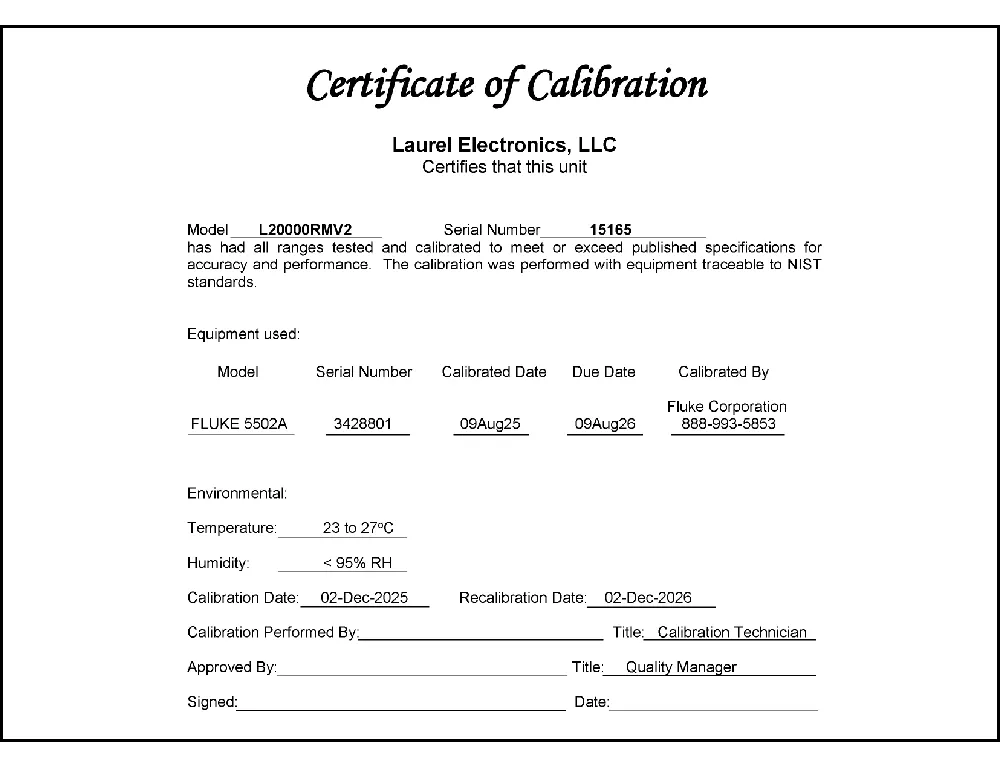
Certificate of Calibration
$65.00DLS-XLOG2
XLog2 Data logging Software
$495.00IPC
Digital Panel Meter Splashproof Cover
$55.00CASE1
Digital Panel Meter Benchtop Case1
$150.00CASE2
Digital Panel Meter Benchtop Case2
$150.00BOX1
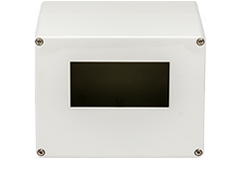
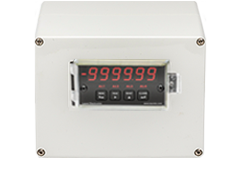
DPM Enclosure Nema-4x Box1
$180.00BOX2
DPM Enclosure Nema-4x BOX2
$230.00CON01
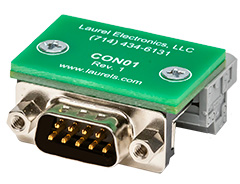
CON01 Connector
$75.00CBL6
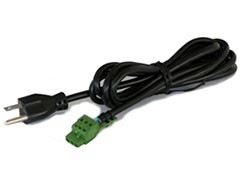
6-foot Power Cable
$41.00CBL12
12-foot Power Cable
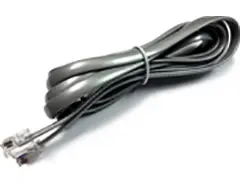
$47.00CBL01
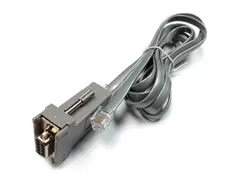
RS232 Cable for Meters
$35.00CBL02
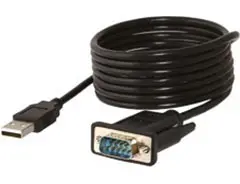
USB-to-RS232 Adapter Cable
$47.00CBL04
RS232 Cable for LT Transmitters
$47.00CBL05
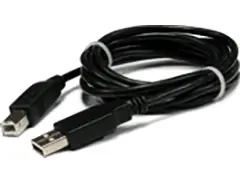
USB Data Cable for Meters
$47.00CBL06
USB-to-RS485 Adapter Cable
$47.00CBL07
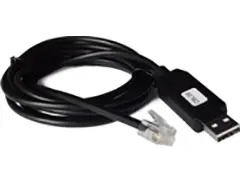
USB Programming & Data Cable
$47.00CBL08
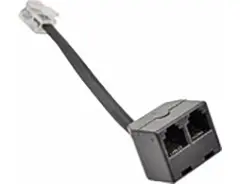
RS485 Splitter Cable
$33.00Digital Panel Meters are essential tools in industrial and process control environments, where precise measurement and display of data are crucial. 1/8 DIN Digital Panel Meters are compact and versatile instruments that have become a standard in the industry due to their size, reliability, and functionality. When paired with process and ratiometric measurement applications, they become even more powerful tools.
DIN, which stands for "Deutsches Institut für Normung," is a set of standards originating from Germany that are now widely used internationally. The "1/8 DIN" refers to the size of Digital Panel Meters. The term indicates that the Digital Panel Meters occupy one-eighth of a full DIN standard panel, which typically measures 192 x 96 mm. Therefore, 1/8 DIN Digital Panel Meters have dimensions of approximately 96 x 48 mm. This compact size allows for easy integration into control panels and enclosures without taking up excessive space.
Digital Panel Meters are electronic devices used to display digital readings of various types of input signals, including voltage, current, temperature, pressure, and more. These Digital Panel Meters are widely used in various industries for monitoring and control purposes. The digital displays provide clear and precise readouts, which are easier to interpret than analog meters. Digital Panel Meters often come with features like programmable setpoints, alarms, and outputs, making them versatile tools for various applications.
Process measurement Digital Panel Meters are specifically designed to measure and display process variables such as temperature, pressure, flow, and level. These Digital Panel Meters are integral in maintaining and optimizing industrial processes, ensuring that they run within set parameters for safety and efficiency.
Ratiometric measurement Digital Panel Meters specialize in displaying ratios between two input signals. This type of measurement is particularly useful in applications where relative changes are more important than absolute values, such as in strain gauges, potentiometers, or other sensors that provide ratiometric output.
In some industrial applications, there is a need to monitor both absolute process variables and relative changes simultaneously. 1/8 DIN Digital Panel Meters that can handle both process and ratiometric inputs become valuable tools in these scenarios. For example, they could be used to measure the absolute temperature in a reactor while also monitoring the ratio of temperatures between two different points within the system. This dual functionality allows for greater flexibility and precision in control systems, leading to improved process efficiency and product quality.
1/8 DIN Digital Panel Meters are versatile and compact devices widely used in industrial applications for monitoring and controlling various parameters. These Digital Panel Meters are known for their reliability, accuracy, and ease of integration into various systems, commonly used to measure parameters such as temperature, pressure, flow, voltage, and current.
1/8 DIN Digital Panel Meters for process and ratiometric measurement are essential tools across a broad range of industries. Their compact size, accuracy, and versatility make them ideal for applications where monitoring and controlling various parameters are critical. Whether it's ensuring the right temperature in a manufacturing process or maintaining the correct ratio in a chemical mixture, these Digital Panel Meters play a key role in keeping operations running smoothly and safely.
A 4-20 mA current loop is an industry-standard way of transmitting a process variable — pressure, temperature, flow, or level — as a proportional electrical current rather than a voltage. Because current stays constant throughout the loop regardless of wire resistance, it remains accurate over long cable runs and is largely immune to the voltage drop that would affect a similar voltage-based signal.
This is called a "live zero." Starting the scale at 4 mA rather than 0 mA lets the meter distinguish between a genuine zero process reading (4 mA) and a broken loop or failed transmitter (0 mA), which would otherwise look identical on a signal that started at zero.
Zero and span adjustment is how a process meter is scaled to match a specific transmitter's range. Zero sets what the meter displays at the bottom of the signal range (typically 4 mA), and span sets what it displays at the top (typically 20 mA), so the meter shows the process value in real engineering units rather than raw milliamps.
A 2-wire transmitter is loop-powered, meaning the same two wires that carry the signal also supply its operating power. A 4-wire transmitter has a separate power connection and can typically drive a higher total loop resistance since it isn't relying on the loop itself for power, which matters when a loop includes long cable runs or several devices in series.
A standard process input measures one signal against a fixed internal reference. A ratiometric input instead measures a signal relative to its own excitation or reference voltage, so variations in the supply voltage largely cancel out. This makes ratiometric measurement well suited to sensors like potentiometers and strain-based transducers, where stability against supply fluctuations matters more than an absolute voltage reading.
Many 1/8 DIN process meters are programmable for multiple input types from the same hardware — 4-20 mA, 0-10V, and ratiometric signals, for example — with the specific input type selected in software or via jumpers rather than requiring a different meter for each signal type.
Meters with an extended or dual-channel main board can perform arithmetic between two input channels, displaying values such as the sum, difference, or ratio of two process signals, which is useful for applications comparing two related measurements rather than reading a single absolute value.
These meters commonly support programmable relay outputs for high/low alarms, an isolated analog retransmission output, and serial communications such as RS-232, RS-485, or Ethernet with Modbus, allowing the meter to both alert operators locally and feed data to a PLC or SCADA system.
Yes, particularly in process control settings with multiple instruments sharing a panel. Isolated inputs and outputs prevent ground loops and ensure that a fault or noise source on one part of the system doesn't corrupt the process reading or damage connected equipment.
Calibration is typically done by entering the meter reading that should correspond to the transmitter's low signal (commonly 4 mA) and its high signal (commonly 20 mA), either through front-panel pushbuttons or setup software. The meter then linearly interpolates all readings in between, so the display matches the transmitter's actual calibrated range.
This is one of the most frequently reported 4-20 mA issues, and it almost always points to a scaling problem rather than a wiring or transmitter fault. The display reacts predictably to changes in the loop current but was never scaled to match the transmitter's actual range, so the fix is re-entering the correct zero and span values to match the transmitter's datasheet rather than replacing any hardware.
Field troubleshooting guides note that if a loop-powered display reads roughly 25% of its span below its expected zero point, that's a strong sign the loop current isn't actually flowing through the meter at all, rather than the process genuinely being at a below-zero value. This usually traces back to a wiring break or the meter not being properly inserted into the current loop path.
The standard field approach is to measure the actual loop current directly with a multimeter or loop calibrator in series with the loop, independent of what the meter is displaying. If the measured current is correct but the display is wrong, the issue is in the meter's scaling or configuration; if the measured current itself is wrong, the fault lies upstream in the transmitter or wiring.
This has been reported in cases where an analog input card's fault threshold doesn't match what's actually expected from the transmitter — for example, a card configured to expect a raised-zero range like 0-21 mA may flag a signal as a fault even when a technician measures a seemingly valid 4+ mA at the terminals. Comparing the configured fault thresholds in the PLC or meter against the transmitter's actual datasheet range is the recommended first step before assuming the transmitter has failed.
Yes — this has been documented even between sensors that should be identical, sometimes due to a manufacturing offset, a non-standard signal range (such as 5-20 mA instead of 4-20 mA) being mistaken for standard 4-20 mA, or a factory zero/span adjustment that hasn't been matched between units. Confirming each sensor's actual datasheet range and applying the correct scaling per device resolves most of these mismatches.
Current loops are specifically valued in the field because they resist the voltage-drop problems that affect voltage-based signals over long wire runs — since the loop maintains a constant current regardless of wire resistance within the loop's power budget, a 4-20 mA signal generally stays accurate over runs of several thousand feet where an equivalent voltage signal would need compensation.