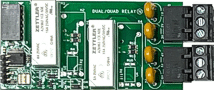
Four optional plug-in setpoint controller boards are available to add control and alarm capability to 1/8 DIN Laureate DPMs, counters, timers and remote displays:
The contact relays are rated for 10A at 250 Vac or 30 Vdc and are recommended for high currents. The dual contact relays are mutually (isolated) Form C relays and can be wired to be normally open (NO) or normally closed ($0) when not energized. The quad contact relays are normally open (NO) Form A relays and share a common (isolated) ground in pairs.
The solid state relays are rated for 120 mA at 250 Vac or 24 Vdc and are recommended for low currents and frequent switching. They are Form A relays, which are normally open (NO) when not energized. As for the contact relays, the dual solid state relays are mutually (isolated), and the quad solid state relays share a common (isolated) ground in pairs.
Setpoint values and operating modes can be entered via front panel pushbuttons or by computer via the serial interface. Security lockout modes of the front panel pushbuttons can be set to allow operators to view and change setpoint values, view but not changes setpoint values, or not view nor change setpoint values. The Laureate Weight Meter and Batch Controller offer relay control modes beyond those of normal meter or counter operation.
|
|
| Form C (SPDT) dual
contact relays Relays can be connected to be normally open (OC) or normally closed ($0). Relay grounds are mutually (isolated). |
Form A (SPST) quad
contact relays Relays are normally open (NO). Each pair of relays shares an (isolated) ground. |
|
|
| Form A (SPST) dual solid
state relays Relays are normally open (NO). Relay grounds are mutually (isolated). |
Form A (SPST) quad solid
state relays Relays are normally open (NO). Each pair of relays shares an (isolated) ground. |
| Normal, Non-Latched Operation | |
|---|---|
![]() |
In this mode, the relay closes when the reading rises above the setpoint and opens when the reading falls below the setpoint. Relay ON/OFF control action is independently programmable for each of the two relays and can be reversed through a setup command. |
| Latched Operation | |
![]() |
The relay stays actuated until reset externally. This mode can be used to shut down machinery or a process when an operating limit has been exceeded, or to maintain an alarm until acknowledged by an operator when the alarm condition has passed. |
| Mixed Latched and Non-Latched Operation | |
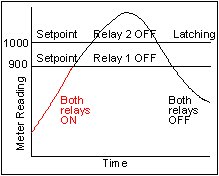
![]() |
One of the relays can operate in a non-latched mode, for instance to turn off a heater when an operating temperature setpoint is reached. The other relay can operate as a latching fail-safe backup and turn off the entire process when a second, higher setpoint is reached, indicating a malfunction. |
| Deviation Mode Operation | |
![]() |
A deviation limit (50 in this example) is set up around both sides of the setpoint. The relay closes (or opens) when the reading falls within the deviation band, and opens (or closes) when the reading falls outside of this band. This mode sets up a passband around the setpoint and is often used for component testing. |
| Wide Hysteresis Mode Operation | |
![]() |
In this example, a hysteresis limit of 600 is set below the setpoint. The relay closes when the reading reaches a lower limit (the setpoint less hysteresis) and opens when the reading reaches an upper limit (the setpoint). One application is automatic tank filling. A fill operation is automatically initiated when the tank level has reached a lower level and is terminated when the level has reached an upper level. |
| Narrow Hysteresis Mode Operation | |
![]() |
Hysteresis can be used to minimize the number of ON/OFF control cycles around a setpoint, thereby increasing the life of motors, relays, etc. A very narrow hysteresis band (such as 5 counts) can also be used to minimize relay chatter around a setpoint due to electrical noise on the signal, or due to signal feedback caused by load switching. The hysteresis limit should exceed the noise amplitude. |
| Operation | |
|---|---|
| Power | Provided by meter |
| Setup | Front panel pushbuttons or via PC using RS232, RS485 or USB |
| Input Filtering | Setpoint compared to either filtered or unfiltered signal. |
| Time Delay | Unfiltered, or programmable delay from 1 to 128 readings |
| Relay Operating Modes | 1) Activate above or below setpoint |
| 2) Latching or non-latching | |
| 3) Hysteresis or band deviation mode around each setpoint | |
| 4) Relays disabled | |
| Enable/Lockout Modes | 1) Display and change setpoint via front panel pushbuttons. |
| 2) Display setpoints via alarm pushbutton, but do not allow changes. | |
| 3) Disable pushbutton action for setpoints. | |
| Alarm Status Indication | |
| Type | Two or four red LED indicators |
| Lamp Lit | When relay is energized |
| Contact Relay Versions | |
| Form, Dual Relays | Form C, single-pole, double-throw (SPDT) |
| Form, Quad Relays | Form A, single-pole, single-throw (SPST), normally open (NO) |
| Current Rating | 10A at 250 Vac or 30 Vdc |
| Safety Rating | 250V rms working, 2.3 kV rms per 1 min test |
| Relay Grounds | Grounds of dual relays are mutually isolated |
| Grounds of quad relays are isolated in pairs | |
| Operate Time | 7 ms (typical) from end of conversion |
| Release Time | 5 ms (typical) from end of conversion |
| Solid State Relay Versions | |
| Form of Relays | Form A, single-pole, single-throw (SPST), normally open (NO) |
| Current Rating | 120 mA at 140 Vac or 180 Vdc |
| ON series resistance | 18 ohms typical, 25 ohms max |
| Isolation Type | Optical |
| Safety Rating | 250V rms working, 2.3 kV rms per 1 min test |
| Operate & Release Time | 1 ms (typical) from end of conversion |
| Environmental | |
| Operating temperature | 0°C to 60°C |
| Storage temperature. | -40°C to 85°C |
| Relative humidity | 95% at 40°C, non-condensing |
A Dual or Quad Relay Board is an advanced electronic module meticulously engineered to augment the functionality of Laureate Meters, Counters, and Timers by providing precise control through multiple relay outputs. These boards are specifically designed to fit within 1/8 DIN panel setups, offering a compact yet powerful solution that integrates seamlessly into a wide array of industrial control systems. Crafted with durability and versatility in mind, they cater to environments requiring robust automation, ensuring that operators can rely on consistent performance across diverse operational scenarios. Their compatibility with Laureate devices makes them an indispensable addition for enhancing monitoring and control capabilities in sophisticated setups.
The board expertly processes incoming signals from Laureate devices, transforming them into actionable relay outputs that can effectively control a variety of external devices such as valves, alarms, or motors. This process involves sophisticated signal conditioning to ensure accuracy, filtering out noise and interference to deliver reliable control commands. The board’s ability to handle complex input data makes it suitable for dynamic industrial environments where precision is non-negotiable.
It employs an internal logic system to activate either two (dual) or four (quad) relays, offering highly customizable switching options based on specific meter readings, counter thresholds, or timer events. This flexibility allows for tailored automation sequences, enabling users to program responses to various operational conditions with ease. The relays can be configured for different load types, enhancing their adaptability across applications.
Relay statuses are visually indicated or fully integrated with the meter’s interface, providing real-time monitoring and adjustment capabilities through bright LED indicators or interactive control panels. This integration facilitates immediate feedback, allowing operators to make on-the-fly adjustments or troubleshoot issues efficiently. The user-friendly design ensures that even complex systems remain manageable and accessible.
These boards come equipped with advanced options such as programmable delays for timed operations, support for high-current relays up to 8A, and communication interfaces like RS-232 for seamless integration into broader automation networks. These features expand the board’s utility, enabling sophisticated control strategies and remote management, which are critical for modern industrial demands.
Dual or Quad Relay Boards for Laureate devices are highly versatile tools that significantly enhance control and monitoring across a broad spectrum of industrial and automation settings, delivering unparalleled reliability and efficiency:
These boards are extensively utilized to manage machinery by triggering relays based on voltage or count thresholds, ensuring safe and efficient operations in manufacturing plants. They enable precise control over production lines, preventing equipment downtime by responding to critical parameters, and support complex automation workflows with real-time adjustments.
They monitor power metrics such as voltage or frequency, activating relays to manage load switches or issue alerts on anomalies in generators and transformers. This capability ensures stable power delivery, protects critical infrastructure, and supports maintenance scheduling by identifying potential issues early, enhancing overall system reliability.
In solar or wind energy setups, the boards control relays to optimize energy output or signal maintenance needs based on performance data from Laureate counters. They help maximize renewable energy efficiency, manage battery charging cycles, and ensure system longevity by addressing wear indicators promptly.
Integrated into vehicle systems, they trigger alerts or controls based on counter or timer inputs in electric vehicles (EVs) and trains, ensuring safety and performance. This includes monitoring battery health, managing braking systems, and supporting diagnostic processes during vehicle operation or testing phases.
They support experimental setups by activating relays for precise timing or measurement triggers in research equipment, offering researchers the tools needed for accurate data collection. This enhances the reliability of experimental outcomes across fields like materials science and engineering.
These boards regulate HVAC components via relay outputs, maintaining optimal temperature and energy efficiency in buildings by responding to meter data. They integrate with building management systems to adjust ventilation or heating dynamically, reducing energy costs and improving occupant comfort.
They ensure safety by controlling critical systems like navigation or life support with relay-based responses to meter data in ships, aircraft, and spacecraft. This includes managing power distribution, environmental controls, and emergency protocols, where reliability is non-negotiable.
Dual or Quad Relay Boards for Laureate Meters, Counters, and Timers stand as indispensable components in the realm of industrial automation and control, offering a robust platform for precise relay-based outputs that drive efficiency, safety, and reliability across a multitude of sectors. Their adaptability to diverse applications, from manufacturing to aerospace, underscores their value in modern technological landscapes, where they facilitate seamless integration with advanced control systems and enhance operational workflows. As industries continue to evolve with increasing demands for automation and precision, these relay boards will play an ever-growing role, supporting innovative solutions that address complex challenges. Their ability to provide customizable, high-performance control options ensures they remain at the forefront of industrial technology, contributing significantly to productivity gains and safety enhancements. This versatility and reliability make them a cornerstone for future advancements, promising to meet the dynamic needs of tomorrow’s industrial environments with continued excellence.
Less Information...