
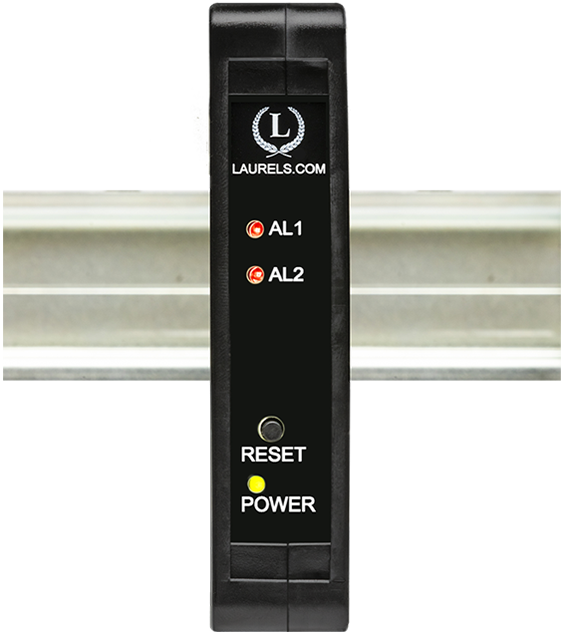
LTS Series DIN Rail Transmitter
Accuracy of 0.01% of reading ± 2 counts. High read rates at up to 60 or 50 conversions per second.
LTS Series DIN Rail Transmitter
Accuracy of 0.01% of reading ± 2 counts. High read rates at up to 60 or 50 conversions per second.
The Laureate LTS is a DIN rail-mounted serial-to-analog converter that does something the LT Series does not — it works in reverse. Instead of reading a physical sensor and producing an analog output, the LTS accepts streaming RS232 or RS485 serial data from an external device and converts that data into a scaled 4-20 mA, 0-20 mA, 0-10V, or -10V to +10V analog output.
This makes the LTS the right tool when you already have a device that outputs serial data — a digital scale, a flow computer, a gas analyzer, a PLC, a GPS receiver, or any instrument that streams ASCII readings over RS232 or RS485 — but need that data in analog form to drive a chart recorder, a control valve, a panel meter, a DCS analog input card, or any other device that requires a standard current or voltage signal.
The LTS accepts data rates from 300 to 9600 baud and can extract a reading from anywhere within a long ASCII string — including strings that contain multiple values, address characters, alarm flags, and non-printing control characters. Setup is done using Laurel's free Instrument Setup Software, and every LTS includes up to 30 minutes of technical phone support with screen sharing to help configure the string parsing for your specific device.
The LTS receives a continuous stream of ASCII data from the external device via RS232 or RS485 (jumper selectable, half or full duplex). The user configures which characters in the stream represent the reading to be converted, using one of seven programmable input modes. The LTS is not plug-and-play — the format of the incoming data string must be known in advance, including any non-printing control characters. Laurel's tech support and free Instrument Setup Software make this configuration process straightforward.
Seven input modes cover the full range of ASCII data formats encountered in practice:
The extracted reading is converted to a scaled analog output — 4-20 mA, 0-20 mA, 0-10V, or -10V to +10V — jumper selectable and user scalable via Instrument Setup Software. Output resolution is 16 bits (0.0015% of span) with ±0.02% accuracy. The output updates at a rate determined by the incoming data rate, up to 10 per second. The analog output is isolated (250V rms working), eliminating ground loop problems between the source device and the receiving instrument.
Two solid state relays (120 mA at 140 Vac or 180 Vdc) are standard and can respond to the received digital readings — activating when a value exceeds a setpoint — or respond to received ASCII control characters in the data stream. The relays can also be commanded remotely via Modbus RTU, Modbus ASCII, or Laurel Custom ASCII protocols, allowing a PLC or master controller to set relay states and output levels directly.
Digital scales and weigh controllers output weight data as ASCII strings over RS232 or RS485. When that weight data needs to drive a filling valve, a batching controller, or a chart recorder that only accepts 4-20 mA, the LTS bridges the gap. The Remote C mode handles the complex string formats common in scale indicators, extracting the weight value from strings that include unit labels, stability flags, and checksum characters.
Many gas analyzers, moisture analyzers, and process instruments output measurement data as serial ASCII but older DCS systems and control loops only accept 4-20 mA inputs. The LTS provides the conversion without requiring replacement of either the analyzer or the DCS, preserving the investment in both while enabling full integration.
When a PLC or SCADA system has calculated a value — a totalized flow, an efficiency metric, a derived temperature — and needs to retransmit that value as a 4-20 mA signal to a remote analog indicator or recorder, the LTS accepts the serial output via Modbus RTU or Custom ASCII commands and produces the corresponding analog output. This is particularly useful for driving large digit displays, strip chart recorders, or analog indicators at remote locations without running additional analog wiring from the PLC.
Flow computers output calculated flow rates, totals, and densities as ASCII data over serial ports. The LTS can extract the instantaneous flow rate from the output string and produce a 4-20 mA signal proportional to flow — enabling integration with analog flow controllers, recorders, and SCADA analog input cards without requiring a Modbus or digital interface on those devices.
GPS receivers and positioning systems that output NMEA or custom ASCII position data over RS232 can be connected to the LTS to produce an analog output proportional to a specific coordinate or speed value. This is used in marine, agricultural, and transportation applications where analog position signals are required by legacy autopilot or control systems.
Up to 30 Laureate panel meters and LT Series transmitters can be daisy-chained on a single RS485 bus. The LTS can read any one of those instruments — extracting its reading from the Laureate serial transmission using Remote 1–4 modes — and retransmit that value as a 4-20 mA signal to any analog-input device on the network. This enables seamless integration of Laureate digital instrumentation with legacy analog control infrastructure.
The Laureate LTS fills a specific and common gap in industrial instrumentation — the need to take serial ASCII data from any device and produce a clean, isolated, calibrated analog output. Its seven input modes handle virtually any ASCII string format, its Modbus and Custom ASCII command modes allow active control by a master device, and its included technical support makes the string parsing configuration accessible even for complex data formats. For any application where serial data needs to become a 4-20 mA signal, the LTS is the purpose-built solution.
Less Information.