DC Voltage & Current Input Signal
Accuracy of 0.01% of reading ± 2 counts. High read rates at up to 60 or 50 conversions per second.
$558.00DC Voltage & Current Input Signal
Accuracy of 0.01% of reading ± 2 counts. High read rates at up to 60 or 50 conversions per second.
$558.00Load Cell, Strain Gauge & Microvolt
Accuracy of 0.01% of reading ± 2 counts. High read rates at up to 60 or 50 conversions per second.
Scale Transmitter for Weighing
Accuracy of 0.01% of reading ± 2 counts. High read rates at up to 60 or 50 conversions per second.
Process & Ratiometric Signals
Accuracy of 0.01% of reading ± 2 counts. High read rates at up to 60 or 50 conversions per second.
True AC RMS Voltage & Current
Accuracy of 0.01% of reading ± 2 counts. High read rates at up to 60 or 50 conversions per second.
Thermocouple Temperature
Accuracy of 0.01% of reading ± 2 counts. High read rates at up to 60 or 50 conversions per second.
RTD Temperature
Accuracy of 0.01% of reading ± 2 counts. High read rates at up to 60 or 50 conversions per second.
Resistance in Ohms
Accuracy of 0.01% of reading ± 2 counts. High read rates at up to 60 or 50 conversions per second.
Frequency, Rate, or Period
Time Base Crystal calibrated to ±2 ppm
Span tempco ±1 ppm/°C (typ)
Long-term Drift ±5 ppm/year (typ)
Rate, Totalizer with Functions
Time Base Crystal calibrated to ±2 ppm
Span tempco ±1 ppm/°C (typ)
Long-term Drift ±5 ppm/year (typ)
Pulse Input Totalizer
Time Base Crystal calibrated to ±2 ppm
Span tempco ±1 ppm/°C (typ)
Long-term Drift ±5 ppm/year (typ)
Analog Input Totalizer
Time Base Crystal calibrated to ±2 ppm
Span tempco ±1 ppm/°C (typ)
Long-term Drift ±5 ppm/year (typ)
Batch Controller Pulse Input
Time Base Crystal calibrated to ±2 ppm
Span tempco ±1 ppm/°C (typ)
Long-term Drift ±5 ppm/year (typ)
Batch Controller Analog Input
Time Base Crystal calibrated to ±2 ppm
Span tempco ±1 ppm/°C (typ)
Long-term Drift ±5 ppm/year (typ)
AC Phase Angle and Power Factor
Time Base Crystal calibrated to ±2 ppm
Span tempco ±1 ppm/°C (typ)
Long-term Drift ±5 ppm/year (typ)
Quadrature Encoder Input
Time Base Crystal calibrated to ±2 ppm
Span tempco ±1 ppm/°C (typ)
Long-term Drift ±5 ppm/year (typ)
Digital Stopwatch and Timer
Time Base Crystal calibrated to ±2 ppm
Span tempco ±1 ppm/°C (typ)
Long-term Drift ±5 ppm/year (typ)
Time Interval of Periodic Events
Time Base Crystal calibrated to ±2 ppm
Span tempco ±1 ppm/°C (typ)
Long-term Drift ±5 ppm/year (typ)
Duty Cycle and (PWM)
Time Base Crystal calibrated to ±2 ppm
Span tempco ±1 ppm/°C (typ)
Long-term Drift ±5 ppm/year (typ)
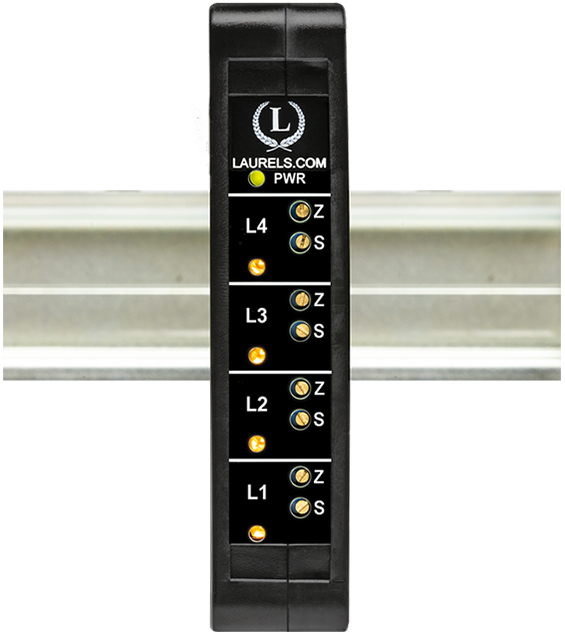
QLS Quad Current Loop Splitter
Drives four (4) independent 4-20 mA,
1-5V, 0-5V or 0-10V output signal
proportional to input.
The Laureate LTE Series is a DIN rail transmitter with built-in Ethernet communication. It takes a sensor or process input, conditions it through a plug-in signal conditioner board, and delivers both a standardized isolated analog output and digital data over Ethernet using Modbus TCP/IP. The LTE accepts the same broad range of inputs as the rest of the Laureate transmitter family — DC voltage and current, true-RMS AC voltage and current, thermocouple and RTD temperature, load cell and strain gauge, process loops such as 4–20 mA and 0–10 V, resistance, and frequency, rate, or pulse signals — and pairs each input with a 4–20 mA isolated analog output, dual relays, and isolated transducer excitation. What sets the LTE apart from the LT Series is the communication layer: where the LT transmits over RS-232 or RS-485 serial, the LTE connects directly to an Ethernet network, so a transmitter can be read, configured, and monitored from anywhere on the network or remotely. It shares the same measurement engine, accuracy, and high read rate as Laurel's 1/8 DIN panel meters.
The two series share the same Laureate measurement engine, plug-in signal conditioners, 4–20 mA analog output, dual relays, and accuracy. The difference is the communication interface: the LTE Series connects over Ethernet using Modbus TCP/IP, while the LT Series communicates over RS-232 or RS-485 serial. Choose the LTE when the transmitter needs to live on a network or be accessed remotely, and the LT when you are running serial.
The LTE Series uses Ethernet with Modbus TCP/IP. That lets a transmitter connect directly to a plant network, report digitally to PLCs and SCADA systems, and be configured or monitored remotely, all at the same time it drives its isolated analog output.
Through interchangeable plug-in signal conditioner boards, the LTE Series accepts DC voltage and current, true-RMS AC voltage and current, thermocouple and RTD temperature, load cell and strain gauge, process signals such as 4–20 mA and 0–10 V, resistance, and frequency, rate, or pulse inputs. You match the board to the sensor, so one Ethernet transmitter family covers a broad range of measurements.
Yes. Ethernet communication is in addition to, not instead of, the analog output. Each LTE transmitter provides an isolated 4–20 mA analog output (with 0–10 V available where preferred), so it can feed legacy analog control loops and report to a networked system simultaneously.
DIN rail is the standardized mounting system used inside industrial control cabinets. Rail mounting lets transmitters clip in next to PLCs, switches, breakers, and relays, keeps wiring tidy with detachable screw-clamp connectors, and makes installation and replacement fast — which suits networked devices that sit in the cabinet rather than on the panel face.
Because they share the measurement engine of the Laureate panel meters, LTE Series analog-input transmitters provide accuracy of 0.01% of reading ± 2 counts with high read rates of up to 60 or 50 conversions per second. Frequency and timer versions use a time-base crystal calibrated to ± 2 ppm. Inputs, outputs, power, and the Ethernet interface are isolated from one another.
In modern industrial automation and control systems, accurate signal transmission is essential for monitoring and controlling various processes. An LTE Series DIN Rail Analog Transmitter is a device specifically designed to convert DC voltage input signals into standardized analog outputs while also offering Ethernet communication capabilities. This combination of features makes it a versatile and powerful tool for industrial applications.
An LTE Series DIN Rail Analog Transmitter is a device that is mounted on a DIN rail, a standardized mounting system used in control cabinets and enclosures. The DIN rail design ensures easy installation and integration into existing systems, making it a popular choice in industrial settings.
In today's rapidly evolving industrial landscape, efficient signal transmission and processing are critical. The LTE Series DIN Rail Analog Transmitter with Ethernet communication and analog outputs for DC voltage input signals is a versatile device that plays a crucial role in various applications. This article will explore where and how this technology is utilized.
In industrial automation, accurate signal transmission is essential for the smooth operation of processes. The LTE Series DIN Rail Analog Transmitter is widely used in these environments to convert DC voltage input signals from sensors or transducers into standardized analog outputs. This allows for precise monitoring and control of various processes, such as temperature, pressure, and flow rates.
The Ethernet communication feature is particularly valuable in industrial automation, as it enables remote monitoring and data acquisition. This capability allows operators to access real-time data from multiple transmitters across different locations, ensuring that processes remain within desired parameters. This connectivity also facilitates integration with supervisory control and data acquisition (SCADA) systems, enhancing overall efficiency and reliability.
Energy management is another area where the LTE Series DIN Rail Analog Transmitter shines. In power plants, substations, and renewable energy installations, this device is used to monitor DC voltage levels from various sources, such as solar panels, batteries, or power supplies. The transmitter converts these signals into analog outputs that can be easily interpreted by energy management systems.
The Ethernet communication feature allows for seamless integration with energy monitoring software, enabling real-time data analysis and reporting. This capability is crucial for optimizing energy consumption, detecting anomalies, and ensuring the efficient operation of power generation and distribution systems.
Modern building automation systems (BAS) rely on precise data from various sensors to maintain optimal environmental conditions. The LTE Series DIN Rail Analog Transmitter is commonly used in these systems to process DC voltage signals from sensors monitoring temperature, humidity, light levels, and occupancy.
With its Ethernet communication capabilities, the transmitter can easily be integrated into a building's network, allowing facility managers to monitor and control conditions remotely. This feature is particularly useful in large buildings or campuses where centralized control is necessary for maintaining comfort and energy efficiency.
Manufacturing processes often require precise control of various parameters, such as voltage, current, temperature, and pressure. The LTE Series DIN Rail Analog Transmitter is essential in converting DC voltage signals from process sensors into analog outputs that can be used by controllers and other equipment.
In addition to analog outputs, the transmitter's Ethernet communication feature enables real-time data sharing across different parts of the manufacturing facility. This ensures that all components of the process are synchronized, reducing the risk of errors and improving overall production quality.
In remote monitoring and telemetry applications, the LTE Series DIN Rail Analog Transmitter is used to gather data from sensors located in hard-to-reach or hazardous environments. These sensors often output DC voltage signals, which the transmitter converts into analog signals for further processing.
The Ethernet communication capability allows the transmitter to send data over long distances to a central monitoring station. This is particularly useful in applications such as environmental monitoring, oil and gas exploration, and infrastructure management, where timely data acquisition is critical for making informed decisions.
In laboratories and research facilities, the LTE Series DIN Rail Analog Transmitter is used to process DC voltage signals from various experimental setups. The analog outputs provided by the transmitter can be used to interface with data acquisition systems, control equipment, or other instrumentation.
The Ethernet communication feature allows researchers to remotely monitor and control experiments, making it easier to manage complex setups or conduct long-term studies. This capability is especially valuable in situations where experiments need to be monitored continuously or where environmental conditions must be tightly controlled.
The LTE Series DIN Rail Analog Transmitter with Ethernet communication and analog outputs for DC voltage input signals is a versatile and essential device in a wide range of applications. Whether in industrial automation, energy management, building automation, manufacturing, remote monitoring, or research, this transmitter provides accurate signal conversion and reliable communication, ensuring optimal performance and efficiency in various systems. Its ability to integrate with modern digital networks makes it an indispensable tool in the age of Industry 4.0 and beyond.
In industrial automation and process control environments, precise and reliable signal transmission is crucial for monitoring and controlling various processes. An LTE Series DIN Rail Analog Transmitter with Ethernet Communication and Analog Outputs for DC Current Input Signal is a specialized device designed to meet these requirements by providing accurate signal conversion, communication, and output functionalities. This article will explore what this device is, how it works, and its significance in modern industrial settings.
The LTE Series refers to a family of high-performance analog transmitters that are typically mounted on DIN rails, a standard type of mounting used in industrial control panels. These transmitters are specifically designed to process DC current input signals and convert them into standardized analog outputs that can be easily interpreted by various monitoring and control systems.
DC Current Input Signal Handling: The primary function of an LTE Series DIN Rail Analog Transmitter is to accept DC current input signals. These signals are often generated by sensors, transducers, or other field devices that measure various physical parameters such as temperature, pressure, or flow. The transmitter then conditions and converts these signals into a form that can be utilized by other components in the control system.
Analog Output: Once the DC current input signal is processed, the transmitter outputs an analog signal, typically in the form of a 4-20 mA or 0-10 V signal. This standardized output can be easily read by programmable logic controllers (PLCs), distributed control systems (DCS), and other monitoring equipment, facilitating seamless integration into industrial automation systems.
Ethernet Communication: One of the standout features of the LTE Series is its ability to communicate via Ethernet. Ethernet communication provides several advantages, including high-speed data transfer, remote monitoring, and control capabilities. This feature allows the transmitter to be integrated into a larger network, enabling real-time data access, diagnostics, and configuration from remote locations. This is particularly beneficial in modern industrial environments where connectivity and data-driven decision-making are paramount.
DIN Rail Mounting: The DIN rail mounting design ensures that the LTE Series transmitters can be easily installed in standard control panels, saving space and simplifying wiring. The compact form factor and standardized mounting make it a versatile solution for a wide range of industrial applications.
The LTE Series DIN Rail Analog Transmitter with Ethernet Communication and Analog Outputs is widely used in various industrial sectors, including manufacturing, energy, water treatment, and more. Its ability to accurately process DC current input signals and provide reliable analog outputs makes it an essential component in systems where precision and reliability are critical.
Some of the key benefits of using this type of transmitter include:
In today's industrial landscape, efficient and reliable data transmission is crucial for monitoring and controlling processes. LTE Series DIN Rail Analog Transmitters equipped with Ethernet communication and analog outputs are vital components in various applications, especially where DC current input signals need to be accurately converted and transmitted for further processing. Let's explore where these advanced devices are used and why they are so important.
In industrial automation, precision and real-time data are essential for maintaining productivity and safety. LTE Series DIN Rail Analog Transmitters convert DC current input signals into standardized outputs that can be easily integrated into larger control systems. The Ethernet communication capability allows these transmitters to be connected to a network, enabling remote monitoring and data acquisition across multiple devices and locations. This feature is particularly useful in:
PLC Systems: Programmable Logic Controllers (PLCs) rely on accurate data inputs to control machinery and processes. The analog transmitter ensures that the current signals from sensors and transducers are accurately converted and communicated to the PLC.
SCADA Systems: Supervisory Control and Data Acquisition (SCADA) systems require reliable data transmission from various sensors and equipment. The LTE Series transmitters facilitate this by converting and sending the necessary data to central control units over Ethernet.
In power plants and electrical distribution systems, monitoring current flow is crucial for ensuring the safe and efficient operation of the grid. The LTE Series DIN Rail Analog Transmitters play a key role in these environments by:
Monitoring Transformer Currents: These transmitters convert the DC current signals from transformers into analog outputs, which can then be used for real-time monitoring and control.
Substation Automation: In substations, Ethernet communication enables centralized control and monitoring of various equipment. The analog transmitters provide the necessary interface between the high-current equipment and the control systems, ensuring accurate data transmission.
The rise of renewable energy sources, such as solar and wind, has increased the need for precise monitoring and control of electrical currents. LTE Series DIN Rail Analog Transmitters are used in these systems to:
Monitor DC Currents in Solar Panels: The transmitters convert the DC output from solar panels into standard signals that can be analyzed to optimize performance and detect issues.
Control Wind Turbine Operations: In wind farms, these devices help in converting and transmitting data related to current flow within the turbines, ensuring efficient energy production and grid stability.
In building automation, managing energy consumption and ensuring occupant comfort are top priorities. LTE Series DIN Rail Analog Transmitters contribute to these goals by:
Controlling HVAC Systems: These transmitters convert current signals from various HVAC components, such as fans and compressors, into data that can be used for precise control and energy management.
Energy Monitoring: In smart buildings, Ethernet-enabled transmitters facilitate the remote monitoring of energy usage, enabling facility managers to optimize consumption and reduce costs.
In water and wastewater treatment plants, maintaining the correct flow and pressure of fluids is critical for process efficiency and regulatory compliance. LTE Series DIN Rail Analog Transmitters are essential in these environments for:
Pump and Valve Control: These devices convert current signals from pumps and valves into standardized outputs, which are then used to control the flow and pressure of fluids.
Remote Monitoring: With Ethernet communication, these transmitters allow for real-time monitoring and control of water treatment processes, even from remote locations.
LTE Series DIN Rail Analog Transmitters with Ethernet communication and analog outputs are indispensable tools in various industrial, energy, building, and water management applications. Their ability to convert DC current input signals into standardized outputs, combined with the advantages of Ethernet connectivity, makes them crucial for efficient, reliable, and scalable operations. Whether in automation systems, power distribution, renewable energy, building automation, or water treatment, these transmitters ensure that vital data is accurately transmitted and utilized for optimal process control.
The LTE Series DIN Rail Analog Transmitter with Ethernet Communication and Analog Outputs for DC Current Input Signal is a versatile and powerful tool in the world of industrial automation. By combining reliable signal processing with modern communication capabilities, this device plays a crucial role in ensuring the efficient operation of complex industrial systems. Whether you are looking to upgrade an existing control system or build a new one, understanding the capabilities and benefits of this transmitter can help you make informed decisions that enhance your system's performance and reliability.
In modern industrial and automation systems, precise measurement and control are paramount. A key component that facilitates these processes is the analog transmitter, which converts physical measurements into a standardized electrical signal for further processing, monitoring, or control. Among these, the LTE Series DIN Rail Analog Transmitter with Ethernet Communication and Analog Outputs stands out, especially when dealing with microvolt-level signals from load cells or strain gauges. This article delves into the features, functionality, and applications of this advanced device.
A DIN rail analog transmitter is a device designed to be mounted on a standard DIN rail, commonly used in industrial control panels. It takes an analog input signal, typically from a sensor like a load cell or strain gauge, and converts it into a different signal format, such as a standardized analog output (e.g., 4-20mA or 0-10V). This output can then be used by controllers, data acquisition systems, or other instrumentation.
The Ethernet communication capability of the LTE Series transmitter adds a significant layer of functionality, allowing the device to communicate over a network. This feature is crucial in modern industrial settings, where data from various sensors and transmitters need to be integrated into a centralized control system or shared across different platforms for monitoring, analysis, or logging purposes.
Load cells and strain gauges are precision sensors used to measure force, weight, or strain. These devices typically output very small signals, often in the microvolt (µV) range, which need to be accurately amplified and converted into a more manageable signal for further processing. The LTE Series transmitter is specially designed to handle these low-level signals with high precision, ensuring that the measurements are accurate and reliable.
Microvolt Input Signal Compatibility: The LTE Series is engineered to handle extremely low-level signals from load cells and strain gauges. This feature is critical for applications requiring high accuracy and sensitivity.
Ethernet Communication: The built-in Ethernet port enables the transmitter to send data over a network, making it easier to integrate with modern industrial control systems. This capability supports remote monitoring, data logging, and integration with IoT systems.
Analog Outputs: The transmitter provides standard analog outputs, such as 4-20mA or 0-10V, which are widely used in industrial control systems. These outputs can be connected to controllers, PLCs, or other instrumentation.
DIN Rail Mounting: The transmitter is designed for easy installation on a standard DIN rail, which is common in industrial control panels. This design allows for compact and organized wiring setups.
High Precision and Stability: The LTE Series transmitter is built with high-quality components to ensure accurate signal conversion and long-term stability, even in demanding industrial environments.
In industrial and automation settings, precise measurement and data communication are critical. Load cells, strain gauges, and microvolt-level signal measurements are common in these environments, where accuracy and real-time data are crucial. An LTE Series DIN Rail Analog Transmitter with Ethernet communication and analog outputs for load cell strain gauge microvolt input signals plays a pivotal role in such applications. This article will explore the various use cases of this advanced transmitter and its significance in different industries.
An LTE Series DIN Rail Analog Transmitter is a device designed to convert microvolt-level signals from load cells and strain gauges into standard analog outputs or digital signals for further processing. These transmitters are mounted on DIN rails, a standard mounting system in industrial automation. They often include Ethernet communication capabilities, enabling seamless integration into modern industrial networks.
One of the primary applications of an LTE Series DIN Rail Analog Transmitter is in industrial weighing systems. Load cells, which are sensors that convert force into electrical signals, are widely used to measure weight in various industrial processes. The microvolt signals generated by load cells are extremely low and require precise amplification and conversion. The transmitter amplifies these signals and converts them into usable analog or digital outputs, ensuring accurate weight measurements in real-time. This is particularly important in sectors like manufacturing, logistics, and food processing, where accurate weight measurement is crucial for quality control and operational efficiency.
In civil engineering, monitoring the structural integrity of buildings, bridges, and other infrastructure is essential. Strain gauges are often used to measure the strain in structural components, which can indicate stress or potential failure. The microvolt signals from these strain gauges need to be accurately captured and transmitted for analysis. An LTE Series DIN Rail Analog Transmitter with Ethernet communication allows for remote monitoring and real-time data analysis, making it a vital component in structural health monitoring systems.
In manufacturing and heavy industries, machine condition monitoring is essential to prevent downtime and extend equipment life. Strain gauges and load cells can be used to monitor the forces and stresses experienced by machinery during operation. The microvolt signals from these sensors provide critical information about the machine’s condition. The transmitter converts these signals into analog outputs that can be integrated with monitoring systems, providing valuable insights for predictive maintenance.
Automation systems in industries like automotive, aerospace, and robotics often require precise measurement of forces and strains. The LTE Series DIN Rail Analog Transmitter plays a key role in such systems by providing accurate, real-time data from load cells and strain gauges. This data is used to control robotic arms, manufacturing equipment, and other automated processes, ensuring high precision and efficiency.
With the rise of the Industrial Internet of Things (IIoT), there is a growing demand for devices that can connect to networks and provide real-time data. The Ethernet communication capability of the LTE Series DIN Rail Analog Transmitter makes it ideal for remote monitoring applications. Whether it's monitoring the structural health of remote infrastructure or tracking the performance of machinery in distant locations, this transmitter ensures that critical data is always accessible.
The LTE Series DIN Rail Analog Transmitter with Ethernet communication and analog outputs for load cell strain gauge microvolt input signals is a versatile and essential tool in modern industrial applications. Its ability to accurately measure and transmit low-level signals makes it invaluable in industries where precision and real-time data are paramount. From industrial weighing and structural health monitoring to machine condition monitoring and automated control systems, this transmitter ensures that operations run smoothly and efficiently, providing the necessary data for informed decision-making and optimal performance.
In the realm of industrial automation and process control, precise measurement and communication are crucial for ensuring efficiency and accuracy. One of the key components that enable this is the LTE Series DIN Rail Analog Transmitter with Ethernet Communication and Analog Outputs. This device is particularly beneficial for weighing applications, where it plays a vital role in converting, transmitting, and managing data from weight sensors or load cells.
An LTE Series DIN Rail Analog Transmitter is a specialized device designed to convert analog signals from sensors, like load cells, into digital or analog outputs that can be easily transmitted and processed. These devices are typically mounted on a DIN rail, a standardized metal rail used to secure and organize control equipment in industrial settings.
The LTE Series refers to a specific line of transmitters that are optimized for various industrial applications, including weighing. These transmitters are known for their reliability, precision, and ease of integration into existing control systems.
In industrial and commercial environments, precision in weighing and data management is paramount. As industries become increasingly automated, the need for reliable and accurate data transmission grows. The LTE Series DIN Rail Analog Transmitter with Ethernet communication and analog outputs is a key component in weighing applications, ensuring that weight data is accurately transmitted, processed, and utilized.
Manufacturing and Production Lines
In manufacturing environments, particularly those that handle bulk materials, the accurate measurement of weight is crucial. The LTE Series transmitter is typically integrated into weighing systems on production lines, where it converts the weight signal from a load cell into a standardized analog or digital output. The Ethernet communication capability ensures that this data can be seamlessly transmitted to a central control system or a PLC (Programmable Logic Controller), enabling real-time monitoring and adjustments. This is vital for maintaining product quality and consistency, especially in industries like food processing, pharmaceuticals, and chemicals.
Automated Packaging Systems
Automated packaging systems often require precise weight measurements to ensure that each package contains the correct amount of product. The LTE Series transmitter provides the necessary accuracy and reliability. By transmitting weight data directly to the control system via Ethernet, it allows for rapid adjustments to be made to the packaging process, minimizing waste and ensuring compliance with industry standards.
Inventory Management Systems
In warehouses and distribution centers, accurate weight measurements are essential for inventory management. The LTE Series transmitter can be used in conjunction with weighing scales to monitor the weight of goods as they are moved in and out of storage. The Ethernet communication feature enables real-time data integration with inventory management software, allowing for better tracking of stock levels and reducing the likelihood of errors.
Process Control in Chemical and Pharmaceutical Industries
In the chemical and pharmaceutical industries, precise dosing and mixing of materials are critical. The LTE Series transmitter can be integrated into systems that monitor the weight of ingredients as they are added to a batch. The transmitter's analog outputs provide feedback to the process control system, ensuring that the correct amounts are used. Ethernet communication facilitates the transmission of this data to a central database, where it can be analyzed and used to optimize the process.
Agricultural Applications
In agriculture, weighing systems are often used to monitor the feed intake of livestock, measure crop yields, or manage the distribution of fertilizers and pesticides. The LTE Series transmitter can be employed in these applications to ensure accurate and consistent weight measurements. The ability to communicate via Ethernet allows for integration with farm management systems, enabling farmers to make data-driven decisions that improve efficiency and productivity.
Remote Monitoring and Data Logging
In remote or harsh environments, where direct access to equipment may be limited, the LTE Series transmitter's Ethernet communication capability is particularly valuable. It allows for the transmission of weight data over long distances to a central monitoring station. This is especially useful in applications such as remote silos, grain storage facilities, or mining operations, where continuous monitoring is necessary but physical access may be challenging.
The LTE Series DIN Rail Analog Transmitter is favored for its robust design, ease of installation, and reliable performance in demanding environments. Its ability to provide both analog outputs and Ethernet communication makes it highly versatile, allowing it to be integrated into a wide range of systems. Additionally, the transmitter's compact DIN rail mount design ensures that it can be easily incorporated into existing setups without requiring significant modifications.
The LTE Series DIN Rail Analog Transmitter with Ethernet communication and analog outputs is an essential component in various weighing applications across multiple industries. Its reliability, accuracy, and ability to transmit data in real-time make it an invaluable tool for any operation that relies on precise weight measurements. Whether in manufacturing, agriculture, or remote monitoring, this transmitter plays a crucial role in ensuring that processes are efficient, consistent, and data-driven.
In modern industrial automation and control systems, accurate and reliable measurement of electrical parameters is crucial for ensuring system efficiency, safety, and performance. One of the essential components that facilitate this process is the LTE Series DIN Rail Analog Transmitter. Specifically designed to measure True RMS AC Voltage, this device integrates advanced technology with practical features like Ethernet communication and analog outputs. Let’s explore what makes this transmitter a valuable tool in industrial settings.
The LTE Series DIN Rail Analog Transmitter is a compact, versatile device designed for installation on a DIN rail, making it suitable for integration into control panels and other industrial environments. Its primary function is to measure AC voltage and convert it into a standardized signal that can be used by other equipment in the system. What sets the LTE Series apart from other transmitters is its ability to accurately measure True RMS (Root Mean Square) AC voltage, which is critical in applications where the waveform is non-sinusoidal.
True RMS measurement is essential for accurately determining the effective value of an AC voltage, especially in cases where the voltage waveform is not purely sinusoidal. Traditional RMS measurement methods might not provide accurate readings for distorted or complex waveforms, leading to errors in monitoring and control. The LTE Series transmitter uses advanced signal processing to ensure that the RMS value it provides truly reflects the energy in the waveform, making it suitable for modern electrical systems with variable frequency drives, inverters, or other non-linear loads.
One of the standout features of the LTE Series Analog Transmitter is its built-in Ethernet communication. This allows the device to be connected directly to a network, enabling real-time data monitoring and control from a centralized location. Ethernet communication is particularly advantageous in large-scale or distributed systems, where data needs to be shared across multiple devices or accessed remotely. The LTE Series transmitter typically supports standard communication protocols, making it easy to integrate into existing networks and compatible with various SCADA (Supervisory Control and Data Acquisition) systems.
In addition to its digital communication capabilities, the LTE Series Analog Transmitter also provides analog outputs, usually in the form of a 4-20 mA current loop or 0-10 V voltage signal. These outputs are widely used in industrial automation for interfacing with controllers, PLCs (Programmable Logic Controllers), and other analog input devices. The analog output ensures that the transmitter can be used in both legacy systems, which rely on analog signals, and modern setups that utilize digital communication.
In the ever-evolving landscape of industrial automation and process control, precise measurement and reliable communication are paramount. One such component designed to meet these requirements is the LTE Series DIN Rail Analog Transmitter with Ethernet Communication and Analog Outputs for True RMS AC Voltage. This versatile device finds applications across various industries due to its robust functionality and adaptability. Here’s a detailed look at where and why this transmitter is used.
In industrial automation, accurate monitoring and control of electrical systems are crucial. The LTE Series DIN Rail Analog Transmitter provides precise measurements of AC voltage using True RMS technology. This ensures that fluctuations in voltage are accurately captured, regardless of the waveform shape. Its DIN rail mounting capability makes it easy to integrate into existing control panels and systems, making it an essential component for maintaining efficient and reliable operations in manufacturing plants and processing facilities.
Power generation and distribution networks require continuous monitoring to ensure stable and efficient operation. The LTE Series transmitter can be employed to monitor AC voltage levels in power plants, substations, and distribution boards. The Ethernet communication feature enables real-time data transfer to central monitoring systems, allowing for timely adjustments and interventions. The True RMS measurement capability ensures that voltage readings are accurate, even under non-sinusoidal conditions, which is critical for maintaining grid stability and power quality.
In building management systems, monitoring electrical parameters helps in optimizing energy usage and ensuring safety. The LTE Series transmitter can be used to measure AC voltage in various building systems, including HVAC units, lighting controls, and power supplies. Its analog outputs provide valuable data for integration with BMS controllers, while Ethernet communication facilitates remote monitoring and management. This allows facility managers to proactively address issues and improve overall energy efficiency.
Renewable energy systems, such as solar power installations and wind turbines, require accurate monitoring of electrical outputs to ensure optimal performance. The LTE Series transmitter is well-suited for these applications due to its True RMS capability, which is important for handling the variable and sometimes non-sinusoidal waveforms produced by renewable energy sources. The device’s Ethernet communication allows for seamless integration with monitoring systems, enabling real-time analysis and troubleshooting of energy production and distribution.
In research and development labs, precise measurement of electrical parameters is essential for experimentation and testing. The LTE Series transmitter provides accurate AC voltage measurements with True RMS technology, making it suitable for use in various experimental setups and prototypes. The ability to communicate data via Ethernet also supports the development of complex test scenarios and data analysis, facilitating innovation and research in electrical engineering and related fields.
For electrical maintenance teams, having reliable tools for diagnosing and troubleshooting issues is critical. The LTE Series transmitter’s ability to provide accurate True RMS voltage readings and its easy integration into existing systems make it a valuable tool for maintenance personnel. The Ethernet communication capability allows for remote monitoring and data logging, which aids in identifying and resolving electrical issues quickly and efficiently.
The LTE Series DIN Rail Analog Transmitter with Ethernet Communication and Analog Outputs for True RMS AC Voltage is a versatile and essential component across various sectors. Its precise measurement capabilities, robust communication features, and ease of integration make it invaluable for industrial automation, power generation, building management, renewable energy systems, research labs, and maintenance applications. By ensuring accurate and reliable monitoring of AC voltage, this transmitter supports the efficient and safe operation of complex electrical systems.
In the realm of industrial automation and control systems, precise measurement and communication are crucial for maintaining operational efficiency and safety. The LTE Series DIN Rail Analog Transmitter, specifically designed for measuring True RMS AC current, is a pivotal device that integrates analog output functionality with modern communication protocols. Let’s delve into what makes this transmitter an essential component in industrial settings.
The LTE Series DIN Rail Analog Transmitter is a specialized instrument designed to measure alternating current (AC) with high accuracy. It is housed in a compact DIN rail mountable enclosure, making it ideal for integration into control panels and other standard industrial environments. The transmitter's primary function is to convert AC current measurements into standardized output signals for further processing or monitoring.
True RMS Measurement: The transmitter measures the true root mean square (RMS) value of AC current. This feature is critical as it provides accurate readings regardless of the waveform shape, whether sinusoidal or distorted. True RMS measurements ensure reliability in applications where precise current monitoring is necessary.
Analog Outputs: The LTE Series includes analog outputs that represent the measured current in a form that can be easily interpreted by other devices, such as PLCs (Programmable Logic Controllers) or DCS (Distributed Control Systems). Common output options include 4-20 mA or 0-10 V, which are standard in industrial measurement systems.
Ethernet Communication: A notable advancement in the LTE Series is its integration of Ethernet communication capabilities. This allows the transmitter to interface with modern networked systems, facilitating remote monitoring and configuration. Ethernet connectivity supports protocols like Modbus TCP/IP, enabling seamless integration with a wide range of control systems and data acquisition platforms.
DIN Rail Mounting: Designed to be mounted on a DIN rail, the LTE Series transmitter is easy to install and integrates seamlessly into existing panel configurations. This standard mounting method simplifies installation and maintenance, making it a versatile choice for various industrial applications.
High Accuracy and Stability: The transmitter is engineered for high accuracy and stability, ensuring reliable performance over a broad range of operating conditions. This precision is essential for applications where even minor deviations can impact overall system performance or safety.
The LTE Series DIN Rail Analog Transmitter with Ethernet Communication and Analog Outputs is a versatile device designed to meet the needs of various industrial and commercial applications. This article explores where and how this transmitter is used, highlighting its importance in modern systems.
In industrial automation, the LTE Series transmitter plays a crucial role in monitoring and controlling electrical systems. Its True RMS measurement capability ensures accurate current readings, which are vital for maintaining the efficiency and safety of machinery. The transmitter's Ethernet communication feature allows seamless integration into industrial networks, facilitating real-time data acquisition and remote monitoring. This capability helps operators make informed decisions and perform timely maintenance, reducing downtime and improving operational efficiency.
Energy management systems (EMS) rely on accurate current measurement to optimize energy consumption and reduce costs. The LTE Series transmitter’s analog outputs provide precise AC current readings that can be used to analyze energy usage patterns. By integrating the transmitter with an EMS, businesses can monitor electrical loads, identify inefficiencies, and implement strategies to lower energy expenses. The Ethernet communication feature also enables easy data transfer to central management systems, enhancing overall energy management.
In building management systems (BMS), the LTE Series transmitter helps monitor and control electrical systems within commercial and residential buildings. Accurate current measurement is essential for managing HVAC systems, lighting controls, and other electrical components. The transmitter’s Ethernet communication allows for remote monitoring and control, making it easier to manage building systems from a centralized location. This integration improves operational efficiency, enhances comfort, and reduces energy consumption.
Power quality monitoring is critical in ensuring the reliable operation of electrical systems. The LTE Series transmitter’s True RMS measurement capability is ideal for detecting issues such as harmonics, voltage drops, and current imbalances. By providing accurate AC current readings, the transmitter helps diagnose and troubleshoot power quality problems. Its Ethernet communication feature allows for real-time monitoring and analysis, enabling prompt corrective actions to maintain power quality standards.
Data acquisition systems (DAQ) benefit from the LTE Series transmitter’s precise analog outputs and communication capabilities. The transmitter’s accurate current measurements can be integrated into DAQ systems for detailed analysis and reporting. Its Ethernet communication feature facilitates the transfer of data to centralized databases or cloud-based platforms, where it can be analyzed and visualized. This integration is valuable for research, development, and quality control processes.
In process control systems, maintaining accurate current measurements is crucial for ensuring stable and efficient operations. The LTE Series transmitter provides reliable True RMS readings of AC current, which can be used to monitor and control various process parameters. The Ethernet communication capability allows for integration into process control networks, enabling real-time data access and control adjustments. This enhances process reliability, product quality, and overall system performance.
The LTE Series DIN Rail Analog Transmitter with Ethernet Communication and Analog Outputs for True RMS AC Current is a versatile tool with applications across various industries. From industrial automation and energy management to building systems and power quality monitoring, this transmitter provides accurate current measurements and seamless communication capabilities. By integrating this transmitter into your systems, you can enhance operational efficiency, improve energy management, and ensure the reliable performance of electrical systems.
In the realm of industrial automation and control systems, the LTE Series DIN Rail Analog Transmitter stands out as a vital component designed to enhance the accuracy and efficiency of signal measurement and transmission. This article explores the features and benefits of this advanced transmitter, focusing on its role in handling process and ratiometric signals, its integration with Ethernet communication, and its compatibility with DIN rail mounting.
The LTE Series DIN Rail Analog Transmitter is a versatile device used in industrial settings to convert various types of analog signals into standardized output formats. It is specifically designed to be mounted on a DIN rail, a common method for securing electrical and automation equipment in control cabinets.
DIN Rail Mounting: The transmitter is designed to be mounted on a DIN rail, which offers a standardized and organized way to install and connect electrical components in control panels.
Analog Outputs: The device provides reliable analog outputs, which can be used to transmit data to other components or systems. These outputs are essential for interfacing with various types of equipment, including PLCs (Programmable Logic Controllers) and data acquisition systems.
Process Signals: The LTE Series transmitter is capable of handling process signals, which are used to monitor and control industrial processes. These signals could include temperature, pressure, flow, and level measurements, ensuring accurate and real-time data representation.
Ratiometric Signals: It also supports ratiometric signals, which are proportional to the supply voltage. This feature is crucial for applications requiring precise and consistent measurements, even when there are variations in the power supply.
Ethernet Communication: One of the standout features of the LTE Series is its Ethernet communication capability. This allows for seamless integration into modern industrial networks, enabling remote monitoring, configuration, and data acquisition through standard Ethernet protocols. Ethernet communication enhances connectivity and data exchange, making it easier to manage and optimize industrial processes.
Enhanced Accuracy: By converting analog signals with high precision and providing accurate outputs, the LTE Series transmitter helps improve the overall accuracy of process measurements and control.
Flexibility: The ability to handle both process and ratiometric signals makes the transmitter a versatile solution for various applications. Its adaptability ensures it can meet the needs of diverse industrial environments.
Seamless Integration: The Ethernet communication feature simplifies the integration of the transmitter into existing industrial networks. This integration facilitates efficient data exchange and remote management, which can lead to improved operational efficiency and reduced downtime.
Ease of Installation: The DIN rail mounting system provides a convenient and secure way to install the transmitter. It ensures that the device is firmly attached and reduces the likelihood of installation errors.
Remote Access: With Ethernet capabilities, operators can access and configure the transmitter remotely. This remote access capability is invaluable for troubleshooting, system updates, and performance monitoring.
In the world of industrial automation and process control, precise measurement and reliable data communication are paramount. One crucial component in achieving this is the LTE Series DIN Rail Analog Transmitter, which combines several advanced features to enhance the efficiency and accuracy of various systems. This article explores where and how this versatile device is used, highlighting its key applications and benefits.
The LTE Series DIN Rail Analog Transmitter is a sophisticated instrument designed for measuring and converting process and ratiometric signals into analog outputs. It is mounted on a DIN rail, a standardized rail used for mounting electrical components in control cabinets. This transmitter is equipped with Ethernet communication capabilities, allowing for seamless integration into networked systems. It supports various process signals such as temperature, pressure, and level, and provides output signals that can be easily interfaced with other equipment.
DIN Rail Mounting: The DIN rail design ensures easy installation and integration into existing control panels, promoting a neat and organized setup.
Ethernet Communication: This feature enables remote monitoring and control, facilitating real-time data access and system diagnostics via network connections.
Analog Outputs: The transmitter offers reliable analog outputs that can be used to interface with analog input devices and systems.
Process and Ratiometric Signal Handling: It supports a range of process signals, including temperature, pressure, and flow, and can handle ratiometric signals, making it versatile for different applications.
Industrial Process Control
In industrial environments, the LTE Series Transmitter plays a critical role in process control systems. It converts signals from sensors measuring parameters like temperature, pressure, and flow into standard analog outputs that can be interpreted by control systems. This conversion ensures accurate process monitoring and control, enhancing operational efficiency and safety.
Building Automation
In building automation systems, the transmitter can be used to monitor environmental conditions such as temperature and humidity. The Ethernet communication feature allows building managers to access real-time data and control systems remotely, optimizing energy usage and maintaining optimal environmental conditions.
Manufacturing and Production
The transmitter is widely used in manufacturing and production lines where precise measurement of process variables is crucial. For instance, in a production line where temperature and pressure must be closely monitored, the LTE Series Transmitter ensures that these variables are accurately measured and converted into signals that can be used to adjust machinery and processes in real-time.
Energy Management Systems
For energy management applications, the transmitter can monitor various parameters related to energy consumption and efficiency. By providing accurate and timely data through analog outputs and Ethernet communication, it helps in optimizing energy usage and reducing operational costs.
Automotive Industry
In the automotive industry, the LTE Series Transmitter can be employed to monitor and control various processes within automotive manufacturing systems. It ensures that critical parameters such as temperature and pressure are accurately measured, contributing to the production of high-quality automotive components.
Chemical and Pharmaceutical Industries
Accurate measurement and control of process parameters are essential in the chemical and pharmaceutical industries. The transmitter's ability to handle process signals and provide reliable analog outputs makes it ideal for applications such as chemical processing, pharmaceutical manufacturing, and quality control.
The LTE Series DIN Rail Analog Transmitter with Ethernet Communication and Analog Outputs is a highly versatile and essential tool in modern industrial automation. Its ability to handle process and ratiometric signals, combined with its advanced communication capabilities, makes it suitable for a wide range of applications. Whether in industrial process control, building automation, manufacturing, energy management, automotive, or chemical and pharmaceutical industries, this transmitter plays a crucial role in ensuring accurate measurements, efficient operations, and effective data communication.
In the realm of industrial automation and process control, the LTE Series DIN Rail Analog Transmitter stands out as a versatile and essential component, particularly when dealing with thermocouple temperature measurement. This article delves into the features and benefits of this advanced transmitter, highlighting its integration capabilities, communication features, and the advantages it offers for precise temperature monitoring and control.
1. What is a DIN Rail Analog Transmitter?
A DIN Rail Analog Transmitter is an electronic device designed to convert temperature measurements from a thermocouple into an analog signal, which can then be used by various control systems and instrumentation. The "DIN Rail" designation refers to the standard mounting method on DIN rails, which are widely used for securing electrical components in industrial settings.
2. Key Features of the LTE Series:
Thermocouple Compatibility: The LTE Series transmitter is specifically designed to work with thermocouples, which are widely used temperature sensors known for their accuracy and wide temperature range. Thermocouples generate a small voltage proportional to temperature changes, which the transmitter converts into a usable signal.
Analog Outputs: The transmitter provides analog outputs, such as 4-20 mA or 0-10 V, which are standard in industrial applications. These outputs can be easily interfaced with data acquisition systems, PLCs (Programmable Logic Controllers), and other control devices.
Ethernet Communication: One of the standout features of the LTE Series is its Ethernet communication capability. This allows for seamless integration into modern industrial networks, enabling remote monitoring, configuration, and data logging. Ethernet connectivity supports protocols like TCP/IP, making it compatible with a wide range of industrial systems and software.
DIN Rail Mounting: The transmitter's design includes a DIN rail mounting feature, which simplifies installation and maintenance. DIN rail mounting provides a secure and standardized method for attaching the transmitter to an industrial control panel or enclosure.
1. Precision and Accuracy:
The LTE Series is engineered to deliver precise temperature measurements by effectively translating the thermocouple's voltage signal into accurate analog outputs. This ensures reliable temperature monitoring, which is crucial for maintaining process quality and safety in industrial applications.
2. Enhanced Communication:
With built-in Ethernet communication, the LTE Series enables advanced data handling capabilities. Users can easily access real-time temperature data, configure transmitter settings, and perform diagnostics remotely. This enhances operational efficiency and allows for proactive maintenance and troubleshooting.
3. Versatile Integration:
The transmitter's analog outputs make it compatible with a wide range of control and monitoring systems. Whether integrating with existing control panels or modern data acquisition systems, the LTE Series provides flexibility in system design and implementation.
4. Ease of Installation:
DIN rail mounting simplifies the physical installation of the transmitter, making it easier to integrate into existing control panels and systems. The standardized mounting system ensures that the transmitter is securely fastened and properly aligned.
In the realm of industrial automation and process control, precision and reliability are paramount. An LTE Series DIN Rail Analog Transmitter with Ethernet Communication and Analog Outputs for Thermocouple Temperature is a sophisticated instrument designed to meet these needs. This article delves into the various applications of this versatile device, illustrating how it enhances temperature measurement and control across different sectors.
Before exploring its applications, it’s essential to understand what an LTE Series DIN Rail Analog Transmitter is. This device is designed to convert the temperature readings from a thermocouple sensor into a standard analog signal, such as 4-20 mA or 0-10 V, which can be easily interpreted by other control systems. Additionally, the transmitter features Ethernet communication capabilities, allowing for seamless integration into modern digital control networks.
Industrial Manufacturing:
In industrial manufacturing, precise temperature control is crucial for maintaining product quality and ensuring operational efficiency. The LTE Series transmitter is often used in processes such as metal forging, plastic extrusion, and chemical production. By accurately measuring temperatures through thermocouples and providing real-time data via Ethernet communication, the transmitter helps in monitoring and controlling processes with high precision.
Building Automation:
Building automation systems benefit from the LTE Series transmitter’s ability to integrate temperature data into broader control systems. Whether it's for managing HVAC systems, monitoring environmental conditions, or controlling energy use, the analog transmitter provides critical temperature measurements that support efficient building management.
Energy Sector:
In the energy sector, temperature monitoring is vital for the operation of equipment such as turbines, generators, and reactors. The LTE Series transmitter ensures accurate temperature readings, which are essential for maintaining safety and optimizing performance. The Ethernet communication capability allows for remote monitoring and diagnostics, enhancing operational oversight and reducing downtime.
Food and Beverage Industry:
Temperature control is essential in the food and beverage industry to ensure product safety and quality. The LTE Series transmitter can be used to monitor temperatures in processes such as pasteurization, fermentation, and cooking. By providing accurate and reliable temperature data, it helps in maintaining compliance with regulatory standards and improving process efficiency.
Pharmaceutical Manufacturing:
The pharmaceutical industry requires stringent temperature control to ensure the efficacy and safety of products. The LTE Series transmitter’s precision and reliability make it suitable for applications in pharmaceutical manufacturing, where accurate temperature measurement is critical for processes such as drug production and storage.
Automotive Industry:
In automotive manufacturing and testing, temperature control plays a significant role in ensuring the performance and safety of vehicles. The LTE Series transmitter is used to monitor temperatures in various automotive systems, including engines, transmissions, and exhaust systems, providing valuable data for quality control and performance testing.
The LTE Series DIN Rail Analog Transmitter with Ethernet Communication and Analog Outputs for Thermocouple Temperature is a vital tool in modern industrial and commercial applications. Its ability to provide accurate temperature readings, coupled with its advanced communication features, makes it an invaluable asset for various industries. Whether it’s for optimizing manufacturing processes, enhancing building automation, or ensuring compliance in regulated industries, this transmitter delivers the precision and reliability needed to meet today’s demanding operational requirements.
In the realm of industrial automation and control, precision and reliability are paramount. The LTE Series DIN Rail Analog Transmitter with Ethernet Communication and Analog Outputs for RTD Temperature stands out as a robust solution designed to meet these demands. This article will explore what makes this device essential in temperature measurement and control systems, its features, and its benefits.
The LTE Series DIN Rail Analog Transmitter is a specialized device designed to convert temperature readings from Resistance Temperature Detectors (RTDs) into analog signals and communicate data over Ethernet. It is designed to be mounted on DIN rails, which are standard mounting components in control panels and industrial settings, providing a compact and organized installation.
The LTE Series DIN Rail Analog Transmitter with Ethernet Communication and Analog Outputs for RTD (Resistance Temperature Detector) Temperature offers a versatile solution to meet these needs. Here’s an overview of where this advanced device is typically used and how it benefits various applications.
In industrial manufacturing environments, temperature control is crucial for maintaining product quality and operational efficiency. The LTE Series transmitter allows for accurate temperature measurement of processes such as extrusion, molding, and heating. By integrating with Ethernet networks, the device enables real-time data monitoring and control, which is essential for ensuring consistent production standards and early detection of process deviations.
Building Management Systems utilize temperature sensors to manage HVAC (Heating, Ventilation, and Air Conditioning) systems effectively. The LTE Series transmitter is employed to monitor and control the temperature within buildings, ensuring energy efficiency and comfort. Its ability to provide analog outputs and Ethernet communication makes it a valuable component for integrating temperature data into a BMS for optimized building climate control.
Energy management systems benefit from accurate temperature data for monitoring energy consumption and improving efficiency. The LTE Series transmitter can be used in power plants, substations, and renewable energy facilities to measure and monitor temperature at critical points. This helps in preventing overheating, optimizing energy use, and ensuring the safe operation of equipment.
In process automation, maintaining precise temperature control is essential for process stability and product quality. The LTE Series transmitter can be deployed in various processes such as chemical reactions, fermentation, and distillation. Its real-time Ethernet communication allows for seamless integration with process control systems, providing immediate feedback and control to maintain optimal conditions.
Environmental monitoring systems use temperature sensors to track climatic conditions and ensure compliance with environmental regulations. The LTE Series transmitter is used in applications such as weather stations and environmental control systems to measure and report temperature data. Its Ethernet capability facilitates remote monitoring and data analysis, enhancing the efficiency of environmental management practices.
Temperature control is crucial in the food and beverage industry to ensure product safety and quality. The LTE Series transmitter is used to monitor temperatures in processes like cooking, cooling, and storage. By integrating with Ethernet networks, it provides real-time data for quality assurance and regulatory compliance, helping prevent spoilage and ensuring food safety.
In the pharmaceutical industry, precise temperature control is necessary for the production and storage of sensitive products. The LTE Series transmitter helps maintain and monitor temperatures in processes such as drug manufacturing and storage. Its ability to communicate via Ethernet ensures that temperature data can be easily integrated into quality control systems and compliance records.
The LTE Series DIN Rail Analog Transmitter with Ethernet Communication and Analog Outputs for RTD Temperature is a versatile tool across various industries. Its combination of accurate temperature measurement, Ethernet communication, and analog output capabilities makes it ideal for applications in industrial manufacturing, building management, energy management, process automation, environmental monitoring, food and beverage, and pharmaceuticals. By integrating this transmitter into their systems, industries can achieve improved process control, enhanced data accessibility, and overall operational efficiency.
In modern industrial settings, precision and reliability in monitoring and control systems are paramount. The LTE Series DIN Rail Analog Transmitter with Ethernet Communication and Analog Outputs for Resistance in Ohms is an advanced device designed to meet these demands. Here’s an overview of what this sophisticated instrument is and how it can enhance industrial operations.
The LTE Series DIN Rail Analog Transmitter is a robust and versatile device used in various applications where measuring and converting resistance values into a standard electrical signal is crucial. This transmitter is designed to be mounted on a DIN rail, a standard mounting system used in industrial equipment.
Key Features and Functions:
Analog Transmitter: The LTE Series converts resistance values into a proportional analog signal. This is essential for interfacing with other control systems and monitoring equipment that requires a standard signal format.
Resistance Measurement: Specifically designed to measure resistance in ohms, this transmitter can handle various resistive sensors such as thermistors, RTDs, or other resistance-based sensors. This makes it versatile for different measurement needs.
DIN Rail Mounting: The device is built to be mounted on a DIN rail, a standardized metal rail used for mounting industrial control equipment. This allows for easy installation and integration into existing control panels or distribution systems.
Ethernet Communication: One of the standout features of the LTE Series is its Ethernet communication capability. This enables the device to be connected to a network, allowing for remote monitoring and configuration. Ethernet connectivity facilitates data integration into networked systems and improves accessibility for real-time data analysis and control.
Analog Outputs: In addition to Ethernet communication, the transmitter provides analog outputs. These outputs are usually in the form of voltage or current signals, which can be used to interface with other devices or systems that require analog input. This feature is crucial for applications where analog signal processing is needed.
The LTE Series DIN Rail Analog Transmitter is used in various industrial and commercial applications where accurate resistance measurement is required. Typical applications include:
Temperature Monitoring: When paired with RTDs or thermistors, the transmitter can be used to monitor temperature in industrial processes or environments. The resistance values from these sensors are converted into analog signals that can be used to track temperature changes.
Process Control: In manufacturing and process control environments, accurate resistance measurement is critical for maintaining process parameters. The analog outputs can be integrated into control systems to ensure processes operate within desired parameters.
Remote Monitoring: With Ethernet communication, users can access data remotely, making it easier to monitor systems from different locations. This feature enhances operational efficiency and allows for timely interventions when needed.
The LTE DIN Rail Analog Transmitter with Ethernet Communication and Analog Outputs is a versatile and crucial component. Designed for high-precision applications, this transmitter specializes in converting resistance measurements into usable analog signals and digital communications. Here’s an in-depth look at where and how this technology is used:
In industrial settings, precise control and monitoring of processes are essential for maintaining efficiency and safety. The LTE Series transmitter is commonly employed to measure the resistance of various sensors and components, such as temperature sensors (RTDs), which are vital in maintaining the optimal operating conditions. By converting the resistance readings into analog signals and transmitting them over Ethernet, operators can integrate these measurements into their process control systems for real-time monitoring and adjustments.
Modern building management systems rely on accurate environmental data to regulate heating, ventilation, and air conditioning (HVAC) systems, lighting, and other critical functions. The LTE Series transmitter plays a key role in these systems by providing resistance-based sensor data, such as that from temperature or humidity sensors. Its ability to communicate over Ethernet allows for seamless integration into BMS networks, facilitating remote monitoring and control.
In energy management applications, monitoring the performance of equipment and energy consumption is crucial for optimizing efficiency and reducing costs. The LTE Series transmitter helps in this regard by converting resistance measurements from sensors monitoring electrical components or other equipment into actionable data. The Ethernet communication capability enables integration into energy management systems, allowing for centralized monitoring and analysis.
In manufacturing environments, where precision and reliability are paramount, the LTE Series transmitter is used to ensure that machinery and processes operate within specified parameters. By measuring resistance from various sensors within the manufacturing equipment and converting this data into analog signals, the transmitter provides critical information for automation systems. Ethernet communication allows for real-time data collection and integration into broader control systems, enhancing operational efficiency.
Environmental monitoring systems, which track variables such as temperature, humidity, and pressure, often utilize sensors that produce resistance-based outputs. The LTE Series transmitter is used to convert these resistance measurements into analog signals and transmit them over Ethernet. This capability is vital for systems that require accurate and continuous monitoring of environmental conditions, such as those in research facilities, laboratories, or outdoor installations.
In R&D settings, where experiments and prototypes are developed, precise measurement and data acquisition are essential. The LTE Series transmitter supports these activities by providing accurate resistance measurements and enabling data transmission through Ethernet. This integration allows researchers to collect and analyze data efficiently, aiding in the development and validation of new technologies and processes.
The LTE DIN Rail Analog Transmitter with Ethernet Communication and Analog Outputs is a versatile tool used across various industries for its ability to convert resistance measurements into actionable data. Its applications range from industrial process control and building management to energy monitoring, manufacturing, environmental monitoring, and research. By providing accurate data and seamless communication, this transmitter enhances the efficiency and effectiveness of numerous systems and processes.
In the realm of industrial automation and control, accurate data acquisition and communication are paramount. The LTE Series DIN Rail Digital Transmitter stands out as a versatile solution designed to bridge the gap between various types of input signals and output requirements. This article delves into the key features and applications of this sophisticated device, focusing on its Ethernet communication capabilities, analog outputs, and its role as a pulse-to-4-20 mA converter.
The LTE DIN Rail Digital Transmitter is engineered to offer precise and reliable signal conversion and communication. It is specifically designed to be mounted on a DIN rail, which is a standard method for mounting industrial control equipment. This device caters to the need for converting different types of inputs—primarily frequency, rate, or period signals—into standardized analog outputs.
DIN Rail Mounting: The transmitter is built for easy installation on a DIN rail, which is common in industrial settings. This mounting method ensures a compact and organized setup, optimizing space in control panels.
Ethernet Communication: One of the standout features of the LTE Series is its Ethernet communication capability. This allows for seamless integration into networked environments, facilitating real-time data monitoring and remote access. Ethernet communication is crucial for modern industrial systems that require integration with broader network infrastructures.
Analog Outputs: The transmitter is equipped with analog outputs that convert pulse signals into a 4-20 mA current loop. This is a standard output range in industrial automation, providing a reliable and scalable method for signal transmission. The 4-20 mA output is ideal for interfacing with other control systems, sensors, and indicators.
Pulse-to-4-20 mA Conversion: The LTE Series excels in converting pulse inputs—such as those from flow meters or tachometers—into a 4-20 mA analog signal. This conversion is crucial for applications where digital pulses need to be represented as a continuous analog signal, which is often required for process control and monitoring.
Versatility in Inputs: The transmitter supports a variety of input types, including frequency, rate, and period. This versatility makes it suitable for different measurement and control applications, from flow rate monitoring to rotational speed measurement.
In the world of industrial automation and process control, accurate measurement and seamless data communication are critical. The LTE Series DIN Rail Digital Transmitter with Ethernet Communication and Analog Outputs is a versatile device designed to address these needs. Here's a closer look at where and why this transmitter is used, and the key applications it serves.
In industrial automation systems, precise monitoring and control of various parameters are essential. The LTE Series transmitter converts pulse signals, such as those from flow meters or speed sensors, into standard 4-20 mA analog signals. These signals can be easily integrated into existing control systems, enabling real-time monitoring and automation. The Ethernet communication capability also allows for remote configuration and data acquisition, facilitating better management of automated processes.
In process control environments, the LTE Series transmitter is used to measure and monitor parameters such as flow rate, rotational speed, or cycle time. By converting pulse outputs from instruments into a 4-20 mA signal, it enables the integration of these measurements into control systems that rely on analog inputs. The Ethernet communication feature allows for easy integration with modern control systems, providing real-time data and facilitating remote monitoring.
Building management systems often require the monitoring of various environmental parameters such as HVAC (Heating, Ventilation, and Air Conditioning) systems, energy consumption, and occupancy rates. The LTE Series transmitter can convert pulse signals from energy meters or other sensors into analog signals compatible with BMS inputs. The Ethernet connectivity ensures that data can be easily accessed and managed from a central control system, optimizing building performance and energy efficiency.
Energy management systems use the LTE Series transmitter to monitor and manage energy consumption. For instance, it can be used to convert pulse outputs from energy meters into analog signals that reflect energy consumption rates. The Ethernet communication feature allows for real-time data access and analysis, aiding in the optimization of energy usage and cost reduction.
In water and wastewater treatment facilities, accurate measurement of flow rates and other parameters is crucial. The LTE Series transmitter converts pulse signals from flow meters or other sensors into 4-20 mA signals for integration with process control systems. Its Ethernet capability ensures that data can be monitored and analyzed remotely, enhancing the efficiency and reliability of water treatment processes.
Manufacturing processes often involve monitoring and controlling various production parameters. The LTE Series transmitter can be used to convert pulse signals from production equipment into analog signals for integration into control systems. This allows for precise monitoring and adjustment of manufacturing processes, improving product quality and operational efficiency.
The LTE Series DIN Rail Digital Transmitter with Ethernet Communication and Analog Outputs is a highly adaptable device suitable for a wide range of applications. Its ability to convert pulse signals to 4-20 mA analog signals, combined with Ethernet communication, makes it an invaluable tool in industrial automation, process control, building management, energy management, water treatment, and manufacturing. By enabling accurate measurement and seamless data integration, it plays a crucial role in optimizing processes and improving efficiency across various sectors.
In industrial and automation environments, precise measurement and control of various parameters are crucial for optimal performance and efficiency. One of the key components that aid in these tasks is the DIN rail digital transmitter, specifically the LTE Series with Ethernet communication and analog outputs. This article explores the features and applications of this advanced transmitter, focusing on its ability to handle complex ratio, product, sum, or difference calculations of two rates or totals.
The LTE Series DIN Rail Digital Transmitter is a sophisticated device designed for industrial control systems. Its primary function is to convert various process signals into standardized outputs for further processing or monitoring. The transmitter is designed to be mounted on a DIN rail, a common standard for mounting electrical and industrial equipment, ensuring easy installation and integration within existing systems.
Ethernet Communication: The LTE Series transmitter comes equipped with Ethernet communication capabilities, allowing it to integrate seamlessly into modern networked control systems. This feature enables real-time data transmission, remote monitoring, and configuration via standard network protocols. Ethernet communication enhances data accessibility and facilitates advanced network management and diagnostics.
Analog Outputs: One of the standout features of the LTE Series transmitter is its provision of analog outputs. These outputs can represent various calculated values such as ratio, product, sum, or difference of two rates or totals. The analog outputs are crucial for interfacing with other control systems or instruments that require continuous signal representation.
Ratio, Product, Sum, or Difference Calculations: The LTE Series transmitter is designed to handle complex calculations involving two input rates or totals. This capability allows it to perform:
In industrial automation and control systems, precision and versatility are critical. The LTE Series DIN Rail Digital Transmitter with Ethernet communication and analog outputs stands out as a vital component in various applications. This article explores where such a transmitter is used, highlighting its role in measuring and managing multiple rates or totals.
In industrial settings, managing and monitoring multiple processes simultaneously is essential. The LTE Series DIN Rail Digital Transmitter excels in environments where precise measurement of flow rates, pressures, or temperatures is required. For example, in a chemical processing plant, the transmitter can be used to measure and control the ratio of two different chemical flows, ensuring that the final product meets specific quality standards. By providing analog outputs for the ratio, product, sum, or difference of these rates or totals, the transmitter allows for real-time adjustments and control.
Building Management Systems require accurate monitoring of various parameters such as energy consumption, HVAC system performance, and water usage. The LTE Series transmitter's ability to handle multiple inputs and outputs makes it ideal for integrating into BMS. For instance, it can be used to monitor the total energy consumption of different building sections and provide a sum or difference of these totals for efficient energy management. The Ethernet communication capability allows for easy integration with the BMS network, enabling centralized monitoring and control.
Water and wastewater treatment facilities rely heavily on accurate measurement and control of various flow rates and chemical dosages. The LTE Series transmitter can measure the ratio of influent to effluent flows, ensuring optimal treatment processes. Additionally, it can handle the sum of flow rates from different treatment stages or the difference between inflow and outflow rates, aiding in effective management and operational efficiency. The Ethernet communication feature facilitates remote monitoring and data analysis, improving overall system management.
In the oil and gas sector, the LTE Series DIN Rail Digital Transmitter is used to monitor and control the flow of different fluids and gases. Its ability to measure and output ratios, products, sums, or differences of rates or totals is crucial for optimizing production and ensuring safety. For example, it can be used to balance the flow rates of various components in a refinery or monitor the total output from different production units. The Ethernet communication allows for integration with SCADA systems, enhancing data accessibility and control.
Manufacturing facilities often require precise control of material inputs and outputs to ensure product consistency and quality. The LTE Series transmitter can measure the ratio of different raw materials fed into a production line or the sum of output from multiple machines. By providing real-time data through analog outputs, it supports automated adjustments and enhances process efficiency. The Ethernet communication capability enables seamless integration with manufacturing execution systems (MES) for improved process monitoring and control.
The LTE Series DIN Rail Digital Transmitter with Ethernet communication and analog outputs is a versatile tool used across various industries for precise measurement and control of multiple rates or totals. Its applications in industrial process control, building management systems, water and wastewater treatment, oil and gas, and manufacturing underscore its importance in optimizing operations and ensuring efficiency. By offering real-time data and integration capabilities, it plays a crucial role in modern automation and control systems.
In the world of industrial automation and control systems, precise data transmission and conversion are crucial for efficient operations. The LTE Series DIN Rail Digital Transmitter with Ethernet Communication and Analog Outputs is a sophisticated device designed to meet these needs, especially in applications involving pulse totalizers and data conversion. This article explores what this transmitter is, its features, and its applications.
The LTE Series DIN Rail Digital Transmitter is a robust device engineered for seamless integration into industrial control panels. Its compact design allows it to be mounted on standard DIN rails, making it easy to install and integrate into existing systems. The device is equipped with advanced features to handle various industrial measurement and control tasks.
In the world of industrial automation and process control, precision and reliability are paramount. One critical component that addresses these needs is the LTE Series DIN Rail Digital Transmitter. Designed for versatility and efficiency, this device combines Ethernet communication, analog outputs, and serial data transmission into a single unit, making it an invaluable tool for various applications. This article delves into where and how the LTE Series DIN Rail Digital Transmitter is used, focusing on its role as a pulse totalizer to 4-20 mA converter and serial data transmitter.
The LTE DIN Rail Digital Transmitter is a sophisticated instrument designed to measure and convert signals from various sources into a standardized output. It is mounted on a DIN rail, which is a standard rail used for mounting industrial control equipment. This transmitter is equipped with Ethernet communication capabilities, analog outputs, and serial data transmission functions. These features make it ideal for integrating into complex industrial systems where precise measurement and communication are required.
The LTE DIN Rail Digital Transmitter is a versatile and essential tool in modern industrial settings. Its ability to act as a pulse totalizer, convert signals to 4-20 mA outputs, and support serial data transmission makes it highly adaptable to various applications. Whether used in flow measurement, energy management, industrial automation, batch processing, or telemetry, this transmitter enhances precision, efficiency, and integration across different systems. By leveraging the capabilities of the LTE Series, industries can achieve more accurate control and monitoring, leading to improved operational performance and reliability.
In the realm of industrial automation and process control, the LTE Series DIN Rail Digital Transmitter stands out as a versatile and essential component. This device is designed to offer precise measurement and reliable communication, making it a valuable tool in various industrial applications. Let's delve into what this device is, its features, and how it integrates into modern process control systems.
The LTE Series DIN Rail Digital Transmitter is a sophisticated instrument used to measure and transmit process signals in industrial settings. It is mounted on a DIN rail, a standardized metal rail used for mounting electrical components. This transmitter is notable for its ability to handle multiple types of input and output signals, making it highly adaptable to different process requirements.
DIN Rail Mounting: The transmitter is designed to be mounted on a DIN rail, which provides a compact and organized way to install the device within an electrical panel. This mounting method is favored for its ease of installation and maintenance.
Digital Communication: Equipped with Ethernet communication capabilities, the LTE Series transmitter can seamlessly integrate into modern networked control systems. This allows for remote monitoring and configuration, facilitating real-time data access and system management.
Analog Outputs: The transmitter offers flexible analog output options including 0-1 mA, 4-20 mA, and 0-10V. These outputs are crucial for interfacing with other devices or control systems that require analog signals for further processing or display.
Process Signal Totalizer: One of the key functions of this transmitter is its ability to act as a totalizer. It can accumulate and display the total amount of a process variable over time, which is essential for measuring quantities like flow, volume, or energy consumption.
The LTE transmitter takes an input process signal, which can be any measurable variable in an industrial process. This signal is then converted into a digital format that can be processed and transmitted over an Ethernet network. Simultaneously, the transmitter provides analog output signals that can be used by other equipment or systems for real-time monitoring and control.
The totalizer function is particularly useful for applications that require the accumulation of data over time. For instance, in a flow measurement application, the totalizer can keep track of the total volume of fluid passing through a pipeline.
In the realm of industrial automation and process control, precision and reliability are paramount. One of the critical components facilitating accurate data measurement and communication is the LTE Series DIN Rail Digital Transmitter. This device, equipped with Ethernet communication and analog outputs, is integral in various applications. This article explores where and how such transmitters are used, particularly focusing on totalizer measurements and analog process signals.
An LTE DIN Rail Digital Transmitter is a versatile instrument designed to measure and convert various physical parameters into standardized electrical signals. These transmitters are mounted on DIN rails, which are widely used in industrial settings for organizing and securing electrical components. The key features of these transmitters include:
In industrial settings, the LTE Series transmitter is essential for monitoring and controlling various process parameters. For instance:
In building automation systems, these transmitters play a role in managing HVAC (heating, ventilation, and air conditioning) systems:
Manufacturing environments require precise control and monitoring of various processes:
In utilities and infrastructure management, these transmitters are used for:
The Ethernet communication capability of the LTE Series transmitter allows for seamless integration with existing networked systems. This connectivity enables:
The LTE Series DIN Rail Digital Transmitter with Ethernet Communication and Analog Outputs is a valuable asset in various industrial and commercial applications. Its ability to provide accurate measurements, reliable totalizer functions, and flexible analog outputs makes it indispensable for process control, monitoring, and optimization. Whether used in industrial processes, building automation, manufacturing, or utilities, this transmitter enhances operational efficiency and data management, contributing to the smooth functioning of modern systems.
In the ever-evolving world of industrial automation and control, precise measurement and monitoring of electrical parameters are crucial. One such advanced device designed to meet these needs is the LTE Series DIN Rail Digital Transmitter with Ethernet Communication and Analog Outputs for AC Phase Angle and Power Factor. Let’s delve into what this device is, its functions, and why it’s valuable in industrial settings.
The LTE Series DIN Rail Digital Transmitter is a sophisticated instrument designed for measuring and transmitting critical electrical parameters. It’s housed in a DIN rail-mountable enclosure, which is a standard in industrial environments for ease of installation and organization.
Ethernet Communication:
Analog Outputs:
AC Phase Angle Measurement:
Power Factor Measurement:
In today’s increasingly complex industrial environments, monitoring and control systems play a crucial role in maintaining operational efficiency and safety. One such component that stands out in this domain is the LTE Series DIN Rail Digital Transmitter equipped with Ethernet communication and analog outputs for AC phase angle and power factor measurements. This device combines advanced technological features to provide accurate data on electrical parameters, ensuring effective management of electrical systems.
1. Energy Management Systems (EMS):
In energy management systems, the LTE Series Transmitter provides vital data that helps in optimizing energy consumption. By measuring the phase angle and power factor, it assists in identifying inefficiencies and potential issues within the electrical system. Accurate phase angle measurement allows for the adjustment of power factor correction devices, improving overall energy efficiency and reducing electricity costs.
2. Industrial Automation:
In industrial automation, maintaining optimal power quality is crucial for the reliable operation of machinery and equipment. The LTE Series Transmitter’s ability to monitor phase angle and power factor helps in ensuring that electrical systems operate within desired parameters. This reduces the risk of equipment failure and enhances the overall reliability of automated processes.
3. Building Management Systems (BMS):
For building management systems, which control and monitor various building functions, including HVAC and lighting, the LTE Series Transmitter provides important data on electrical usage and power quality. This data helps in managing energy use more effectively, contributing to lower operational costs and improved sustainability.
4. Data Centers:
Data centers, which are highly dependent on stable and reliable power, benefit significantly from the LTE Series Transmitter. By monitoring phase angle and power factor, data centers can ensure that their power supply remains consistent and within specifications, preventing potential disruptions and optimizing energy usage.
5. Power Quality Analysis:
For professionals involved in power quality analysis, the LTE Series Transmitter provides essential measurements that are used to evaluate and improve the quality of electrical power. Accurate phase angle and power factor data are critical for diagnosing issues related to harmonics, load balancing, and overall system performance.
The LTE Series DIN Rail Digital Transmitter with Ethernet Communication and Analog Outputs is a versatile and valuable tool for a wide range of applications. Its ability to provide precise measurements of AC phase angle and power factor, coupled with advanced communication features, makes it an essential component in modern energy management, industrial automation, and building management systems. By integrating this transmitter into your electrical system, you can achieve better efficiency, reliability, and cost-effectiveness in your operations.
In the world of industrial automation and control, precision and reliability are paramount. The LTE Series DIN Rail Digital Transmitter stands out as a critical component designed to meet these high standards. This article delves into the specifics of this device, focusing on its features, functionalities, and the benefits it offers for bidirectional position or rate measurement using quadrature encoders.
The LTE Series DIN Rail Digital Transmitter is a sophisticated device used to convert signals from quadrature encoders into digital data that can be processed by industrial systems. Encoders are essential for accurately measuring the position or rate of rotating or linear components in various applications. The LTE Series enhances this capability by providing a reliable interface that translates these measurements into actionable information.
DIN Rail Mounting: Designed for easy installation, the LTE Series transmitter is equipped for DIN rail mounting. This standard mounting method ensures that the device can be securely attached to control panels or enclosures, making it convenient for industrial environments.
Ethernet Communication: One of the standout features of the LTE Series is its Ethernet communication capability. This allows for seamless integration into networked systems, facilitating remote monitoring, control, and data acquisition. Ethernet connectivity also ensures high-speed data transmission and compatibility with modern industrial networks.
Analog Outputs: The device provides analog outputs that represent the measured position or rate. These outputs are crucial for interfacing with analog equipment or systems that require continuous data streams for monitoring or control purposes.
Bidirectional Measurement: The LTE Series is designed to handle bidirectional measurements, making it versatile for applications that require tracking movement in both directions. This feature is particularly useful in systems where components can move or rotate in both positive and negative directions.
Quadrature Encoder Compatibility: The transmitter is specifically tailored to work with quadrature encoders, which are known for their precision and reliability in capturing rotational or linear movement. Quadrature encoders provide two output signals that are 90 degrees out of phase, allowing for accurate position and speed measurement.
Enhanced Accuracy and Reliability: By converting encoder signals into digital data, the LTE Series ensures precise measurement and reliable performance. This accuracy is crucial in applications where even small deviations can lead to significant issues.
Integration with Modern Systems: The Ethernet communication feature allows for easy integration with contemporary industrial networks, enabling real-time data access and control. This integration facilitates advanced monitoring and analysis capabilities.
Versatility in Application: The bidirectional measurement capability and compatibility with quadrature encoders make the LTE Series suitable for a wide range of applications, from manufacturing and robotics to automated control systems.
Ease of Installation: The DIN rail mounting design simplifies the installation process, making it quick and straightforward to set up the transmitter in various industrial settings.
Continuous Data Monitoring: The analog outputs provide a continuous stream of data, allowing for real-time monitoring and control of the measured parameters. This feature is essential for systems that require constant feedback to maintain optimal performance.
In modern industrial automation and control systems, precision and flexibility are paramount. The LTE Series DIN Rail Digital Transmitter with Ethernet Communication and Analog Outputs for Bidirectional Position or Rate from Quadrature Encoders offers a sophisticated solution for these needs. But where exactly is such a device utilized, and what advantages does it offer? Let’s explore the applications and benefits of this advanced transmitter.
One of the primary applications of the LTE Series DIN Rail Digital Transmitter is in industrial automation systems. These transmitters are used to accurately monitor and control machinery and processes that involve rotational or linear movement. For instance, in conveyor systems, the transmitter can measure the position or speed of the conveyor belt, ensuring that products are processed at the correct rate and position.
In manufacturing, precision is critical. The LTE Series transmitter is employed in applications requiring exact measurement of position and rate from quadrature encoders. This is particularly useful in automated assembly lines where the positioning of parts or tools needs to be monitored and controlled with high accuracy to ensure product quality and operational efficiency.
Robotic systems often rely on precise control of position and rate to perform tasks accurately. The LTE Series DIN Rail Digital Transmitter can be integrated into robotic control systems to provide real-time feedback on the position and speed of robotic arms or other components. This feedback is crucial for tasks such as pick-and-place operations, welding, or painting, where precision and timing are essential.
In packaging lines, where high-speed operations are common, the LTE Series transmitter helps in monitoring and controlling the speed and position of packaging machines. This ensures that packaging materials are fed, sealed, and cut correctly, reducing waste and increasing production efficiency.
Material handling systems, including those involving lifts, conveyors, and automated guided vehicles (AGVs), benefit from the use of the LTE Series transmitter. It helps in tracking the movement and speed of materials within a facility, ensuring smooth operation and preventing bottlenecks or collisions.
In the energy and utilities sector, accurate measurement of position and rate is essential for managing various processes such as the operation of valves, pumps, and turbines. The LTE Series transmitter provides the necessary data for control systems to optimize performance and maintain operational stability.
Elevators and escalators require precise control of position and speed to ensure safety and comfort. The LTE Series transmitter can be used to monitor and regulate these systems, providing real-time data to control the movement of the elevator car or escalator steps.
In R&D environments, where experiments and prototypes often involve complex mechanical systems, the LTE Series transmitter is valuable for collecting precise data on position and rate. This data is crucial for evaluating and optimizing the performance of new technologies and systems.
The LTE Series DIN Rail Digital Transmitter with Ethernet Communication and Analog Outputs is a versatile and precise device used across various industrial and commercial applications. Its ability to measure bidirectional position and rate from quadrature encoders makes it a valuable tool in maintaining the efficiency and accuracy of complex systems. Whether in manufacturing, robotics, packaging, or other sectors, this transmitter plays a crucial role in modern automation and control systems.
In the evolving landscape of industrial automation and process control, precision and reliability are paramount. An essential component in achieving these goals is the digital transmitter, specifically the LTE Series DIN Rail Digital Transmitter with Ethernet Communication for Time of Single or Accumulated Events. This device combines advanced digital technology with robust communication capabilities to offer accurate event timing and monitoring solutions.
The LTE Series DIN Rail Digital Transmitter is a sophisticated instrument designed to measure and record the time intervals of both single events and accumulated events. Its DIN rail mounting design ensures easy installation and integration into existing industrial control panels and automation systems.
Key Features and Capabilities:
DIN Rail Mounting: The transmitter is designed to be mounted on a standard DIN rail, a common rail mounting system used in industrial environments. This design simplifies installation and maintenance, allowing the transmitter to be securely attached to control panels or cabinets.
Digital Precision: As a digital transmitter, the LTE Series offers high-precision time measurement. This ensures accurate tracking of event durations, which is crucial for process control, monitoring, and data logging.
Ethernet Communication: One of the standout features of the LTE Series is its Ethernet communication capability. This allows the transmitter to connect directly to a network, enabling remote monitoring, data access, and integration with other networked systems. Ethernet connectivity facilitates real-time data transmission and enhances the versatility of the transmitter in modern industrial setups.
Time Measurement for Single and Accumulated Events: The device is designed to handle both single-event timing and accumulated event timing. Single-event timing tracks the duration of individual events, while accumulated event timing sums up the total time across multiple events. This flexibility is useful for various applications, including process monitoring, machine performance evaluation, and maintenance scheduling.
User-Friendly Interface: The LTE Series typically features a user-friendly interface for configuration and operation. This can include digital displays, intuitive menus, and configurable settings to tailor the transmitter's functionality to specific needs.
Durability and Reliability: Built to withstand industrial environments, the LTE Series offers robust construction and reliable performance. Its durability ensures consistent operation even in harsh conditions, contributing to overall system reliability.
In the realm of industrial automation and process control, accurate measurement and communication of time-based data are crucial for efficient operations. The LTE Series DIN Rail Digital Transmitter with Ethernet Communication is a sophisticated tool designed to cater to this need. But where exactly is such a device used, and what benefits does it offer? Let’s explore its applications and advantages.
The LTE Series DIN Rail Digital Transmitter is engineered to measure and communicate time-related data, specifically for single or accumulated events. Mounted on a DIN rail, a standard for industrial equipment, this device is compact and robust, making it suitable for various environments. The Ethernet communication feature allows it to seamlessly integrate with modern industrial networks, facilitating real-time data monitoring and management.
Manufacturing and Production Lines:
Building Management Systems (BMS):
Energy Management:
Transportation and Logistics:
Utilities and Infrastructure:
The LTE DIN Rail Digital Transmitter with Ethernet Communication is a versatile tool with broad applications across various industries. Its ability to accurately measure and communicate time-based data helps in optimizing operations, enhancing efficiency, and ensuring effective management of processes. Whether in manufacturing, building management, energy, transportation, or utilities, this device is a valuable asset for modern industrial and infrastructure systems.
In the realm of industrial automation and process control, precise monitoring and data acquisition are crucial for optimizing operations and ensuring system efficiency. The LTE Series DIN Rail Digital Transmitter with Ethernet Communication and Analog Outputs is a sophisticated device designed to address these needs by offering advanced functionalities for tracking and managing periodic events. This article delves into the key features and benefits of this innovative transmitter.
The LTE Series DIN Rail Digital Transmitter is a compact, high-performance instrument engineered to be mounted on a standard DIN rail, a common feature in industrial settings for organizing and securing electrical components. This transmitter is specifically designed to measure and monitor the time of periodic events, making it an essential tool for various applications where precise timing and data collection are required.
Digital Transmitter Technology: The LTE Series employs digital technology to provide accurate and reliable measurements of periodic events. Digital transmitters are known for their precision, stability, and resistance to interference, ensuring that the data collected is both accurate and consistent.
Ethernet Communication: One of the standout features of the LTE Series is its Ethernet communication capability. This allows for seamless integration with existing network infrastructures, enabling real-time data transfer and remote monitoring. Ethernet connectivity enhances the flexibility of the transmitter, allowing users to access and analyze data from anywhere within the network.
Analog Outputs: The device is equipped with analog outputs, which are crucial for interfacing with other analog-based systems and instruments. These outputs provide a continuous signal proportional to the measured value, facilitating integration with various control systems and data acquisition platforms.
DIN Rail Mounting: The DIN rail mounting design simplifies installation and maintenance, making it easy to integrate the transmitter into existing control panels and systems. This standardization also ensures compatibility with other DIN rail-mounted equipment.
Periodic Event Measurement: The transmitter is specifically designed to measure the time intervals of periodic events. This feature is particularly valuable in applications such as machinery maintenance, process control, and production monitoring, where understanding the timing and frequency of events is essential.
The LTE Series DIN Rail Digital Transmitter with Ethernet Communication and Analog Outputs is a versatile device used in various industrial and commercial applications. It is designed to monitor and measure periodic events with precision and reliability. Here's a look at where and why this device is commonly used:
In industrial settings, the LTE Series DIN Rail Digital Transmitter is crucial for monitoring and controlling periodic events. It is often used to track machinery performance, production cycles, and equipment status. By integrating with industrial control systems via Ethernet, it enables real-time data collection and analysis, which helps in optimizing processes, preventing downtime, and ensuring smooth operations.
In building management systems, this transmitter is used to monitor various periodic events such as HVAC system cycles, lighting schedules, and energy consumption patterns. The ability to interface with other systems through Ethernet communication allows for centralized control and management of building systems, contributing to energy efficiency and cost savings.
For environmental monitoring applications, the LTE Series transmitter is employed to track periodic environmental conditions such as temperature, humidity, and air quality. The analog outputs can be used to integrate with other environmental control systems, while Ethernet communication facilitates data logging and remote monitoring, ensuring that environmental parameters are maintained within desired ranges.
In process control applications, the transmitter helps in monitoring and controlling processes that involve periodic events, such as batch production or chemical reactions. Its analog outputs provide critical data to control systems, while Ethernet communication enables real-time monitoring and adjustments, improving process efficiency and product quality.
Energy management systems use the LTE Series transmitter to monitor periodic events related to energy consumption and generation. For instance, it can track the operation of generators, energy meters, and renewable energy systems. The device’s ability to provide real-time data through Ethernet communication helps in optimizing energy usage and reducing costs.
In utilities management, this transmitter is used to monitor periodic events such as water flow, power generation, and gas distribution. The integration with Ethernet allows for remote monitoring and control, while the analog outputs provide essential data for utility management systems, ensuring efficient and reliable operation.
In manufacturing environments, the LTE Series transmitter monitors periodic events like production line speeds, equipment cycles, and quality control processes. Its real-time data capabilities through Ethernet communication aid in optimizing production processes, reducing waste, and improving overall efficiency.
The LTE Series DIN Rail Digital Transmitter with Ethernet Communication and Analog Outputs is a highly adaptable device suitable for a wide range of applications. From industrial automation and building management to environmental monitoring and energy management, its ability to provide real-time data and integrate with various systems makes it an invaluable tool for monitoring and controlling periodic events across diverse fields.
In the realm of industrial automation and control systems, precise and reliable measurement is crucial for ensuring optimal performance and efficiency. The LTE Series DIN Rail Digital Transmitter is a key player in this space, offering advanced functionality with its Ethernet communication capabilities and analog outputs. This article delves into the features and benefits of this sophisticated device, focusing on its applications in duty cycle and pulse width modulation (PWM) measurement.
The LTE DIN Rail Digital Transmitter is designed to provide accurate measurement and monitoring of various parameters in industrial processes. Its DIN rail mounting feature makes it convenient for installation in standard control panels, ensuring a neat and organized setup.
Ethernet Communication: The inclusion of Ethernet communication enables seamless integration into networked environments. This feature allows for remote monitoring and control, making it easier to manage and adjust parameters from a centralized location or even from a remote site. Ethernet connectivity also supports data logging and real-time analysis, which enhances overall system performance.
Analog Outputs: The transmitter is equipped with analog outputs that provide continuous data representation. These outputs are crucial for interfacing with other equipment, such as controllers and monitoring systems, allowing for real-time data visualization and processing.
Duty Cycle Measurement: Duty cycle refers to the proportion of time a system is active compared to the total time period. The LTE Series Transmitter accurately measures the duty cycle of a signal, which is vital for applications that require precise control of operational cycles, such as in motor drives and automated machinery.
Pulse Width Modulation (PWM) Measurement: PWM is a technique used to control power delivery by varying the width of pulses in a signal. The LTE Series Transmitter measures PWM signals, providing valuable data for controlling and optimizing electronic devices and systems that rely on PWM for regulation.
In industrial settings, the LTE Series Transmitter's ability to measure duty cycle and PWM is essential for controlling machinery and processes. Accurate measurement ensures that systems operate within desired parameters, reducing the risk of errors and improving efficiency.
The Ethernet communication capability allows for remote access and control, which is particularly beneficial for monitoring systems in hard-to-reach locations or for managing multiple systems from a central control room.
The transmitter's analog outputs and Ethernet connectivity facilitate comprehensive data logging and analysis. This data can be used for performance optimization, fault detection, and trend analysis, leading to improved decision-making and operational efficiency.
In modern industrial automation and control systems, the LTE Series DIN Rail Digital Transmitter stands out for its versatility and advanced capabilities. This compact yet powerful device integrates seamlessly into various applications due to its Ethernet communication and analog outputs for duty cycle and pulse width modulation (PWM). Understanding where this transmitter is used can help leverage its full potential in optimizing system performance.
In industrial automation, the LTE Series transmitter plays a crucial role in controlling and monitoring machinery and processes. The Ethernet communication allows for remote access and integration into supervisory control and data acquisition (SCADA) systems. This connectivity is essential for modern industrial environments where real-time data and remote diagnostics are critical.
Building management systems (BMS) utilize the LTE Series transmitter to manage and optimize various building functions, including HVAC (heating, ventilation, and air conditioning) systems, lighting controls, and energy management.
In the energy and utilities sector, the LTE Series transmitter is employed for monitoring and controlling critical infrastructure, such as power generation and distribution systems.
The transmitter is also valuable in automated testing and quality assurance environments where precise control and monitoring are required.
The LTE DIN Rail Digital Transmitter with Ethernet Communication and Analog Outputs is a versatile tool in industrial automation, building management, energy and utilities, and automated testing. Its ability to provide precise duty cycle and PWM outputs, combined with robust Ethernet connectivity, makes it an essential component for optimizing performance and ensuring seamless integration in various systems. Understanding its applications can help in leveraging its capabilities to enhance operational efficiency and control in diverse environments.
Less Information.