
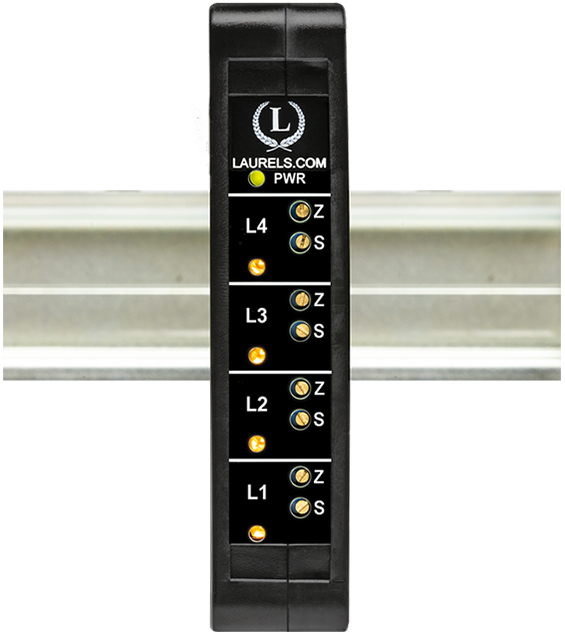
QLS-1 Quad Current Loop Splitter / Retransmitter
Drives four (4) independent 4-20 mA,
1-5V, 0-5V or 0-10V output signal
proportional to input.
85-264 Vac/90-300 Vdc
QLS-1 Quad Current Loop Splitter / Retransmitter
Drives four (4) independent 4-20 mA,
1-5V, 0-5V or 0-10V output signal
proportional to input.
85-264 Vac/90-300 Vdc
QLS-2 Quad Current Loop Splitter / Retransmitter
Drives four (4) independent 4-20 mA,
1-5V, 0-5V or 0-10V output signal
proportional to input.
10-48 Vdc/12-32 Vac
The Laureate QLS Quad Current Loop Splitter / Retransmitter takes a single 4-20 mA, 1-5V, 0-5V, or 0-10V input and drives four fully independent, isolated 4-20 mA output loops — solving the reliability and grounding problems inherent in wiring multiple devices in series on one loop. Each output loop has its own current generator, its own zero/span calibration, and its own LED and test-point diagnostics, so a fault on one loop never affects the others. The QLS is available in two power variants covering the full range of panel power found in industrial facilities: the QLS-1 for standard AC-powered panels, and the QLS-2 for low-voltage DC and battery-backed systems. Both share identical signal performance, isolation, and diagnostics, differing only in how they're powered, so the right choice comes down to what's already available at the panel.
The two models are identical in signal performance — four independent, isolated 4-20 mA outputs from a single 4-20 mA, 1-5V, 0-5V, or 0-10V input. The only difference is power input. The QLS-1 runs on 85-264 Vac or 90-300 Vdc, for standard AC-powered industrial panels. The QLS-2 runs on 10-48 Vdc or 12-32 Vac, for 24 Vdc panels, battery-backed systems, and solar or remote installations.
Check the power available at the panel where the splitter will be installed. If it's 120 Vac, 240 Vac, or a high-voltage DC bus, order the QLS-1. If it's a 24 Vdc control bus, a battery system, or low-voltage AC, order the QLS-2. Both ship in the same case and mount the same way, so switching between them later only involves repowering the unit, not rewiring the signal side.
Yes. Since both models have identical signal behavior, isolation, and diagnostics, they can be mixed freely across a facility — for example, a QLS-1 fed from AC panel power at one location and a QLS-2 fed from a 24 Vdc UPS at another, both splitting signals for the same monitoring system.
Series wiring means every device shares one current path: if a connection opens, a device fails, or a wiring fault occurs anywhere in the loop, every device downstream loses signal at the same time, and devices must float electrically rather than share a ground. Both QLS models solve this by driving each of the four outputs from its own independent current generator, so a fault on one loop never affects the others.
No, though they can be. Both models allow remote output grounds to differ from local signal ground by up to ±10V through active common mode compensation, which accommodates the ground potential differences typically seen between field devices and control panels in larger facilities.
Yes. Both the QLS-1 and QLS-2 include a 24 Vdc excitation output rated up to 30 mA, which can power a 2- or 3-wire field transmitter directly — removing the need for a separate loop power supply regardless of which model you choose.
