
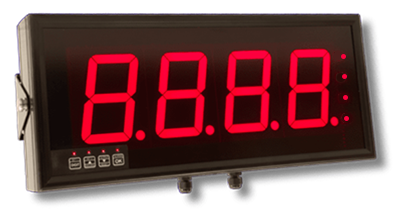
Features
- 4 inch (102 mm) digit height
- 4 digits with period or color dividers
- Choice of normal or outside viewing brightness
- Choice of signal inputs and functions
- Choice of panel mount, wall mount or suspension mount
- Choice of 95-264 Vac or 11-30 Vdc power
- Sealed to NEMA-4 (IP65)
- Only 3.0" (75 mm) deep
- Programmable from front panel
- Optional two or four 2A relay outputs, analog output, serial I/O
The Magna Series Large Digit Display with a 4-inch (102 mm) 4-digit configuration is a rugged industrial display engineered for clear data visualization. Featuring solid-segment LEDs for indoor use or optional 5 mm LEDs for outdoor brightness, it supports inputs including RS232/RS485, 4-20 mA, 0-10V, and pulse (0-100 kHz), with a 24V excitation output, 10-point linearization, and digital filtering (0-25s). It includes two or four 2A relays and an analog output, operating on 95-264 Vac or 11-30 Vdc, with an IP65 (NEMA-4X) seal and a temperature range of -40°C to 70°C, plus a heater option. Ideal for production monitoring and process control, it offers customizable LED colors and flexible mounting options.
Viewing distances up to 320 ft (100 m) are achieved with 8" digits. A rule of thumb is that viewing distance in feet is 40 times digit height in inches, or in metric terms, that viewing distance in meters is digit height in millimeters divided by 2.
Four digit heights are available as standard: 57 mm (2-1/4"), 102 mm (4.0"), 150 mm (5.9"), and 200 mm (7.9"). Solid segments are used for normal brightness 2.2" and 4.0" digits. Individual 5 mm LED pixels are used for larger digits and outdoor brightness versions. The number of digits can be 4, 6 or 8, depending on the display function.
Indoor or outdoor viewing: MAGNA Series Displays with normal brightness LEDs can be read over a machine or across a plant floor. Displays with outdoor brightness LEDs can be read across an industrial yard, parking lot or roadway, for example to display vehicle load. A heater option allows outdoor operation in winter in cold climates. Available mounting options are panel mount, wall mount and suspension mount. Environmental sealing to IP65 (NEMA-4X) is standard.
Choice of signal inputs: MAGNA Series Displays are available for different signal types, with can each be associated with 4 or 6 digits. Please click on the links below for detailed information by signal type:
- Serial data from PCs, PLCs, serial output transmitters, and smart sensors.
- Process input (e.g., 4-20 mA)
- Strain gauge / load cell input
- Temperature input, Pt100 RTD or thermocouple
- Pulse input for frequency or rate
- Pulse input for total or quadrature position
- Pulse input for operation as a clock or timer
Options available include two or four 2A relays, an analog output, an RS232 or RS485 serial data, and 95-264 Vac or 11-30 Vdc power.
Intuitive setup is normally provided by means of built-in front panel switches, which can be locked. It is also possible to remotely wire four pushbuttons to the display.
MAGNA Series Serial Input Large Digit Displays
Standard Large Digital Displays are available here. Prices are in US dollars and do not include shipping or duty charges (export sales).
Questions about your order? Please email our support@laurels.com
MAGNA units are built to order. MAGNA orders are non-cancelable and non-returnable.
Customized large digit displays are available by special quotation:
- LED colors green, blue, white, yellow (not limited to red).
- Digit heights of 12", 16", 24" or 32" (not just4", 6" or 8").
- 2 or 4 solid state relays (not just mechanical relays).
- Stainless steel housing (for food processing and pharmaceutical industries).
- Explosion-proof stainless steel housing rated for ATEX Zones 2 and 22 (equivalent to Class1 / Div 2).
- Custom signs with different colors, with fixed captions, and with multiple numeric display windows.


| Serial Data Input | |
|---|---|
| Serial Data Types | RS232 or RS485 (specify at time of order) |
| Serial Connector | Detachable plug-in screw terminals |
| Displayed Information | ASCII: Displays any character within 7-segment display limitations. Quant: Displays only numeric ASCII values. |
| Qa.Tot: Quantity totalizer. Can be used to accumulate weight values, for example after each batch. Uses a contact closure to trigger addition. | |
| Baud Rate | 300 to 115200 baud |
| Data Format | 701, 7e1, 7n2, 801, 8e1, 8n1, 8n2 |
| Termination Character | Hex 00 to FF |
| Reject Characters | Counted from termination character |
| Addressing | 00 (wildcard) to F7 |
| Process Signal Input | |
| A/D Converter | 20-bit resolution |
| Current Signal Types | 0-10 mA, 0-20 mA, 4-20 mA with 33Ω input resistance |
| Voltage Signal Types | 0-5V, 1-5V, 0-10V with 1 MΩ input resistance |
| Accuracy | ± 0.05% of range. |
| Tempco, Scale | ± 25 ppm/°C |
| Tempco, Offset | ± 30 ppm/°C |
| Excitation | 24 Vdc up to 40 mA, or ratiometric 0-10V for slide-wire |
| Strain Gauge / Load Cell Input | |
| A/D Converter | 20-bit resolution |
| Signal Gain | Suitable for 0.5 mV / V to 4 mV / V load cells |
| Accuracy | ± 0.05% of range. |
| Tempco, Scale | ± 25 ppm/°C |
| Tempco, Offset | ± 30 ppm/°C |
| Excitation Output | Isolated 10V up to 120 mA to power up to four 350Ω load cells in parallel |
| Pulse Input for Frequency, Rate, Total | |
| Number of Inputs | 4 |
| Signal Types | Configurable for contact closures, NPN or PNP proximity switches, 5V logic pulses, 24V pulses, quadrature |
| Debounce | Programmable to eliminate false counting from contact bounce. |
| Timing Reference | Temperature-controlled quartz crystal. |
| Pulse Input for Clock Operation | |
| Time Reference | Precision, temperature-compensated quartz crystal. |
| Clock Format | HH:MM or HH:MM:SS |
| Display | |
| Number of Digits | 4 or 6 |
| Digit Height | 57 mm (2-1/4"), 102 mm (4.0"), 150 mm (5.9"), or 200 mm (7.9") |
| Digit Color | Red |
| Brightness | Variable |
| Brightness | 8.8.8.8. or 8.8.8.8.8.8. (standard) |
| Clock Format | HH:MM or HH:MM:SS (optional, specify at time of order) |
| User Controls | |
| Scaling | Digital direct or theoretical scaling with scale & offset. |
| Filtering | Digital filtering, time constants adjustable from 0 to 25 sec. |
| Rounding | Selectable last-digit rounding of 1, 2, 5, 10, 20, 50 units. |
| Linearization | Up to 10 points, direct or theoretical calibration. |
| Logic Inputs | |
| Font Panel Controls | Calibration, Tare, Reset, Max/Min, Alarms |
| Logic Functions | Three logic inputs, individually configurable for Hold, Reset, Tare, Peak / Valley, Net/Gross, Memory Address. |
| Logic Levels | Normally open, NPN or contact closure input to activate. 5V open circuit, 1 mA switched current. |
| Power | |
| AC Power (standard) | 100-240 Vac |
| DC Power (option) | 11-30 Vdc |
| Max Consumption | 30 VA |
| Analog Output Option | |
| Output Levels | 0-20/4-20 mA into 0 to 500Ω, 0.4 μA resolution. 0-10V into loads > 600Ω, 0.2 mV resolution. -10 to +10V into loads > 600Ω, 0.4 mV resolution. |
| Resolution | 16 bits |
| Accuracy | 0.1% of range |
| Stability | 50 ppm/°Cl |
| Output Isolation | Isolated from input and power |
| Scaling | Digitally scalable |
| Special Features | Can be set to operate from net or gross value. |
| Alarm Output Option | |
| Relay Type | Two or four relays rated 2A, 250VAC, SPDT |
| Special Features | Adjustable hysteresis |
| In-flight compensation facility. | |
| Energize or de-energize on trip. | |
| Adjustable timers to set energize and de-energize delays. Can also be set to pulse for applications needing less than 100% duty cycle. | |
| In-band and out-of-band alarm function. | |
| Manual and automatic in-flight compensation. | |
| Can be set to operate from net or gross value. | |
| Serial Data Output Option | |
| Output Types | RS232 or RS485, addressable, on demand or continuous output. |
| Special Features | Can include time and date with RTC option fitted. Can be set to operate from net or gross value. |
| Environmental | |
| Storage Temp. | -20°C to +70°C |
| Operating Temp. | 0°C to 50°C, non-condensing. -25°C to 50°C, non-condensing, with MHTR AC heater option. |
| Sealing | IP65 (NEMA-4) standard, all-round |
| Connections | M12 compression glands for round cable, diameter 3.0 to 6.5 mm (0.118" to 0.256") |
| Mounting | Wall mount, suspension mount, panel mount |
| Approvals | |
| Types | Produced to IPC 610 Class 2 Standard |
| UL ISO9001:2008 QA | |
| Serial Data Input | |
|---|---|
| Serial Data Types | RS232 or RS485 (specify at time of order) |
| Serial Connector | Detachable plug-in screw terminals |
| Displayed Information | ASCII: Displays any character within 7-segment display limitations. Quant: Displays only numeric ASCII values. |
| Qa.Tot: Quantity totalizer. Can be used to accumulate weight values, for example after each batch. Uses a contact closure to trigger addition. | |
| Baud Rate | 300 to 115200 baud |
| Data Format | 701, 7e1, 7n2, 801, 8e1, 8n1, 8n2 |
| Termination Character | Hex 00 to FF |
| Reject Characters | Counted from termination character |
| Addressing | 00 (wildcard) to F7 |
| Process Signal Input | |
| A/D Converter | 20-bit resolution |
| Current Signal Types | 0-10 mA, 0-20 mA, 4-20 mA with 33Ω input resistance |
| Voltage Signal Types | 0-5V, 1-5V, 0-10V with 1 MΩ input resistance |
| Accuracy | ± 0.05% of range. |
| Tempco, Scale | ± 25 ppm/°C |
| Tempco, Offset | ± 30 ppm/°C |
| Excitation | 24 Vdc up to 40 mA, or ratiometric 0-10V for slide-wire |
| Strain Gauge / Load Cell Input | |
| A/D Converter | 20-bit resolution |
| Signal Gain | Suitable for 0.5 mV / V to 4 mV / V load cells |
| Accuracy | ± 0.05% of range. |
| Tempco, Scale | ± 25 ppm/°C |
| Tempco, Offset | ± 30 ppm/°C |
| Excitation Output | Isolated 10V up to 120 mA to power up to four 350Ω load cells in parallel |
| Pulse Input for Frequency, Rate, Total | |
| Number of Inputs | 4 |
| Signal Types | Configurable for contact closures, NPN or PNP proximity switches, 5V logic pulses, 24V pulses, quadrature |
| Debounce | Programmable to eliminate false counting from contact bounce. |
| Timing Reference | Temperature-controlled quartz crystal. |
| Pulse Input for Clock Operation | |
| Time Reference | Precision, temperature-compensated quartz crystal. |
| Clock Format | HH:MM or HH:MM:SS |
| Display | |
| Number of Digits | 4 or 6 |
| Digit Height | 57 mm (2-1/4"), 102 mm (4.0"), 150 mm (5.9"), or 200 mm (7.9") |
| Digit Color | Red |
| Brightness | Variable |
| Brightness | 8.8.8.8. or 8.8.8.8.8.8. (standard) |
| Clock Format | HH:MM or HH:MM:SS (optional, specify at time of order) |
| User Controls | |
| Scaling | Digital direct or theoretical scaling with scale & offset. |
| Filtering | Digital filtering, time constants adjustable from 0 to 25 sec. |
| Rounding | Selectable last-digit rounding of 1, 2, 5, 10, 20, 50 units. |
| Linearization | Up to 10 points, direct or theoretical calibration. |
| Logic Inputs | |
| Font Panel Controls | Calibration, Tare, Reset, Max/Min, Alarms |
| Logic Functions | Three logic inputs, individually configurable for Hold, Reset, Tare, Peak / Valley, Net/Gross, Memory Address. |
| Logic Levels | Normally open, NPN or contact closure input to activate. 5V open circuit, 1 mA switched current. |
| Power | |
| AC Power (standard) | 100-240 Vac |
| DC Power (option) | 11-30 Vdc |
| Max Consumption | 30 VA |
| Analog Output Option | |
| Output Levels | 0-20/4-20 mA into 0 to 500Ω, 0.4 μA resolution. 0-10V into loads > 600Ω, 0.2 mV resolution. -10 to +10V into loads > 600Ω, 0.4 mV resolution. |
| Resolution | 16 bits |
| Accuracy | 0.1% of range |
| Stability | 50 ppm/°Cl |
| Output Isolation | Isolated from input and power |
| Scaling | Digitally scalable |
| Special Features | Can be set to operate from net or gross value. |
| Alarm Output Option | |
| Relay Type | Two or four relays rated 2A, 250VAC, SPDT |
| Special Features | Adjustable hysteresis |
| In-flight compensation facility. | |
| Energize or de-energize on trip. | |
| Adjustable timers to set energize and de-energize delays. Can also be set to pulse for applications needing less than 100% duty cycle. | |
| In-band and out-of-band alarm function. | |
| Manual and automatic in-flight compensation. | |
| Can be set to operate from net or gross value. | |
| Serial Data Output Option | |
| Output Types | RS232 or RS485, addressable, on demand or continuous output. |
| Special Features | Can include time and date with RTC option fitted. Can be set to operate from net or gross value. |
| Environmental | |
| Storage Temp. | -20°C to +70°C |
| Operating Temp. | 0°C to 50°C, non-condensing. -25°C to 50°C, non-condensing, with MHTR AC heater option. |
| Sealing | IP65 (NEMA-4) standard, all-round |
| Connections | M12 compression glands for round cable, diameter 3.0 to 6.5 mm (0.118" to 0.256") |
| Mounting | Wall mount, suspension mount, panel mount |
| Meter modifiying options (not shippable separately from meter) | |
| MRDLV | Daylight viewing brightness for operation down to 0°C (32°F) instead of normal indoor brightness. |
| MHTR | Heater for outdoor operation down to -25°C (-13°F). |
| MPS2 | 11-30 Vdc power instead of normal 85-265 Vac power. |
| UM | Extra case width for 2 blank digits. |
| Use UM for units of measure like ºC. Required with M24 for relay, analog output or serial output options. Added at no charge with MHTR for M24 or M44. | |
| Approvals | |
| Types | Produced to IPC 610 Class 2 Standard |
| UL ISO9001:2008 QA | |
Number of Digits & Case Dimensions

| Serial Data Input | 4 Digits | 6 Digits |
|---|---|---|
| Serial Data Input |  |
 |
| Process, Strain Gauge, Rate / Frequency, Totalizer, Quadrature |
|
|
| Clock / Timer |  |
 |
| Digit Height | Case Width x Height | Case Width x Height |
| 57 mm (2.2") | 280 x 155 mm (11.0" x 6.1") | 376 x 155 mm (14.8" x 6.1") |
| 102 mm (4.0") | 434 x 196 mm (16.7" x 7.7") | 616 x 196 mm (24.3" x 7.7") |
| 150 mm (5.9") | 580 x 247 mm (22.8" x 9.8") | 820 x 247 mm (32.3" x 9.8") |
| 200 mm (7.9") | 750 x 290 mm (29.5" x 11.4") | 1072 x 290 mm (42.2" x 11.4") |
| Case depth | 75 mm (3.0") | |
Number of Digits & Case Dimensions
| Serial Data Input | 4 Digits | 6 Digits |
|---|---|---|
| Serial Data Input | |
|
| Process, Strain Gauge, Rate / Frequency, Totalizer, Quadrature |
|
|
| Clock / Timer | |
|
| Digit Height | Case Width x Height | Case Width x Height |
| 57 mm (2.2") | 280 x 155 mm (11.0" x 6.1") | 376 x 155 mm (14.8" x 6.1") |
| 102 mm (4.0") | 434 x 196 mm (16.7" x 7.7") | 616 x 196 mm (24.3" x 7.7") |
| 150 mm (5.9") | 580 x 247 mm (22.8" x 9.8") | 820 x 247 mm (32.3" x 9.8") |
| 200 mm (7.9") | 750 x 290 mm (29.5" x 11.4") | 1072 x 290 mm (42.2" x 11.4") |
| Case depth | 75 mm (3.0") | |
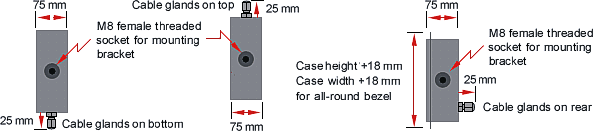
| Note: | Models with 57 mm (2.2") digits, 4 digits and 4 relays require the larger 6-digit case. For panel mount versions, add 18 mm (0.7") to case width and height for bezel and 25 mm (1.0") for cable gland in back of case. |
MAGNA Large Digit Display Product Bulletin
- Product Bulletin: 4 pages, 0.1 MB
MAGNA Large Digit Display Manuals
- MAGNA Process Signal (4-20 mA, 0-10V) Input Manual: 45 pages, 0.5 MB
- MAGNA Clock-Timer Manual: 31 pages, 0.4 MB
- MAGNA Strain Gauge & Load Cell Input Manual: 45 pages, 0.5 MB
- MAGNA RS232 & RS485 Data Serial Data Input Manual: 36 pages, 0.4 MB
- MAGNA Totalizer & Rate Meter Manual: 47 pages, 0.5 MB
- MAGNA Thermocouple & RTD Input Manual: 45 pages, 0.5 MB
- MAGNA Alarm Options Manual: 32 pages, 0.25 MB
- MAGNA Analog Output Options Manual: 12 pages, 0.1 MB
- MAGNA Serial Output Options Manual: 18 pages, 0.2 MB
What Is a MAGNA Series Large Digit Display, 4 Inches (102 mm), 4 Digit Display?
The Magna Series Large Digit Display, measuring 4 inches (102 mm) and featuring a 4-digit display, is a rugged industrial display built for precision, clarity, and versatility. Its taller digit height over the 2-1/4" model steps up the viewing distance considerably, making it a fit for larger plant floors, yards, and control rooms where operators need to read a value from further away.
Key Features of the Magna Series Large Digit Display
1. Generous Digit Height: One of the standout features of the Magna Series display is its 4-inch (102 mm) digit height. This ensures that the information is easily readable from a distance, making it ideal for environments where visibility is crucial, such as manufacturing floors or control rooms.
2. 4 Digits with Period or Color Dividers: This model includes four digits, which can be accompanied by period or color dividers, enhancing the clarity and separation of data points to suit various informational needs and aesthetic preferences.
3. Adjustable Brightness: The Magna Series display caters to different viewing conditions with its choice of normal or outside viewing brightness. Whether it's for indoor use or exposed to sunlight, you can select the appropriate brightness level to ensure optimal readability.
4. Versatile Signal Inputs and Functions: Adaptability is key in many industrial applications. This display provides a choice of signal inputs and functions, allowing for customized integration into diverse systems and processes.
5. Mounting Flexibility: Installation is made easy with options for panel mount, wall mount, or suspension mount. This flexibility ensures that the display can be positioned in the most effective location for visibility and accessibility.
6. Power Options: With a choice of 95-264 Vac or 11-30 Vdc power, the Magna Series display is versatile in its power requirements. This ensures compatibility with a wide range of power sources and makes it suitable for global use.
7. Durable and Compact Design: Built to withstand challenging environments, the Magna Series display is sealed to NEMA-4 (IP65) standards, offering protection against dust and water. Additionally, its compact depth of only 3.0 inches (75 mm) makes it a space-efficient choice for installations where depth is a concern.
8. Front Panel Programmability: Ease of use is a priority with the Magna Series display, featuring programmable settings accessible directly from the front panel. This simplifies setup and adjustments, reducing the need for complex configurations.
9. Optional Outputs: For added functionality, the Magna Series display offers optional features such as two or four 2A relay outputs, analog output, and serial I/O. These options provide additional ways to interact with and utilize the display's information, making it a versatile tool for various applications.
Viewing Distances and Application Suitability
The 4-inch (102 mm) digit height allows for clear viewing up to approximately 160 feet (49 meters), using the rule of thumb that viewing distance in feet is 40 times the digit height in inches. For applications requiring longer viewing distances, Magna Series displays are available with larger digit heights, with 8" digits achieving viewing distances of up to 320 feet (100 meters). For shorter-range indoor applications, the 2-1/4" (57 mm) model is a more compact option.
Where Is a Magna Series Large Digit Display, 4 Inches (102 mm), 4 Digits Used?
The Magna Series Large Digit Display, measuring 4 inches (102 mm) in height with a 4-digit configuration, is a versatile tool in industrial settings. Its prominent size and clear readability make it ideal for various applications where visibility and precision are critical. Here's a closer look at some common uses for this display:
1. Industrial Control Panels
In industrial environments, control panels often require large, easily readable displays for monitoring processes. The Magna Series display provides operators with clear and immediate readings of important metrics such as temperature, pressure, and flow rates. Its large digits ensure that information is visible from a distance, reducing the need for operators to be in close proximity to the panel.
2. Manufacturing Process Monitoring
In manufacturing plants, real-time monitoring of process variables is crucial for maintaining product quality and safety. The Magna Series display can be used to show data such as machine speeds, production counts, or batch numbers. Its high visibility helps operators and supervisors quickly assess production status and make informed decisions.
3. Warehouse and Logistics Management
Accurate inventory management and logistics operations often rely on clear and immediate data display. The Magna Series display can be employed in warehouse management systems to show inventory levels, shipment statuses, or order numbers. The large digits ensure that critical information is easily visible, helping to streamline operations and reduce errors.
4. Safety and Alarm Systems
Safety systems in industrial settings often include alarms and indicators to alert personnel to potential issues. The Magna Series display can be integrated into these systems to provide clear visual alerts or status updates. For instance, it can display alarm codes or status indicators, ensuring that important alerts are noticed promptly.
5. Calibration and Testing Equipment
During the calibration and testing of industrial equipment, precise readings are essential. The Magna Series display can be used to show calibration values, test results, or diagnostic information. Its large, clear digits facilitate accurate and efficient data recording and analysis.
6. Data Acquisition Systems
For data acquisition systems that collect and display real-time data from various sensors, the Magna Series display provides a straightforward way to present this information. Its robust design ensures reliable performance in demanding industrial environments.
Conclusion
The Magna Series Large Digit Display (4 inches, 4 digits) is a highly effective tool in industrial applications where visibility and clarity are paramount. Its ability to provide large, easily readable data from up to 160 feet away makes it an essential component in control panels, process monitoring, safety systems, and more. By integrating this display into your industrial setup, you enhance operational efficiency and ensure that critical information is always accessible and easy to interpret.
Frequently Asked Questions About This Model
Where does this 4-inch model fit between the 2-1/4" and 6" options in the lineup?
It's the middle tier by both viewing distance and price — roughly 160 feet versus 90 feet for the 2-1/4" model and roughly 240 feet for the 6" model — making it the practical choice when a display needs to be read from across a mid-size room or work area rather than up close or from across an entire plant.
Is this model a good fit for a calibration or test bench where precision matters more than distance?
Yes — large, clear digits reduce misreading risk when recording calibration values or test results, and the 4-inch height is often chosen for bench or station-level use less for its viewing range and more for reducing transcription errors during testing.
Can this display be used as a standalone safety alarm indicator, or does it need a separate alarm system?
It can integrate directly into a safety system using its optional relay outputs and alarm hysteresis settings to show alert codes or status updates, so it functions as an active part of the alarm chain rather than only as a passive readout.
Is this model suitable for aggregating data from multiple sensors in an automation setup?
Yes — with serial or process signal input configured, it can serve as the visual interface for a data acquisition system feeding from various sensors and instruments, though each unit displays one value at a time rather than multiple sensor feeds simultaneously.
How much more does this 4-inch model cost compared to the 2-1/4" version at the same digit count?
The 4-inch, 4-digit configuration is priced higher than the 2-1/4", 4-digit configuration; the price difference reflects the larger case, larger LED elements, and the roughly 70-foot gain in viewing distance, which is worth weighing against whether that extra range is actually needed.
Does this model's larger case size limit where it can be installed compared to the 2-1/4" version?
Yes — the 4-inch, 4-digit case (434 x 196 mm) is noticeably larger than the 2-1/4", 4-digit case (280 x 155 mm), so panel or wall space needs to be confirmed against this larger footprint before choosing this model over the smaller one.
Can this display show batch numbers or production counts that change frequently throughout a shift?
Yes — it's commonly used exactly this way on production lines to show cycle times, batch numbers, or running counts, with the front panel or connected system able to update the reading in real time as the underlying process signal changes.
Is a 6-inch model worth the extra cost if my viewing distance is closer to 160 feet than 240 feet?
Generally no — since this 4-inch model already covers approximately 160 feet, stepping up to the 6-inch model (and its larger case and higher price) only makes sense once the actual distance requirement meaningfully exceeds what the 4-inch model provides.
Does this model support inventory or shipment quantity display for warehouse use?
Yes — it's used in warehouse and logistics settings to show inventory levels, shipment statuses, or order numbers, with the 4-inch digit height suited to being read from a moderate distance across a warehouse floor or loading area.
If I need this display to show diagnostic codes for equipment monitoring, does it need special configuration?
The signal input and display function need to be configured to match the diagnostic codes' actual data format (numeric, ASCII, or a specific protocol), so confirming the source system's output format against the display's configured input type during setup is the standard step, not something that works automatically out of the box.
Questions From the Field
We're upgrading from a 2-1/4" unit to this 4-inch model and the old panel cutout doesn't fit — what should we check?
The 4-inch, 4-digit case (434 x 196 mm) is substantially larger than the 2-1/4", 4-digit case (280 x 155 mm) it's replacing, so confirming the new cutout dimensions against the case dimension table before cutting or modifying the panel is the standard first step.
Our calibration technicians recorded a value that doesn't match what a second observer read off the display — what should we check?
Confirming the digit rounding setting (selectable at 1, 2, 5, 10, 20, or 50 units) matches what the calibration procedure expects, and checking that both observers were reading during the same conversion cycle rather than mid-update, are the standard first checks for this kind of reading discrepancy.
Our safety alarm relay is triggering intermittently on a borderline reading — what should we check?
Reviewing the alarm's hysteresis setting is the standard first step, since a threshold set too tight relative to normal signal noise will cause a relay to chatter on and off around a marginal reading rather than latching cleanly.
We connected this display to our data acquisition system and it's only showing one sensor's value — is that expected?
Yes — a single MAGNA display shows one configured signal input at a time; showing multiple sensor feeds requires either multiple displays or a system that multiplexes/cycles the signal being sent to this unit, since the display itself doesn't natively switch between sources.
Our production count display resets unexpectedly partway through a shift — what should we check?
Checking the logic input configuration for Reset is the standard first step, since one of the three configurable logic inputs may be wired to a reset function that's being triggered unintentionally by a signal on the line rather than by an operator.
We're deciding between keeping our 2-1/4" units or upgrading to this 4-inch model for a yard application — how do we decide?
Measuring the actual distance from the display's mounting point to where personnel need to read it, then comparing that against the 2-1/4" model's roughly 90-foot range and this 4-inch model's roughly 160-foot range, is the standard way to confirm whether the upgrade is actually necessary before paying for the larger case and higher price.
Our warehouse display shows the wrong inventory count compared to our WMS system — what should we check?
Confirming the scaling parameters (direct or theoretical scale and offset) configured on the display match what the source system is actually sending is the standard first check, since a mismatch here will show a wrong value even though the underlying data feed is correct.
