
Features
- Digital panel meters are optimized for weighing applications
- Accuracy of 0.01% of reading ± 2 counts
- Display toggle between gross or net weight
- 4- or 6-wire hookup to avoid lead resistance effects
- 10 Vdc excitation to power four 350-ohm load cells in parallel (isolated)
- Count by 1, 2, 5, 10, 20, 50 or 100 with rounding
- 5-digit resolution with scaling from 0 to 99,999
- Auto-tare or manual tare, with tare value stored in non-volatile memory
- All input ranges are user selectable and factory calibrated
- Up to 60 conversions per second, Ideal for peak or valley capture
- Digital span adjust from 0 to ±99,999, zero adjust from -99,999 to +99,999
- Front panel scalable to ±99,999 for use with current shunts
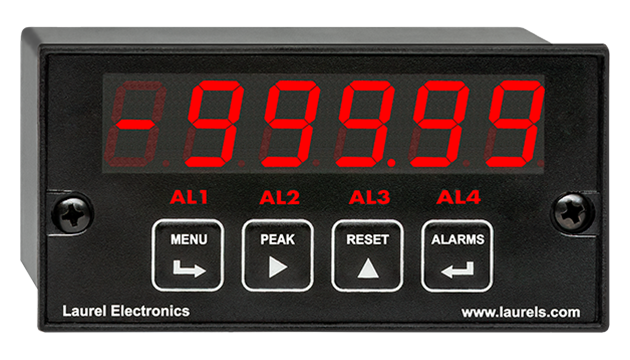
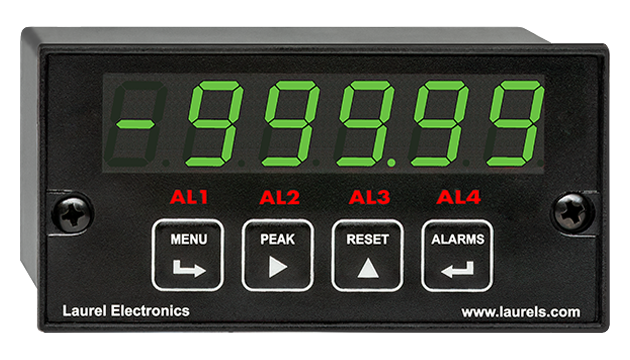
- 1/8 DIN size with bright red or green 0.56" (14.2mm), high LED digits
- Transducer excitation output, 5, 10, 12, or 24 Vdc (isolated)
- Power 85-264 Vac / 90-300 Vdc or 10-48 Vdc / 12-32 Vac (isolated)
- Operating temperature from -40°C to 85°C (-40°F to 158°F)
- Wide choice of Plug-in-Play options:
- 2 or 4 relays, mechanical or solid state, for alarm or control (isolated)
- 1 or 2 Analog output, 4-20 mA, 0-20 mA, 0-10V, or -10V to +10V (isolated)
- Communications: Ethernet, WiFi, USB, RS232, RS485 (isolated)
Certificates of Compliance
The Laureate™ 1/8 DIN Digital Panel Meters for scale weighing applications
is compact, inexpensive, and extremely accurate digital panel meters with special firmware for weighing applications. It is available with the Laureate load cell or DC signal conditioner board. If you do not need the special weighing firmware, consider using the Laureate load cell meter or Laureate process meter.The DC signal conditioner board can used in lieu of the load cell signal conditioner board, be set to ratiometric operation, and be used with the meter's 5 Vdc or 10 Vdc excitation. It's most sensitive full-scale range is ±200 mV with 10 µV resolution, while the load cell signal conditioner board offers most sensitive ranges of ±20 mV and ±50 mV, both with 1 µV resolution. Meters with both boards offer an accuracy of 0.01% of full scale ± 2 counts.
All signal conditioner board ranges are factory-calibrated, with calibration factors for each range securely stored in an onboard EEPROM. These factors can be scaled via software to accommodate external shunts, enabling field replacement of signal conditioner boards without necessitating recalibration of the associated digital panel meters. For optimal accuracy, factory recalibration is recommended annually. All Laurel Electronics instruments undergo factory calibration using the industry-leading Fluke calibrators, which are recalibrated yearly and certified traceable to national standards, ensuring the highest level of precision and reliability.
Scaling is from -99,999 to +99,999 (five full digits) with any decimal point to display readings in engineering units, such as PSI. Three scaling methods are user selectable: scale and offset, two-point method, and system-level calibration using actual transducer signals.
Meter accuracy in ratiometric bridge operation is 0.01% of reading ± 2 counts. Custom curve linearization, which is available with the optional Extended main board, can extend the working range of load cells. Custom curve linearization also allows greater accuracy to be achieved with lower cost, less linear load cells.
A built-in isolated excitation supply can provide up to 120 mA of current at 10V to power four 350-ohm load cells in parallel. The meter operates in a ratiometric mode to eliminate errors due to supply variations. When excitation sense inputs are used in 6-wire connection, the meter compensates for variation in resistance of the transducer leads, thereby allowing long cable runs.
Display & Setpoint Functions for Weighing Applications
- Relay setpoint offset. The ON/OFF setpoint control action can be programmed to occur with a specified offset. For instance, if bags are to be filled to 100 lbs and the material delivery spout is known to hold and dispense an additional 2.5 lbs following shut-off, an offset of -2.5 lbs can be programmed. The setpoint can then be set to 100 lbs, and the filling valve will be automatically shut off when the measured weight reaches 97.5 lbs.
- Count-by function. The weight meter can be programmed so that the display is rounded off to multiples of 1, 2, 5, 10, 20, 50 or 100. For example, if count-by 10 is selected, the meter will display 20 for an internal count of 15 to 24.
- Fixed right-hand dummy zero. The display can be shifted to the left for a fixed zero to the right, allowing values up to 999,990 to be displayed. The right-hand zero precludes the use of decimal points.
- Auto-zero function. An auto-zero limit from 0 to 9 counts can be programmed to compensate for load cell drift. Whenever the meter comes to rest within that limit from zero, it will auto-zero. Entering 0 disables auto-zero.
- Two tare functions: auto-tare and manual tare. In auto-tare, an input line is grounded by an external pushbutton. This causes the current weight, which is normally the empty weight of the container to be stored in memory as an offset. In manual tare, the tare value can be entered manually via the front panel or a computer using Laurel's free Instrument Setup Software. For instance, the tare value may be the stated empty weight of a truck or rail car. Pressing the Reset button on the front panel toggles the display between gross weight (total weight on the scale) and net weight (gross weight with tare subtracted).
Laureate Digital Panel Meters are easily programmed with Laurel’s free Instrument Setup Software, downloadable from our website and compatible with Windows PCs, requiring a data interface board for setup.
Easy scale calibration is achieved using a simple two-point calibration method. First, the desired LO IN reading is set to 0, and the desired HI IN reading is set to a desired value. With no weight on the scale, a button is pushed for LO IN. With a known weight on the scale, that button is pushed again for HI IN. The meter then automatically computes scale and offset for readout up to five digits in weight units.
High read rate of up to 50 or 60 conversions per second, the Laureate™ Digital Panel Meters use a Concurrent Slope (US Pat. 5,262,780) analog-to-digital conversion to integrate signals over a full power line cycle (50 Hz or 60 Hz). This read rate enables peak and valley capture, real-time computer interfacing, and control applications. Peak and valley values are automatically captured and can be viewed using Laurel’s free Instrument Setup Software (compatible with Windows PCs) or transmitted as serial data.
Digital signal filtering modes can be selected to ensure stable readings in electrically noisy environments.
- An unfiltered selection provides true peak and valley readings and aids in control applications.
- A batch average filter selection averages each 16 conversions.
- An adaptive moving average filter selection provides a choice of 8 time constants from 80 ms to 9.6 seconds. When a significant change in signal level occurs, the filter adapts by briefly switching to the shortest time to follow the change, then reverts back to its selected time constant. An Auto setting selects the time constant selection based on signal noise.
Scale and offset can be provided by either of two user-selectable methods:
- With the coordinate reading method, the meter reads the high and low signal values, and the user enters the desired high an low reading values. The meter then calculates the span multiplier and offset. This method is ideal if an external calibration reference is available.
- With the manual coordinate method, the user enters the high and low input values in Volts plus the desired high and low reading values. This method is suitable if no external calibration reference is available.
Peak and valley values are automatically captured. These may be displayed via a front panel pushbutton command or control signal at the rear connector, or be transmitted as serial data.
Two rear panel control Inputs (CMOS/TTL levels, logic 0 = tied to digital ground, logic 1 = open) or dry contacts that can be set to control / activate 14 meter commands.
An (isolated) 5, 10, 12, or 24 Vdc excitation output is standard to power transducers or two-wire transmitters. Ratiometric operation, which automatically compensates for changes in the applied excitation, is jumper selectable for applications, such as bridges, where the signal to be measured is proportional to the excitation level.
Modular Design for Maximum Flexibility at Minimum Cost
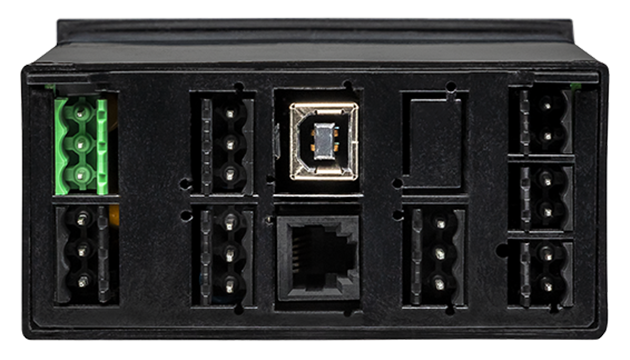
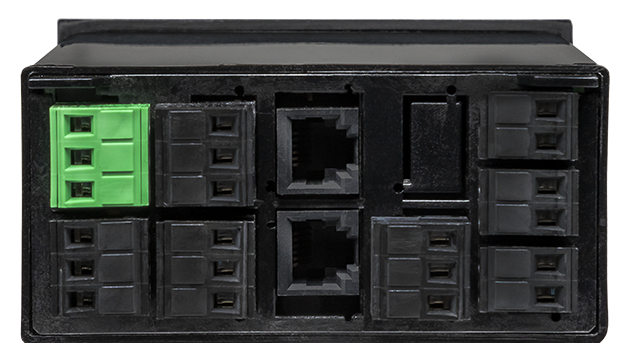
All boards are isolated from meter and power grounds. Optional Plug-in-Play boards for communications and control include Ethernet, WiFi, serial communication boards, dual or quad relay boards, and an analog output board. Laureates may be powered from 85-264 Vac or optionally from 12-32 Vac or 10-48 Vdc. The display is available with bright red or green 0.56" (14.2mm) high LED digits. The 1/8 DIN case meets NEMA 4X (IP65) specifications from the front when panel mounted. Any setup functions and front panel keys can be locked out for simplified usage and security. A built-in 5, 10, 12, or 24 Vdc excitation supply can power transducers, eliminating the need for an external power supply. All power and signal connections are via UL / VDE / CSA rated screw clamp plugs.
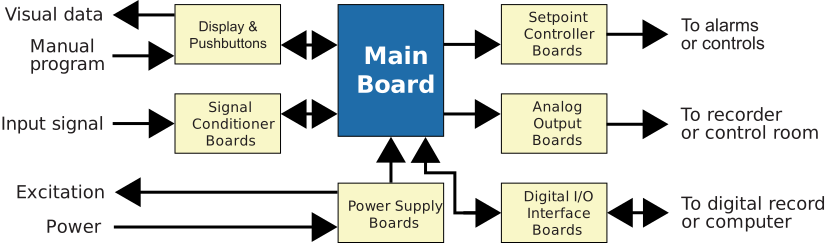
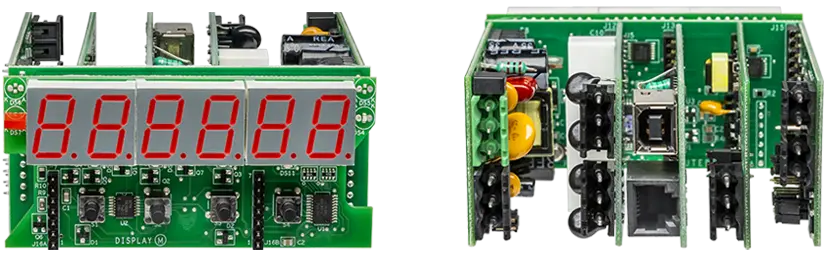
The Laureate™ Series features modular design with up to 7 isolated plug-in boards, applicable to all Laureate 1/8 DIN Digital Panel Meters.
Modular Hardware
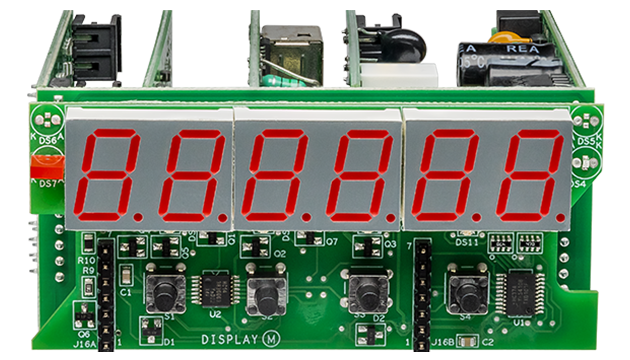
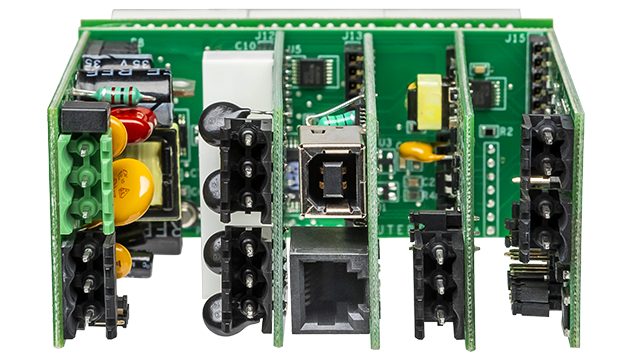
The design of the Laureate™ Series is modular for maximum flexibility at minimum cost. All boards are isolated from meter and power grounds. The base configuration for a panel meter or counter consists of a main module (with computer and plug-in display boards), a power supply board, and a signal conditioner board. Optional plug-in-play boards include an isolated setpoint controller board, an isolated analog output board, and an isolated digital interface board. Modular design and a choice of plug-in options allow the Laureate to be customized for a broad range of applications from simple monitoring to control and computer interface. There can be up to five plug-in boards in a 1/8 DIN Laureate.
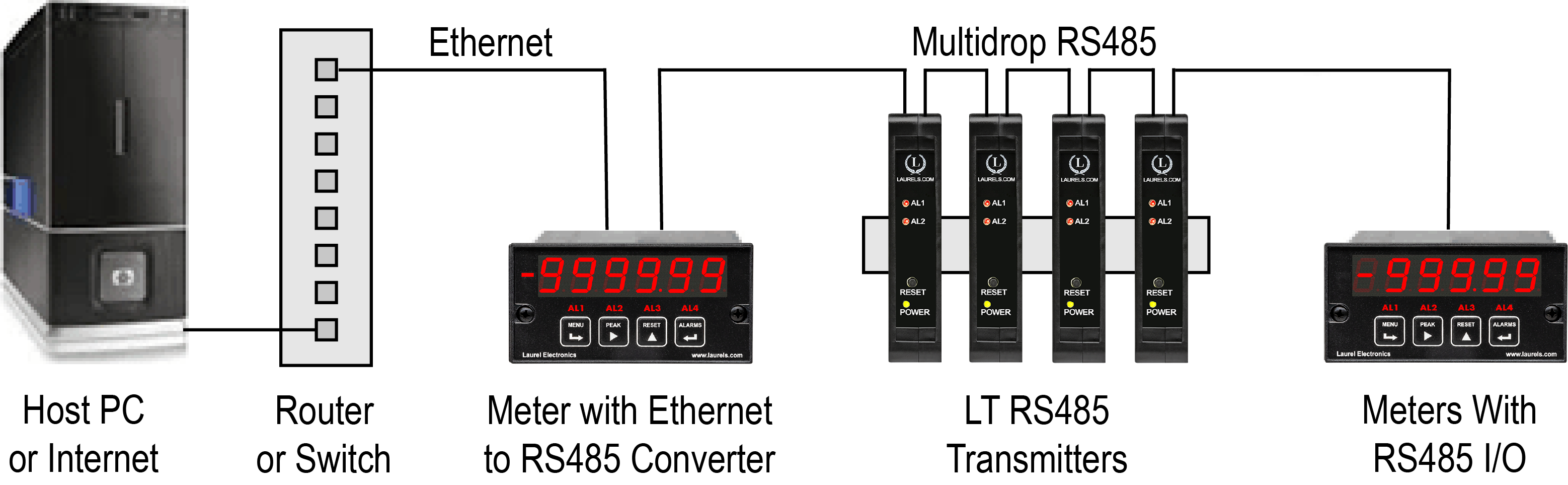
Connecting Laureate Digital Panel Meters to a Local Area Network (LAN)
Up to 30 Laureate Digital Panel Meters and/or LT Transmitters can be configured for RS485 and daisy-chained to an LT Transmitter using Laurel’s High Speed Ethernet-to-RS485 converter board for seamless LAN integration. Alternatively, Laurel LTE series Ethernet transmitters can connect directly to a LAN via an Ethernet cable. Setup for both configurations is streamlined using Laurel’s free Instrument Setup Software, which simplifies node discovery and transmitter configuration.
Flexible Communication Options for Digital Panel Meters
Laureate Digital Panel Meters can be equipped with Laurel communication boards to support various interfaces and protocols. These include serial interfaces with ASCII or Modbus RTU protocols, and Ethernet interfaces with web access, ASCII, or Modbus TCP/IP protocols, ensuring versatile connectivity for your commercial applications.
DC Signal Conditioner
| Full-Scale Input | Input Impedance | Zero Adjust | Span Adjust | Error at 25°C |
|---|---|---|---|---|
| ± 200.00 mV | 1 GΩ | |||
| ± 2.0000 V | 1 GΩ | -99,999 | 0 to | 0.01% FS |
| ± 20.000 V | 10 MΩ | to +99,999 | ±99,999 | ± 2 counts |
| ± 20.000 mA | 10 Ω | |||
| Recalibration: All ranges are calibrated at the factory. Recalibration is recommended every 12 months. | ||||
| Display | |
|---|---|
| Readout | 5 LED digits, 7-segment, 14.2 mm (.56"), red or green |
| Range | -99999 to +99999 |
| -999990 to +999990 (with fixed selectable right-hand zero) | |
| Rounding | Count by 1, 2, 5, 10, 20, 50, 100 |
| Indicators | Four LED lamps |
| Accuracy | |
| Error at 25°C | 0.01% FS ± 2 counts |
| Span tempco | 0.0015% of reading/°C |
| Zero tempco | 0.1 µV/°C (use auto-zero when temperature changes) |
| Calibration Method | 2 points using zero weight and known weight |
| Noise Rejection | |
| CMR, DC to 60 Hz | 130 dB |
| NMR at 50/60 Hz | 90 dB with min filtering |
| A-to-D Conversion | |
| Technique | Concurrent Slope (Pat 5,262,780) |
| A-to-D rate | 60/s at 60 Hz, 50/s at 50 Hz |
| Output update | 56/s at 60 Hz, 47/s at 50 Hz |
| Display update | 3.5/s at 60 Hz, 3/s at 50 Hz |
| Power Supply Boards (one required) | |
| Voltage, standard | 85-264 Vac or 90-300 Vdc |
| Voltage, optional | 12-32 Vac or 10-48 Vdc |
| Frequency | DC or 47-63 Hz |
| Power consumption (typ. with four 350Ω load cells at 10V) | 2.4W @ 120 Vac, 2.7W @ 240 Vac, 2.5W @ 10 Vdc, 2.6W @ 20 Vdc, 2.75W @ 30 Vdc, 3.0W @ 40 Vdc, 3.35W @ 48 Vdc |
| Power Isolation | 250V rms working, 2.3 kV rms per 1 min test |
| Excitation Output (standard) | |
| 5 Vdc | 5 Vdc ± 5%, 100 mA (jumper selectable) |
| 10 Vdc | 10 Vdc ± 5%, 120 mA (jumper selectable) |
| 12 Vdc | 12 Vdc ± 5%, 100 mA (jumper selectable) |
| 24 Vdc | 24 Vdc ± 5%, 50 mA (jumper selectable) |
| Output Isolation | 50 Vdc from signal ground |
| Ratiometric operation | Automatically compensates for changes in excitation level. |
| Analog Output Board (one optional) | |
| Output levels | 4-20 mA, 0-20 mA, 0-10V |
| Current compliance | 2 mA at 10V ( > 5 kΩ load) |
| Voltage compliance | 12V at 20 mA (< 600 Ω load) |
| Scaling | Zero and full scale adjustable from -99999 to +99999 |
| Resolution | 16 bits (0.0015% of full scale) |
| Isolation | 250V rms working, 2.3 kV rms per 1 min test |
| Relay Output Boards (one optional) | |
| Dual magnetic relays | 2 Form C, 10A max, 440Vac or 125Vdc max, 2500VA or 300W |
| Quad magnetic relays | 4 Form A (NO), 10A max, 440Vac or 125Vdc max, 2500VA or 300W |
| Dual solid state relays | 2 Form A (NO), AC or DC, 0V - 400V, 120Ma, 35Ohms (max at On-State) |
| Quad solid state relays | 4 Form A (NO), AC or DC, 0V - 400V, 120Ma, 35Ohms (max at On-State) |
| Relay commons | Isolated commons for dual relays or each pair of quad relays |
| Relay isolation | 250V rms working, 2.3 kV rms per 1 minute test |
| Relay latching modes | Latching or non-latching |
| Relay active modes | Active on or off, active high or low |
| Hysteresis modes | QA passband mode, split hysteresis, span hysteresis |
| Communication Boards (one optional) | |
| Board selections | RS232, RS485 with dual RJ11 connectors, RS485 with dual RJ45 connectors, USB, USB-to-RS485 gateway, WiFi with built-in antenna plus USB & RS485, WiFi with external antenna plus USB & RS485 |
| Protocols | Modbus RTU, Modbus ASCII, Modbus TCP (Ethernet), Laurel ASCII |
| Digital addresses | 247 (Modbus), 31 (Laurel ASCII), |
| Isolation | 250V rms working, 2.3 kV rms per 1 min test |
| Environmental | |
| Operating temperature | -40°C to 70°C (-40°F to 158°F) |
| Storage temperature. | -40°C to 85°C (-40°F to 185°F) |
| Relative humidity | 95% at 40°C, non-condensing |
| Protection | NEMA-4X (IP-65) when panel mounted |
| Mechanical | |
| Enclosure | 1/8 DIN, high impact plastic, UL 94V-0, color: black |
| Mounting | 1/8 DIN panel cutout required: 3.622" x 1.772" (92 mm x 45 mm). |
| Dimensions | 4.68" x 2.45" x 5.64" (119 mm x 62 mm x 143 mm) (W x H x D) |
| Maximum panel thickness | 4.5 mm (0.18") |
| Tightening Torque - Connectors | Screw terminal connectors: 5 lb-in (0.56 Nm) |
| Tightening Torque - Pawls | Digital Panel Meter Case Pawls: 5 lb-in (0.56 Nm) |
| Weight of base meter | 210 g (7.4 oz) typical (DPM, counter, timer, 6-digit remote display) |
| Weight of option boards | 30 g (1.0 oz) typical per board (analog output, relay output, communications) |
| General | |
| Programming Methods | Four front panel buttons or via Laurel's free Instrument Setup Software, which runs on a PC under MS Windows. |
| Security | Lockout options include using the front panel buttons, the free Instrument Setup Software, or a hardware jumper. |
| Warranty | 3 years parts & labor |
| Recalibration: All ranges are calibrated at the factory. Recalibration is recommended every 12 months. | |
Free Instrument Setup Software for Series 2 Laureates
|
|
| 1/8 DIN Digital Panel Meters | DIN Rail Transmitters |
Free Downloadable Windows-based Instrument Setup (IS) software (Data Interface Board Required) for use with our programmable Digital Panel Meters, Scale Meters, Counters, Timers, Remote Displays, and Transmitters, are an easy method to set up Laureate 1/8 DIN digital panel meters, counters, timers, remote displays, and DIN-rail transmitters, as explained in the Instrument Setup Software Manual. Laureate 1/8 DIN instruments can also be set up from the front panel, as explained in their respective Owners Manuals. Instrument Setup software is of benefit whether or not the PC is connected to the instrument.
- When the PC is connected to the instrument, Instrument Setup software can retrieve the setup file from the instrument or open a default setup file or previously saved setup file from disk View Setup, then provides graphical user interface (GUI) screens with pull-down menus applicable to input, display, scaling, filtering, alarms, communications, analog output, and front panel lockouts. Fields that are not applicable to the instrument as configured are either left out or grayed out. Clicking on any item will bring up a detailed Help screen for that item. After editing, the setup file can be downloaded, uploaded to the instrument, or saved to a disk. The same setup file can then be downloaded into multiple instruments.
- When the PC is not connected to the instrument, the above GUI screens can be used to set up a virtual instrument. The setup file can then be saved to disk. Switching toView Menu then brings up a screen with the required front panel programming steps. This view can be printed out for use at the instrument site and to serve as a hard copy record.
Download Free Instrument Setup Software
Installation
Set User Account Control (UAC) of MS Windows to "Never notifiy me" so that Instrument Setup Software can create directories. The UAC change screen can be reached as follows:
- Under Windows 7, click on the Windows Start button in the lower left of the desktop and enter "UAC" in the search field.
- Under Windows 8, navigate to Control Panel, then to the "User Accounts and Family Safety" section, and click on "Change User Account Control Settings."
- Under Windows 10, click on the Windows Start button in the lower left of the desktop, then on "Settings", and enter "UAC" in the search field.
- Reboot your computer for the changed UAC setting to take effect.
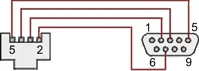
RJ11-to-DB9 cable with rear view of DB9 connector to PC
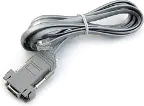
RS232 cable, meter to PC, P/N CBL01
Laureate 1/8 DIN Laureate instruments must be equipped with a serial communications board and be connected to the computer via a serial communications cable. The connection can be via RS232, RS485, USB or Ethernet. Following setup, the serial communications board may be removed from the instrument if desired. The wiring of the RS232 cable is illustrated above with end views of the two connectors.
Laureate LT Series transmitters come standard with a 3-wire serial interface, which can be jumpered for RS232 or RS485.
Laureate LTE Series transmitters come standard with an Ethernet interface.
Meter Setup Screens
Click on any of the reduced screens below for a full-size screen view, then click on the Back button of your browser to return to this page. The screens examples below are for a fully-loaded Series 2 Digital Panel Meter (DPM), which is connected to the PC via RS232. If the meter is a Series 1 meter (pre-2007), this is sensed by the software, and somewhat different screens are brought up. Please see Series 1 setup screens.

Welcome Screen
From the computer desktop, click on Start > Programs > IS2 > IS2. Or click on the IS icon on your desktop. This splash screen will be displayed for three seconds. The software revision number is in the lower right.


Communications Selection Screen
Specify your desired communication protocol and the serial communications bus type, which should match the jumper setup of the instrument. Select None if the PC is not connected to the instrument.

Establish Communications Screen
If you selected RS-232, you will be asked to specify the PC Com Port and Baud Rate, which should match the jumper setup of the instrument. Click on Establish. With the right settings, the Communications Established field will light up in green, and the Meter Type will be recognized. If so, click onMain Menu.

Main Menu Screen
Click on File > Default Setup to retrieve the default setup file from disk for your type of meter. Click on File > Open Setupto retrieve a previously saved setup file from disk or on File > Save Setup to save your edited setup file to disk. Click onDPM > Get Setup to retrieve the setup file from your meter or on DPM > Put Setup to download your edited setup file into the meter.

DPM Input + Display Setup Screen
From the Main Menu, click on View > Setup, then on theInput+Display tab. You can now specify the meter hardware, signal type, display mode, and functions of control inputs A and B. Clicking on any item brings up a pull-down menu with the available choices.

DPM Scaling Setup Screen
Click on the Scaling tab, which provides three scaling methods to relate the signal to the displayed reading: 1) Scale and Offset method, 2) Coordinates of two points method, and 3) Reading Coordinates of Two Points method. The last method uses actual high and low signals, and the computer will prompt you.

DPM Filter Setup Screen
Click on the Filter tab, which allows you to specify the digital filter time constant (if any), the adaptive filter threshold, and whether Peak / Valley values are filtered or unfiltered. As for all setup screens, clicking on the F1 key while an item is highlighted brings up a Help screen for that item, as illustrated.

DPM Relay Alarms Setup Screen
Click on the Relay Alarms tab, which allows you to set up Alarms 1 and 2 for the optional dual relay output board. Clicking on any of the four numeric fields changes these to green and brings up a special field to enter the desired numeric value, which is tied to the displayed reading.

DPM Communications Setup Screen
Click on the Communications tab so set up serial communications. In particular, you can special the Serial Protocol and the meter address if multiple meters are to be addressed on the same serial data line.

DPM Analog Output Setup Screen
Click on the Analog Out tab so set up the optional analog output board. Three output ranges are selectable, the endpoints of which can be tied to user-specified High and Low readings.

DPM Lockouts Setup Screen
Click on the Lockouts tab to check off menu items which will no longer be accessible from the front panel of the meter. This will simplify meter operation and prevent unintended setup changes.
Meter Setup Utilities

DPM Front Panel Setup Screen
As an aid to programming the meter from the front panel when a serial connection is not available, you can return to the Main Menu and click on View > Menu. The required sequence of front panel screens will then be displayed. Click on any step in the sequence for the meaning of each digit, as illustrated for the FILtEr step. For a hardcopy, simply press on Print.

DPM Jumper Setup Screen
Specify your desired communication protocol and the serial communications bus type, which should match the jumper setup of the instrument. Select None if the PC is not connected to the instrument.

DPM Jumper Setup Screens
Click on any of the displayed plug-in boards, and you will be presented with the jumper positions and electrical connections for your selected board. This minimizes the need to refer to the printed manual.

DPM Commands Screen
This page allows you set up external input, serial communications, an analog output proportional to the display (optional), and lockouts for Laureate digital counters. The grayed out area at the top right of the screen applies to Laureate remote displays.


Graphical Output Screens (not available with Ethernet)
From the Main Menu, click on Readings if your PC is connected to the meter. A pull-down menu then offers three choices: List, Plot and Graph.
- List presents the latest readings in a 20-row by 10-column table. Press Pause at any time to freeze the display. This is one method to capture peak readings.
- Plot generates a plot of readings vs. time in seconds. It effectively turns the DPM-PC combination into a printing digital oscilloscope.
- Graph generates a histogram where the horizontal axis is the reading and the vertical axis is the number of occurrences of readings. The display continually resizes itself as the number of readings increases.

DPM Calibration Screens
Click on the Scaling tab, which provides three scalClick on the Scaling tab, which provides three scaling methods to relate the signal to the displayed reading: 1) Scale and Offset method, 2) Coordinates of two points method, and 3) Reading Coordinates of Two Points method. The last method uses actual high and low signals, and the computer will prompt you.

Frequency Meter Calibration Screen
Calibration of the quartz crystal of the Laureate frequency meter requires the input of a known frequency from a calibrator. Apply the frequency, then enter the frequency in Hertz. Calibration will be automatic, with storage of the calibration factor stored in non-volatile memory.
Laureate™ 1/8 DIN Case For Laureate Digital Panel Meters, Counters, Timers & Remote Displays
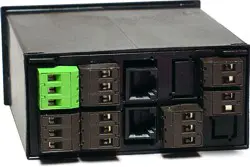
Key Features
- Meets 1/8 DIN Standard.
- Installs from front of panel.
- Short depth behind the panel: only 4" (102 mm) plus connectors.
- Understated 0.157" (4 mm) thick bezel.
- Meets NEMA 4X (IP-65) for high-pressure wawshdon when panel mounted.
- Screw clamps connectors meet VDE / IEC / UL / CSA safety standards.
- Rugged GE Lexan® housing material.
- Safety certified per EN 61010-1.


Dimensions
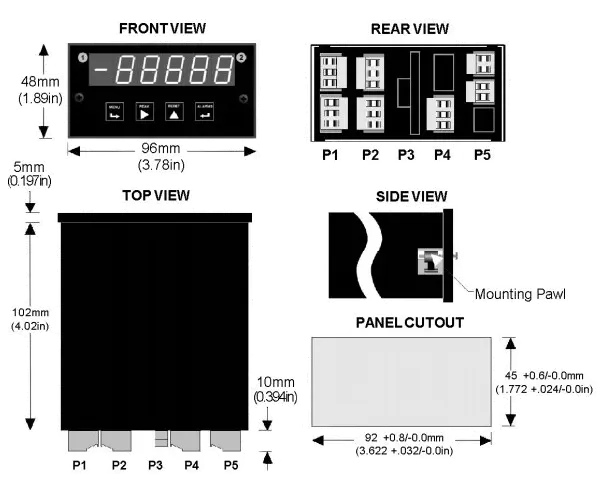
Maximum panel thickness: 4.5 mm (0.18")
Weight of base meter: 210 g (7.4 oz) typical (DPM, counter, timer, 6-digit remote display)
Weight of option boards: 30 g (1.0 oz) typical per board (analog output, relay output, communications)
Tightening Torque - Connectors: Screw terminal connectors: 5 lb-in (0.56 Nm)
Tightening Torque - Pawls: Digital Panel Meter Case Pawls: 5 lb-in (0.56 Nm)
Dimensioned CAD assembly drawings in EPRT, STEP, x_t. dwg, pdf file formats: Laureate-meter-case.zip (zipping prevents browser from opening CAD files as text files).
Panel Mounting
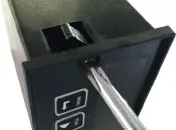 Slide the meter into a 45 x 92 mm 1/8 DIN panel cutout. Ensure that the provided gasket is in place between the front of the panel and the back of the meter bezel.
The meter is secured by two pawls, each held by a screw, as illustrated. Turning each screw counterclockwise extends the pawl outward from the case and behind the panel. Turning each screw clockwise further tightens it against the panel to secure the meter.
Slide the meter into a 45 x 92 mm 1/8 DIN panel cutout. Ensure that the provided gasket is in place between the front of the panel and the back of the meter bezel.
The meter is secured by two pawls, each held by a screw, as illustrated. Turning each screw counterclockwise extends the pawl outward from the case and behind the panel. Turning each screw clockwise further tightens it against the panel to secure the meter.
Turning each screw counterclockwise loosens the pawl and retracts it into its well. This position allows installed meter to be removed from their panel, or new meters to be installed in a panel. Do not remove the screws from their pawls. Doing so would cause the screw and pawl to fall off and likely get lost. Do not overtighten so as not to damage the plastic parts.


Scale Meter Frequently Asked Technical Questions
The load cell meter described on this loadcell page and the scale meter described on this page are similar meters and typically both typically use the same load cell signal conditioner board. Capabilities built into the scale meter’s firmware provide specific features applicable for weighing applications. In most cases, the slightly less expensive load cell meter will also work great for weighing applications. It can be interfaced to the same types of load cells, and it can be scaled to display in units of weight such as pounds, tons or kilograms.
Relay setpoint offset to stop fill operations before a final weight is reached. Count-by function so that the display is rounded off to multiples of 1, 2, 5, 10, 20, 50 or 100. Selectable fixed right-hand dummy zero for a six-digit display to 999990. Auto-zero function to compensate for load cell drift. Auto-tare in additional to manual tare. Please see the explanatory paragraphs on this page.
Yes. A summing box is simply a clean way to connect the meter to the 6 wires of multiple load cells in parallel. Up to four linear load cells of the same type can be connected in parallel and be powered by the same 10 Vdc, 120 mA excitation output of a Laureate scale meter. For example, four load cells can be used to support the four corners of a weighing platform. Each 350 ohm load cell will draw an I=V/R current of 28.6 mA, so that the total current requirement for four load cells is 114.4 mA. For scaling purposes, multiply the weight read by each load cell by the number of load cells, since each only carries part of the load. The best way to scale a system with multiple load cells is to use the "Reading Coordinates of 2 Points" scaling method, which uses actual weights.
Most scale meters use a load cell as the sensor, which provides a 0-20 mV or 0-30 mV output. Meter scaling is the process of converting the load cell output in millivolts to a reading in units of weight. For example, meter scaling would be the setting which allows the scale meter to convert the 0-20.000 mV DC output of a load cell to a 0-5000 pound weight reading.
Simply enter data from the load cell label. For example, the label may state 10V excitation, a load rating of 5000 lbs, and 2.020 mV per volt sensitivity. This means 0 mV should be displayed as 0 lbs, and 20.20 mV should be displayed as 5000. To enter this data into the meter, go to the front panel menu item “SEtuP” and select “Coordinates of 2 points method.” Enter Lo In as 0.000 mV, Hi In as 20.200 mV, Lo Read as 0 lbs, and Hi Read as 5000 lbs. The scale meter will interpolate between these two points to convert the received millivolts to a weight reading in lbs.
The meter’s “Reading coordinates of 2 points method” is most accurate since it scales the meter and load cell as a system by using known reference weights. First zero the scale by not applying any weight and enter zero as the desired reading. Then apply the reference weight and enter its known weight as the reading. Go to the meter’s front panel menu item “SEtuP” and select “Reading coordinates of 2 points method.” The meter will prompt you to measure Lo In and High In, and to enter values for Lo Read and High Read. The scale meter will interpolate between these two points to convert the received millivolts to a weight reading in lbs.
The ordering process for Laureate meters with a WM1 load cell signal conditioner board requires that min input, min reading and max input, max reading be specified at the time of order. This information allows Laurel to set the meter range, which can be ±20.000 mV, ±50.000 mV, ±100.00 mV, ±250.00 mV, or ±500.00 mV. This initial setup can easily be changed by the user by moving jumpers and changing scaling via the meter’s front panel, as explained in the Scale Meter Owner’s Manual.
Laureate meters are modular with slots for a choice of power supply boards, signal conditioner boards, analog output boards, relay boards and communication boards, as illustrated in our Laureates Overview web page. These boards can be ordered installed with a new meter, but they can also be purchased separately later and be simply plugged in. The presence of a new board and the type of board are automatically sensed by the meter’s firmware or by Instrument Setup (IS) software. If you change boards, also change the model number on the meter label.
The Laureate scale meter offers special software feature for weighing and can use either a load cell signal conditioner board (WM1 in the model number) or a process signal conditioner board (P1 or SG1 in the model number). The load cell board is recommended for weighing applications, since it offers a resolution down to 1 microvolt per count, while the process board is limited to 10 microvolts per count. The load cell board can also be set up for a 6-wire connection, while the process board is limited to 4 wires. Both signal conditioner boards can be used with the same types of load cells and can be used to scale millivolt signals for display in units of weight such as lbs or kg.
Annual calibration to NIST standards can be performed by Laurel and by some of its distributors as a service. It can also be performed by the customer using Laurel’s free Windows based Instrument Setup (IS) software. Open the Main Menu of IS software, click on Calibration in the top menu bar, and follow the prompts. An external DC voltage standard is required. Also required in the meter is a communications board, like the Laureate P/N LUSB USB interface board. Following calibration, that board can be removed and be used in another meter.
Analog output scaling is the process of converting the meter reading to an analog output, which can be user selected as 4-20 mA, 0-20 mA, 0-10V or -10 to +10V. Simply enter the load cell meter readings for the bottom and tops of the selected analog output range, and the output will be interpolated linearly between these two readings. Please see Section 17 of the Laureate DPM user manual.
Chances are that your meter is set for the factory default analog output, which is 4-20 mA, and is applying 12V to force a current into an open circuit. To set your meter to a 0-10V or -10 to +10V analog output, set jumpers for unipolar 0-10V or bipolar -10 to +10V operation, select the desired range and scaling, and connect to the correct analog output pins, as explained in the Scale Meter Owner’s Manual.
Application Example: Weighing the Load on a Truck
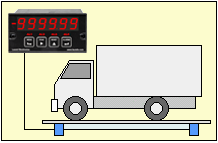
The Laureate weight meter power all four 350 ohm load cells of the scale with its 10 V, 120 mA isolated excitation output. Six-wire connection eliminates the effects of lead resistance and allows long cable runs from the control room to the scale.
The five-digit meter can be scaled to display truck weight up to 99,999 lbs with 1 lb resolution or 999,990 lbs with 10 lb resolution. Accuracy is 0.01% of full scale at 25°C. To avoid the effects of system-level noise, different filter settings as well as "count by" of 1, 2, 5, 10, 20, 50 or 100 with rounding are selectable.
To read out net weight of the load, the truck can first be weighed empty, and this weight can be entered as tare at the push of a button in an auto-tare mode. Or the nominal tare value of the truck can be entered manually. Display of net weight or gross weight is at the push of a button. The gross weight and net weight can be alarmed, be transmitted to a computer via RS232 or RS485, or be transmitted via a 4-20 mA analog signal.
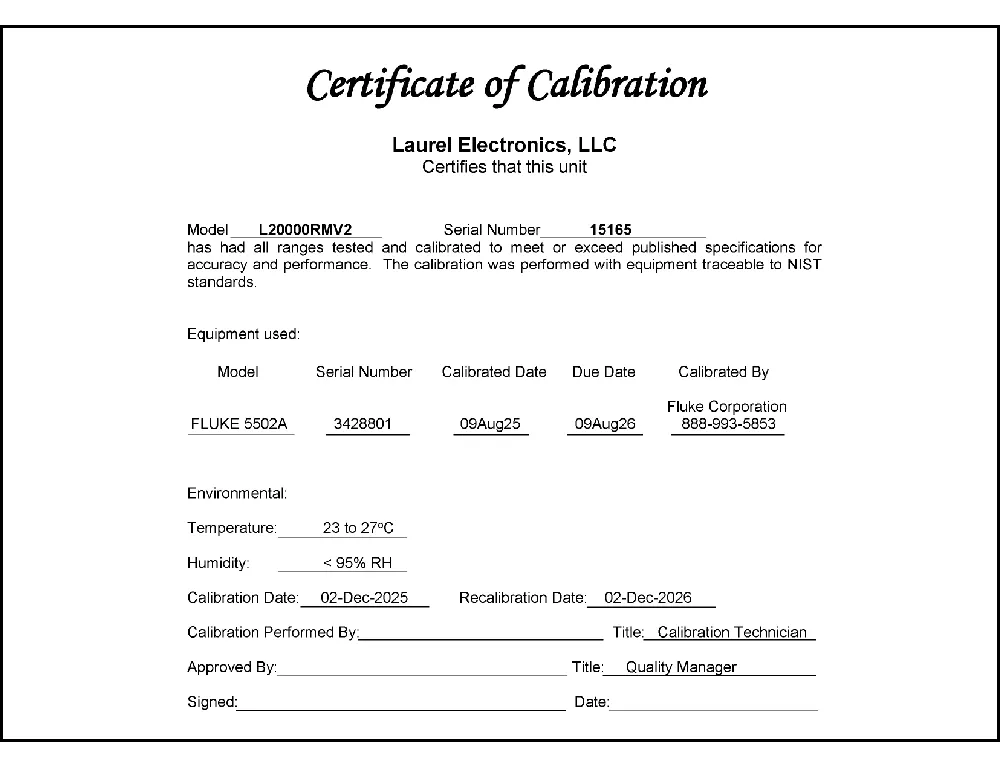
CAL-Analog
Certificate of Calibration
$65.00
DLS-XLOG2
XLog2 Data logging Software
$495.00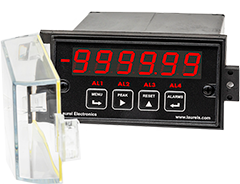
IPC
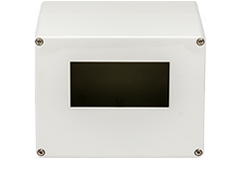
Splashproof Cover
$55.00

CON01
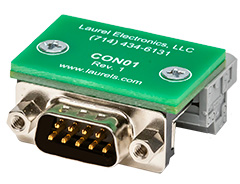
CON01 Connector
$75.00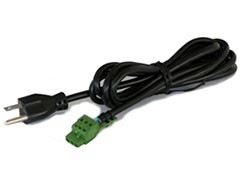
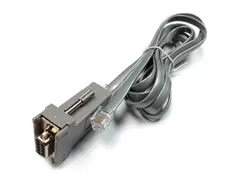
CBL01
RS232 Cable for Meters
$35.00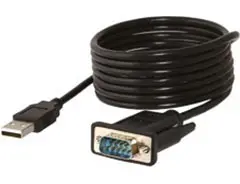
CBL02
USB-to-RS232 Adapter Cable
$47.00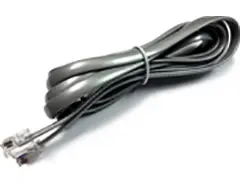
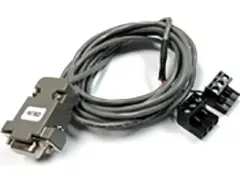
CBL04
RS232 Cable for LT Transmitters
$47.00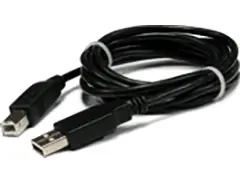
CBL05
USB Data Cable for Meters
$47.00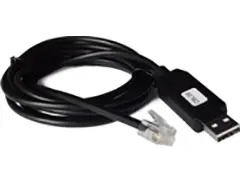
CBL06
USB-to-RS485 Adapter Cable
$47.00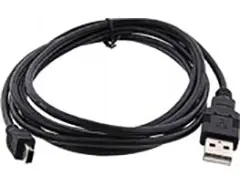
CBL07
USB Programming & Data Cable
$47.00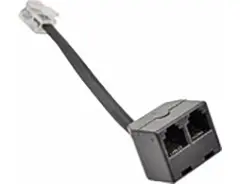
CBL08
RS485 Splitter Cable
$33.00CBL6
6-foot Power Cable
$41.00CBL12
12-foot Power Cable
$47.00What Are 1/8 DIN Digital Panel Meters for Scale and Weighing Applications?
In industrial and commercial settings where precise measurement is crucial, Digital Panel Meters play a vital role. Among the various types of Digital Panel Meters, 1/8 DIN Digital Panel Meters stand out due to their compact size and versatile functionality. This section explores what 1/8 DIN Digital Panel Meters are, their significance in scale and weighing applications, and the features that make them indispensable in these settings.
What Are 1/8 DIN Digital Panel Meters?
1/8 DIN Digital Panel Meters are measurement devices that fit into standard 1/8 DIN cutouts, which typically measure 1.75 inches by 3.62 inches (44.5 mm by 92 mm). The term "DIN" refers to the Deutsches Institut für Normung, a German standards organization, and is used to define the standard sizes for various types of instrumentation, including Digital Panel Meters. The 1/8 DIN size is one of the most common standards used for Digital Panel Meters due to its compact size, allowing these instruments to fit into limited spaces while providing essential measurement capabilities.
Role in Scale and Weighing Applications
In scale and weighing applications, accuracy and reliability are paramount. 1/8 DIN Digital Panel Meters are designed to interface with load cells and other sensors to provide real-time weight measurements. These Digital Panel Meters are often used in various industries, including manufacturing, food processing, logistics, and pharmaceuticals, where precise weight measurements are critical.
Key Functions
- Measurement Display:
The primary function of 1/8 DIN Digital Panel Meters in weighing applications is to display the weight measured by the connected load cell. The display is typically large, bright, and easy to read, even in challenging environments. - Signal Conditioning:
The Digital Panel Meters often include built-in signal conditioning features, such as amplification and filtering, to ensure accurate and stable weight readings. This is particularly important in environments where electrical noise or other interference could affect the measurement. - Tare and Zero Functions:
These Digital Panel Meters usually include tare and zero functions, which are essential in weighing applications. The tare function allows the user to subtract the weight of a container or packaging, while the zero function ensures that the Digital Panel Meters start from a true zero, providing accurate weight measurements. - Data Output:
Many 1/8 DIN Digital Panel Meters come equipped with data output capabilities, such as serial communication (RS-232/RS-485) or analog outputs. This allows the Digital Panel Meters to interface with other systems, such as data loggers, PLCs, or remote displays, enabling further processing or recording of the weight data. - Alarms and Setpoints:
In many weighing applications, there is a need to monitor weight against predefined limits. 1/8 DIN Digital Panel Meters often include programmable alarms and setpoints, which can trigger alerts or control processes when specific weight thresholds are reached.
Advantages of Using 1/8 DIN Digital Panel Meters
- Compact Size:
The 1/8 DIN size makes these Digital Panel Meters easy to integrate into existing control panels, even when space is limited. This compactness does not compromise the functionality, making them a preferred choice in many industrial settings. - Ease of Installation:
Standardized dimensions and mounting procedures simplify the installation process. Most Digital Panel Meters are designed for easy panel mounting, reducing downtime during installation or replacement. - Versatility:
These Digital Panel Meters can be used with various sensors and load cells, making them suitable for a wide range of weighing applications. Whether it's for industrial scales, tank weighing, or conveyor belt systems, 1/8 DIN Digital Panel Meters can handle the task. - Durability:
Built to withstand harsh industrial environments, many 1/8 DIN Digital Panel Meters feature rugged construction with IP-rated enclosures, protecting them from dust, moisture, and other environmental factors.
Where Are 1/8 DIN Digital Panel Meters Used in Scale and Weighing Applications?
Digital Panel Meters are essential in various industrial applications, providing precise and real-time data display. Among these, 1/8 DIN Digital Panel Meters are a popular choice, particularly in scale and weighing applications. 1/8 DIN Digital Panel Meters are compact devices, typically measuring 96 x 48 mm, making them ideal for various settings where space and functionality are key considerations.
- Industrial Weighing Systems
In industrial environments, accurate weight measurement is crucial. 1/8 DIN Digital Panel Meters are commonly integrated into weighing systems used in manufacturing, material handling, and processing industries. These Digital Panel Meters display weight readings from load cells or other weighing sensors, ensuring that operators have precise control over the production process. For example, in a manufacturing plant where raw materials are mixed in specific ratios, 1/8 DIN Digital Panel Meters ensure that each component is weighed accurately, maintaining product quality and consistency. - Laboratory Weighing Equipment
Precision is paramount in laboratory settings, where even the smallest measurement error can compromise the results of experiments and tests. 1/8 DIN Digital Panel Meters are often found in laboratory weighing equipment, providing researchers with accurate and reliable weight data. These Digital Panel Meters can be used in conjunction with analytical balances, moisture analyzers, and other sensitive weighing instruments. In pharmaceutical labs, where precise measurements of chemical compounds are required, the reliability of 1/8 DIN Digital Panel Meters is critical for ensuring the safety and efficacy of the products being developed. - Food and Beverage Industry
In the food and beverage industry, consistency and compliance with regulatory standards are vital. 1/8 DIN Digital Panel Meters are employed in weighing systems used for portion control, packaging, and quality assurance. These Digital Panel Meters help ensure that products are consistently packaged with the correct weight, which is essential for customer satisfaction and regulatory compliance. For instance, in a food processing plant, 1/8 DIN Digital Panel Meters might be used to monitor the weight of ingredients being mixed to produce a final product, ensuring that the recipe is followed accurately every time. - Retail Weighing Scales
Retail environments, such as grocery stores and supermarkets, require accurate and user-friendly weighing scales. 1/8 DIN Digital Panel Meters are often used in these scales to display the weight of products being sold by weight, such as produce, meat, and bulk items. The clear and easy-to-read display provided by these Digital Panel Meters helps ensure that customers are charged accurately for their purchases. These Digital Panel Meters are typically found in point-of-sale systems, integrated into the weighing scales that provide both the customer and the cashier with real-time weight information. - Transportation and Logistics
In the transportation and logistics sector, weight measurement is critical for safety, cost control, and regulatory compliance. 1/8 DIN Digital Panel Meters are used in vehicle weighing systems, such as truck scales, to ensure that vehicles are loaded within safe and legal weight limits. These Digital Panel Meters provide accurate weight readings that are essential for preventing overloading and ensuring that transport operations are both safe and efficient. For example, in a freight terminal, 1/8 DIN Digital Panel Meters might be used to monitor the weight of cargo being loaded onto trucks, ensuring that the total weight does not exceed legal limits and that the load is balanced correctly. - Agriculture and Livestock Weighing
In agriculture, accurate weight measurement is essential for managing livestock, dosing feed, and monitoring crop yields. 1/8 DIN Digital Panel Meters are often used in livestock scales, grain elevators, and other agricultural weighing systems. These Digital Panel Meters provide farmers with the accurate data they need to make informed decisions about feeding, breeding, and harvesting. For instance, in a livestock farm, 1/8 DIN Digital Panel Meters could be used to monitor the weight of animals, helping farmers track growth rates and adjust feeding regimens accordingly.
Conclusion
1/8 DIN Digital Panel Meters are versatile and reliable tools used in a wide range of scale and weighing applications across various industries. Their compact size, precise measurement capabilities, and ease of integration make them an ideal choice for environments where accurate weight data is essential. From industrial manufacturing to retail settings, these Digital Panel Meters play a critical role in ensuring accuracy, safety, and efficiency in weight measurement processes.
Scale & Weighing Digital Panel Meter Frequently Asked Questions
What is the difference between the tare function and the zero function on a weighing meter?
The zero function sets the meter's baseline reading to true zero with the scale empty and unloaded. The tare function subtracts the weight of a container or packaging already on the scale, so the displayed reading shows only the weight of the product added afterward. Both are standard features on Digital Panel Meters configured for weighing, but they serve different purposes and are used at different points in a weighing cycle.
Can these meters trigger an alarm or stop a process at a specific weight?
Yes. Digital Panel Meters for scale and weighing applications commonly include programmable setpoints tied to relay outputs, allowing the meter to trigger an alarm, close a valve, or stop a conveyor once the displayed weight crosses a defined threshold — useful for batching, overfill protection, and checkweighing.
How many load cells can be connected to a single weighing meter?
A single meter input is built for one combined bridge signal. Multiple load cells — for example, four corners of a platform scale — are typically wired into a summing junction box first, which combines their individual signals into one signal the meter reads as total weight, rather than being wired directly in parallel into the meter.
Are these meters suitable for legal-for-trade retail scales?
Some models can be configured and certified for legal-for-trade use, where the scale is used to determine a price based on weight, such as retail produce or meat scales. Legal-for-trade applications require specific certification and, once certified, are usually sealed to prevent recalibration outside of an authorized service call — this is a separate requirement from general industrial or laboratory weighing accuracy.
What causes an unstable or jumping weight reading on the display?
Digital filtering options built into these meters — such as adjustable averaging or adaptive filter time constants — are designed to smooth out an unstable reading caused by vibration, air currents, or electrical noise near the scale. Selecting a longer filter time constant trades a small amount of response speed for a steadier displayed reading.
Can the meter output weight data to a PLC or a printer?
Yes. Many Digital Panel Meters in this category support serial communication such as RS-232 or RS-485, along with an optional analog output, allowing weight data to be sent to a PLC, data logger, printer, or SCADA system rather than only being read locally on the display.
Is auto-tare different from manual tare?
Manual tare requires the operator to press a button to zero out a container's weight each time. Auto-tare, where available, automatically captures and subtracts the container weight based on a triggered event (such as a contact closure) without requiring the operator to press anything, which is useful in repetitive, automated batching or filling operations.
What accuracy can I expect from a scale and weighing Digital Panel Meter?
Accuracy specifications vary by model, but Digital Panel Meters in this category are commonly rated to within a fraction of a percent of full scale, with resolution fine enough to detect small changes in load. The overall system accuracy also depends on the load cell itself, so the meter's rated accuracy should be considered alongside the load cell's own specifications.
Can the display be scaled to show units other than pounds or kilograms?
Yes. These meters are typically user-scalable, so the raw signal from the load cell can be displayed directly in the engineering unit relevant to the application — pounds, kilograms, grams, tons, or a custom process unit — rather than requiring separate conversion by the operator.
What environmental protection is available for weighing meters used in wash-down or dusty areas?
Many models are available with sealed, IP-rated front panels suitable for dusty, humid, or wash-down environments common in food processing and agricultural settings, while the load cells themselves would need a matching environmental rating appropriate to their installation location.
Scale & Weighing Questions From the Field
Why does my scale give different readings depending on where the weight is placed on the platform?
This is commonly diagnosed with a corner load test: placing the same test weight in the center and then in each corner of the platform. A significant difference between corners generally points to a damaged load cell or a warped or improperly shimmed platform mount, rather than a problem with the meter or display electronics.
What does an "UNST" or "unstable" error on the display mean?
This error code indicates the weight reading is fluctuating too much for the meter to settle on a stable value, and is most often traced to drafts, vibration from nearby machinery, or something intermittently touching the platform — not a fault with the meter itself. Field guidance generally recommends checking the physical environment around the scale before assuming there's an electronic problem.
Why won't my scale zero or tare properly?
A common cause reported in the field is that the weight being tared exceeds the meter's tare range — many meters can only tare out up to a certain percentage of their full-scale capacity, often around 25%. If the container or platform weight is too large a fraction of capacity, the meter may refuse to zero or tare until the excess weight is physically removed.
Does a scale need a warm-up period before it gives an accurate reading?
Yes, particularly for high-precision applications — some load cells and meters need roughly 15 to 30 minutes after power-up to thermally stabilize before their readings are fully accurate. Zeroing or calibrating a scale immediately after power-up, before it has stabilized, is a commonly cited cause of readings that drift over the first half hour of use.
Why is my scale or junction box sealed with a tamper sticker, and can I open it myself?
A wire seal or tamper sticker on a junction box or indicator typically indicates the system has been certified for legal-for-trade use — meaning its calibration is regulated because it's used to determine a price based on weight. Breaking that seal generally voids the certification and requires a licensed service technician to reseal and recertify the scale, so it shouldn't be opened for routine troubleshooting.
Can electrical interference from nearby equipment affect my scale's readings?
Yes — running a load cell signal cable alongside power cables for motors, welders, or other heavy equipment is a frequently cited source of erratic readings. Rerouting the signal cable away from those power lines, or switching to shielded cable, is a standard first step recommended before suspecting a hardware fault.
