
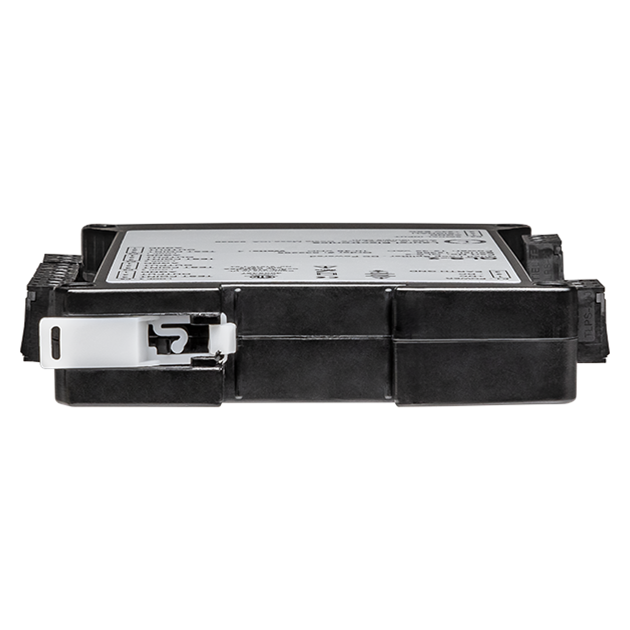
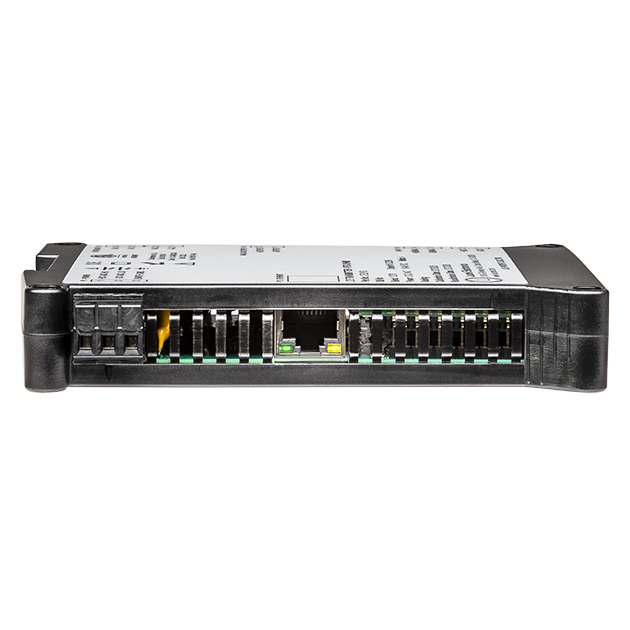
Features
- Reads 100Ω platinum, 10Ω copper & 120Ω nickel RTDs
- Accuracy ±0.01% of reading ±0.04°C (±0.07°F)
- 2, 3 or 4-wire connection with lead resistance compensation
- User selectable input span from entire RTD range down to 15.0°
- Selectable 1°, 0.1°, or 0.01° resolution, °C, °F, K or R
- All input ranges are user selectable and factory calibrated
- Up to 60 conversions per second, Ideal for peak or valley capture
- 4-20 mA, 0-20 mA, 0-10V or -10V to +10V transmitter output, (isolated)
- Analog output resolution 0.0015% of span, accuracy ±0.02% of span
- Ethernet data I/O, Modbus TCP
- Dual 120 mA solid state relays for alarm or control (isolated)
- Power 85-264 Vac / 90-300 Vdc or 10-48 Vdc / 12-32 Vac (isolated)
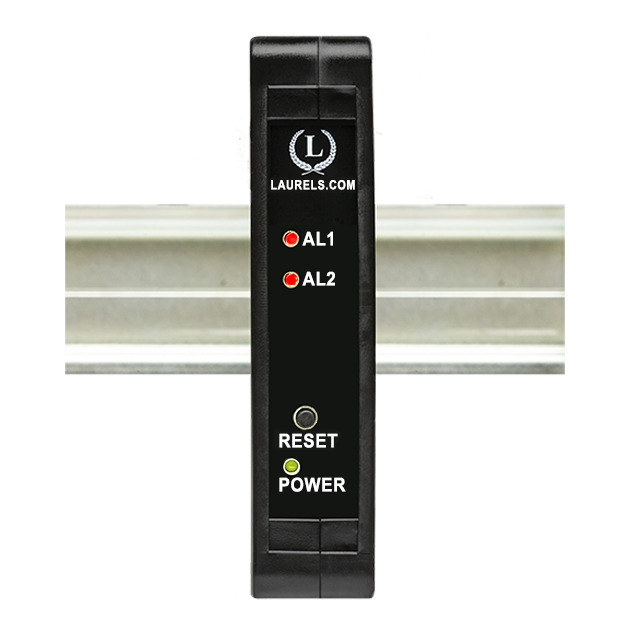
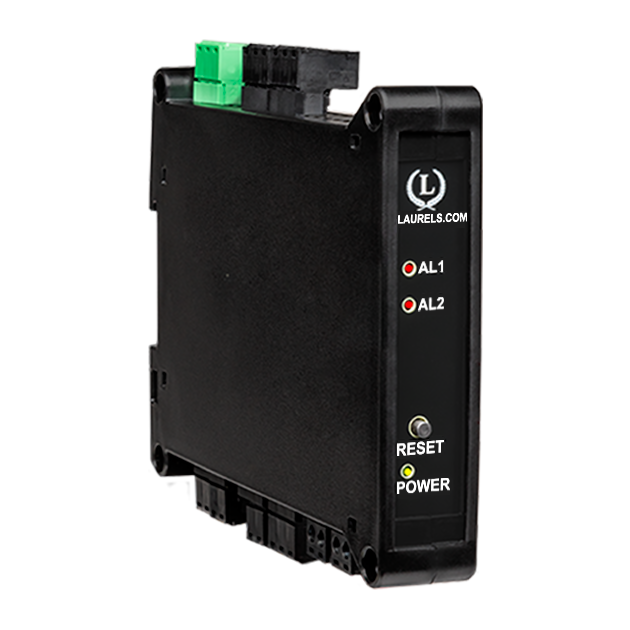
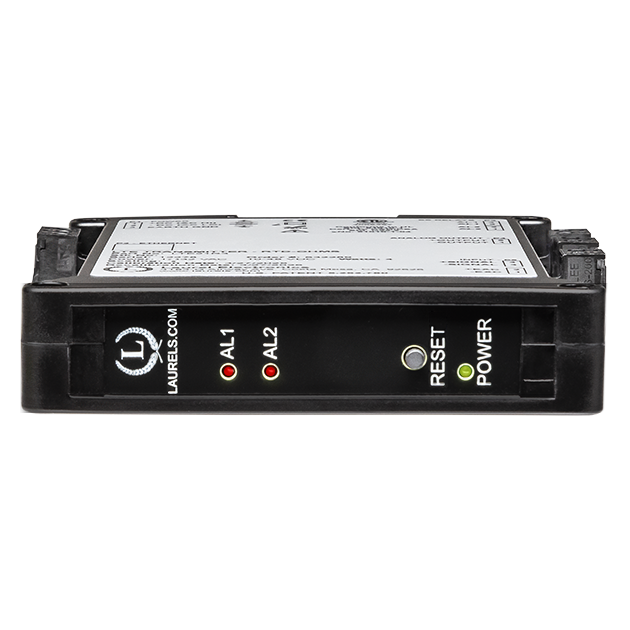
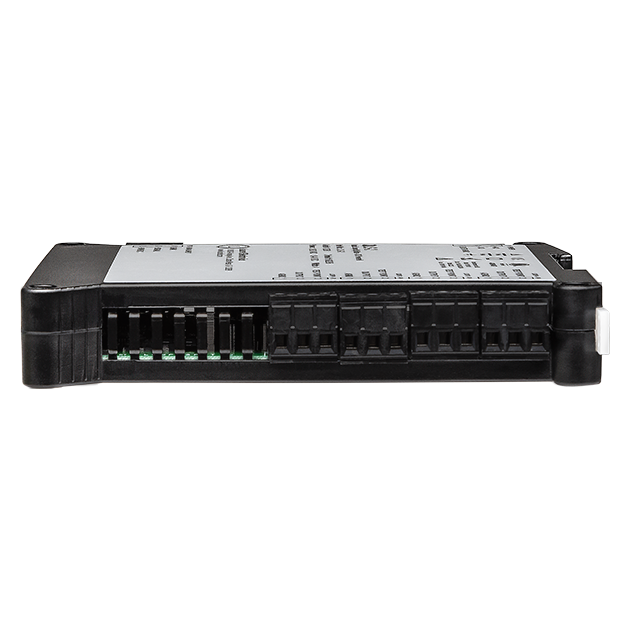
- DIN rail mount housing, 22.5 mm wide, detachable screw-clamp connectors
- Operating temperature from -40°C to 70°C (-40°F to 158°F)
Certificates of Compliance


The Laureate 4-20 mA, 0-20 mA, 0-10V or -10V to +10V and ethernet output transmitter for RTD temperature offers the same high performance, signal conditioning and programmable features as Laureate digital panel meters, counters & timers provides six voltage input ranges and four current input ranges, all factory calibrated and jumper selectable. The temperature transmitter provides a linearized, highly accurate, stable and repeatable transmitter output for 100 ohm platinum, 10 ohm copper and 120 ohm nickel RTDs. Pt100 platinum RTDs can have a DIN alpha of 0.00385 or ANSI alpha of 0.00392. The RTD type and temperature range, specified in °C or °F, are user-selectable. The temperature range can be as wide as the entire span of the RTD type or as narrow as 150 counts (such as 15.0°), limited only by considerations of electrical noise and digital filtering time constants.
RTD connections can be via 2, 3 or 4 wires. With 3 or 4-wire connections, the transmitter automatically compensates for changes in lead resistance to the sensor. With 2-wire connection, the transmitter can measure and then subtract the lead wire resistance.
All RTD types are factory-calibrated, with calibration factors for each range securely stored in an onboard EEPROM. These factors can be scaled via software to accommodate external shunts, enabling field replacement of signal conditioner boards without necessitating recalibration of the associated transmitter. For optimal accuracy, factory recalibration is recommended annually. All Laurel Electronics instruments undergo factory calibration using the industry-leading Fluke calibrators, which are recalibrated yearly and certified traceable to national standards, ensuring the highest level of precision and reliability.
Calibration data is stored in EEPROM on the signal conditioner board. This allows signal conditioner boards and ranges to be changed in the field with no need for recalibration. Typical accuracy for a Pt100 is better than ±0.04°C (±0.07°F) ±0.01% of reading. Open sensor indication is standard and may be set up to indicate either upscale or downscale. RTD excitation is provided by the transmitter. RTD connections can be of the 2-, 3- or 4-wire type. With 3- and 4-wire connections, the transmitter automatically compensates for changes in lead resistance to the sensor. Instrument Setup Software allows user calibration for RTDs whose resistance is different than nominal at 0°C.
Laureate Transmitters are easily programmed with Laurel’s free Instrument Setup Software, downloadable from our website and compatible with Windows PCs, requiring a data interface board for setup.
High read rate of up to 50 or 60 conversions per second, the Laureate™ LTE Series transmitter uses Concurrent Slope (US Pat. 5,262,780) analog-to-digital conversion to integrate signals over a full power line cycle (50 Hz or 60 Hz). This read rate enables peak and valley capture, real-time computer interfacing, and control applications. Peak and valley values are automatically captured and can be viewed using Laurel’s free Instrument Setup Software (compatible with Windows PCs) or transmitted as serial data.
Standard Features of Laureate LTE Transmitters Include:
- Ethernet I/O, (isolated). The supported protocols are Modbus RTU and ASCII, which are tunneled via Modbus TCP. Note that RS232 or RS485 data I/O is provided by Laurel's LT Series transmitters.
- 4-20 mA, 0-20 mA or 0-10V analog transmitter output, (isolated), jumper-selectable and user scalable. All selections provide 16-bit (0.0015 ) resolution of output span and 0.02% output accuracy of a reading from -99,999 to +99,999 counts that is also transmitted digitally. Output isolation from signal and power grounds eliminates potential ground loop problems. The supply can drive 20 mA into a 500 ohm (or lower) load for 10V compliance, or 10V into a 5K ohm (or higher) load for 2 mA compliance.
- Dual solid state relays, (isolated). Available for local alarm or control. Rated 120 mA at 130 Vac or 180 Vdc.
- Selectable transducer excitation output, (isolated), user selectable 5V@100 mA, 10V@120 mA, 12V@100 mA, or 24V@50 mA.
- Power 85-264 Vac, (isolated), low-voltage 10-48 Vdc or 12-32 Vac power is optional.
Digital signal filtering modes can be selected to ensure stable readings in electrically noisy environments.
- An unfiltered selection provides true peak and valley readings and aids in control applications.
- A batch average filter selection averages each 16 conversions.
- Dual solid state relays for control or alarm, (isolated). Rated 120 mA at 140 Vac or 180 Vdc. The relays can respond to digital readings or to received control characters.
- An adaptive moving average filter selection provides a choice of 8 time constants from 80 ms to 9.6 s. When a significant change in signal level occurs, the filter adapts by briefly switching to the shortest time to follow the change, then reverts back to its selected time constant. An auto setting selects the time constant selection based on signal noise.
Two tare functions: auto-tare and manual tare. In auto-tare, an input line is grounded by an external pushbutton. This causes the current weight, which is normally the empty weight of the container to be stored in memory as an offset. In manual tare, the tare value can be entered manually via a control input pushbutton or using Laurel's free Instrument Setup Software.
Peak and valley values are automatically captured. These may be displayed via Laurel's free Instrument Setup Software, which runs on a PC under MS Windows or can be transmitted as serial data.

LTE series DIN rail transmitters & signal conditioners can be interfaced to a wide range of sensors and transducers using one of seven available plug-in signal conditioner boards. The transmitters duplicate the high performance (high accuracy, high read rate) and extensive programmable features of Laureate 1/8 DIN digital panel meters, counters and timers. They utilize the same signal conditioners boards, much of the same firmware, and Laurel's free Windows-based Instrument Setup Software. They come in a compact DIN rail mount package with detachable screw-clamp connectors for easy wiring.
The LTE series Transmitters accessible from this page include a 4-20 mA, 0-20 mA, 0-10V, or -10V to +10V analog output (isolated, user selectable), an ethernet serial data interface (isolated, user selectable), and dual 120 mA solid state AC/DC relays (isolated). An (isolated) 5, 10, 12, or 24 Vdc transducer excitation output is included with all models other than those with a temperature or AC RMS signal conditioner.
Connecting Laureate LTE Transmitters to a Local Area Network (LAN)
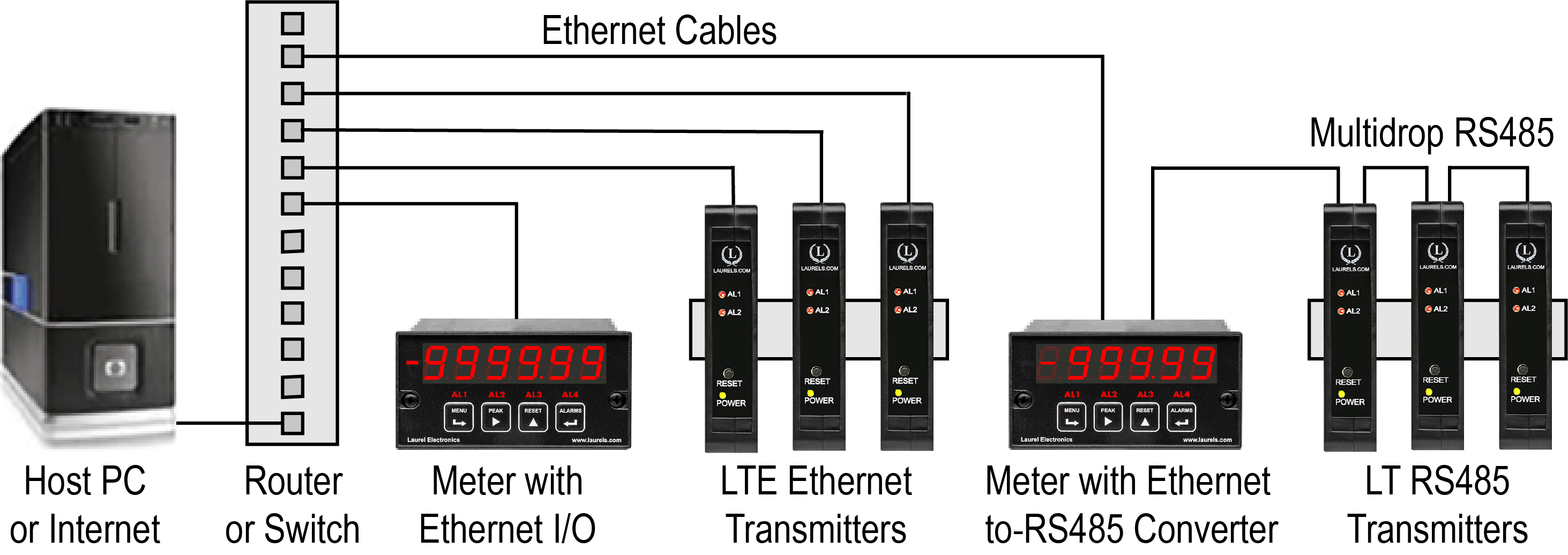
Laurel LTE series Ethernet transmitters can connect directly to a LAN via an Ethernet cable. Up to 30 Laureate LT Transmitters and/or Digital Panel Meters can be configured for RS485 and daisy-chained to an LT Transmitter for seamless LAN integration. Setup for both configurations is streamlined using Laurel’s free Instrument Setup Software, which simplifies node discovery and transmitter configuration.
Flexible Communication Options for LTE Transmitters
Laureate Transmitters can be equipped with Laurel communication boards to support various interfaces and protocols. These include serial interfaces with ASCII or Modbus RTU protocols, and Ethernet interfaces with web access, ASCII, or Modbus TCP/IP protocols, ensuring versatile connectivity for your commercial applications.
| LTE Transmitter Signal Input & Function | Model Series | Analog Output | Ethernet I/O | Dual Relays | |
|---|---|---|---|---|---|
| 1 | DC Input Voltage and Current | LTE-DC |  |
|
|
| 2 | AC RMS Voltage or Current | LTE-RMS | |
|
|
| 3 | Process Voltage or Current | LTE-P | |
|
|
| 4 | Strain Gauge or Potentiometer Follower | LTE-SG | |
|
|
| 5 | Weighing Applications | LTE-WA | |
|
|
| 6 | Load Cell & Microvolt Signals | LTE-WM | |
|
|
| 7 | Thermocouple (Types J, K, T, E, N, R, S) | LTE-TC | |
|
|
| 8 | RTD Temperature | LTE-RTD | |
|
|
| 9 | Resistance in Ohms | LTE-R | |
|
|
| 10 | Frequency, Rate, Speed | LTE-FR | |
|
|
| 11 | Pulse Input Totalizer | LTE-FR | |
|
|
| 12 | Process Signal Totalizer | LTE-VF | |
|
|
| 13 | Batch Controller Analog Input | LTE-FR | |
|
|
| 14 | Batch Controller Pulse Input | LTE-FR | |
|
|
| 15 | Sum, Difference, Ratio, Product of 2 Inputs | LTE-FR | |
|
|
| 16 | On/Off Duty Cycle | LTE-FR | |
|
|
| 17 | Stopwatch Timing for Single Events | LTE-FR | |
|
|
| 18 | Average Time of Periodic Events | LTE-FR | |
|
|
| 19 | AC Phase Angle and Power Factor | LTE-FR | |
|
|
| 20 | Quadrature Position or Rate | LTE-QD | |
|
|
Laureate Ethernet & 4-20 mA Output Thermocouple Temperature Transmitter
| RTD Metal | Alpha | R at 0°C | R at top of range |
Excitation Current |
Range | Max Error |
|---|---|---|---|---|---|---|
| Platinum Pt100 |
0.003850 (DIN) | 100Ω | 390.48Ω at 850°C |
196 µA | -202°C to +850°C -331°F to +1562°F |
±0.03°C ±0.01% of rdg ±0.05°F ±0.01% of rdg |
| Platinum Pt100 |
0.003902 (ANSI) | 100Ω | 394.36Ω at 850°C |
196 µA | -202°C to +850°C -331°F to +1168°F |
±0.04°C ±0.01% of rdg ±0.07°F ±0.01% of rdg |
| Nickel Ni120 |
0.00672 | 120Ω | 380.31Ω at 260°C |
196 µA | -80°C to +260°C -112°F to +500°F |
±0.05°C ±0.01% of rdg ±0.09°F ±0.01% of rdg |
| Copper Cu10 |
0.00427 | 9.035Ω | 19.116Ω at 260°C |
5.0 mA | -100°C to +260°C -148°F to +500°F |
±0.05°C ±0.01% of rdg ±0.09°F ±0.01% of rdg |
| Recalibration: All ranges are calibrated at the factory. Recalibration is recommended every 12 months. | ||||||
| RTD Input | ||||
|---|---|---|---|---|
| Calibration, Pt 100 DIN | IEC 751 (IPTS-68) | |||
| Calibration, Pt 100 ANSI | NIST Monograph 126 | |||
| Configuration | 2, 3 or 4-wire connection | |||
| Excitation current | 0.2 mA | |||
| Max error at 25°C, Pt100 | ±0.04°C (±0.07°F) ±0.01% of reading | |||
| Span tempco | ±0.003% of reading/°C | |||
| Zero tempco | ±0.03 deg/deg | |||
| Sensor lead resistance | 2-wire: 10 mdeg/Ω/deg up to 10Ω; | |||
| tempco per conductor | 3 & 4-wire: 10 μdeg/Ω/deg up to 100Ω | |||
| Over-voltage protection | 125 Vac | |||
| Open sensor indication | 0 mA or > 20 mA output, selectable | |||
| Provision for user calibration | Multiplier of RTD resistance plus offset in degrees | |||
| Analog Output (standard) | ||||
| Output Levels | 4-20 mA and 0-10 Vdc (selectable) | |||
| Compliance, 4-20 mA | 10V (0-500Ω load) | |||
| Compliance, 0-10V | 2 mA (5 kΩ load) | |||
| Output Resolution | 16 bits (65,536 steps) | |||
| Output Accuracy | ±0.02% of output span | |||
| Output Isolation | 250V rms working, 2.3 kV rms per 1 minute test | |||
| Step response time | 50 ms | |||
| Ethernet Data I/O (standard) | ||||
| Type | 10/100Base-T Ethernet per IEEE 802.3 | |||
| Data Rates | 300, 600, 1200, 2400, 4800, 9600, 19200 baud | |||
| Output Isolation | 250V rms working, 2.3 kV rms per 1 min test | |||
| Serial Protocol | Modbus TCP | |||
| Modbus Compliance | Modbus over Serial Line Specification V1.0 (2002) | |||
| Digital Addresses | 247 for Modbus | |||
| Dual Relay Output (standard) | ||||
| Relay Type | Two solid state relays, SPST, normally open, Form A | |||
| Load Rating | 120 mA at 140 Vac or 180 Vdc | |||
| Power Input | ||||
| Standard Power | 85-264 Vac or 90-300 Vdc | |||
| Low Power Option | 10-48 Vdc or 12-32 Vac | |||
| Power Frequency | DC or 47-63 Hz | |||
| Power Isolation | 250V rms working, 2.3 kV rms per 1 min test | |||
| Power Consumption | 2.5W typical at 24V | |||
| Environmental | ||||
| Operating Temperature | -40°C to 70°C (-40°F to 158°F) | |||
| Storage Temperature | -40°C to 85°C (-40°F to 185°F) | |||
| Relative Humidity | 95% at 40°C, non-condensing | |||
| Cooling Required | Mount transmitters with ventilation holes at top and bottom. Leave 6 mm (1/4") between transmitters, or force air with a fan. | |||
| Mechanical | ||||
| Enclosure | Rugged black polycarbonate housing material | |||
| Mounting | 35 mm rail per DIN EN 50022 | |||
| Dimensions | 129 x 104 x 22.5 mm case | |||
| Connectors | Detachable screw clamp connectors meet VDE / IEC / UL / CSA standards. RJ45 jack for Ethernet | |||
| Tightening Torque | Screw terminal connectors: 5 lb-in (0.56 Nm) | |||
| Weight | Complete transmitter: 183 g (6.5 oz) | |||
| Replacement Case Screws | ||||
| Size | 6 | |||
| Thread Pitch | 6-19 | |||
| Length | 1/2" | |||
| Head Style | Pan Head | |||
| Drive Style | Phillips | |||
| Head Diameter | 0.256-0.270 | |||
| Head Height | 0.087-0.097 | |||
| Full/Partial Thread | Full | |||
| Drive Size | 2 | |||
| Material | Steel | |||
| Finished | Black Oxide | |||
| General | ||||
| Programming | Utilize Laurel's free Instrument Setup Software, which runs on a PC under MS Windows. | |||
| Security | Lockout options available using Laurel's free Instrument Setup Software. | |||
| Warranty | 3 years parts & labor | |||
| Recalibration: All ranges are calibrated at the factory. Recalibration is recommended every 12 months. | ||||
Transmitter Pinout
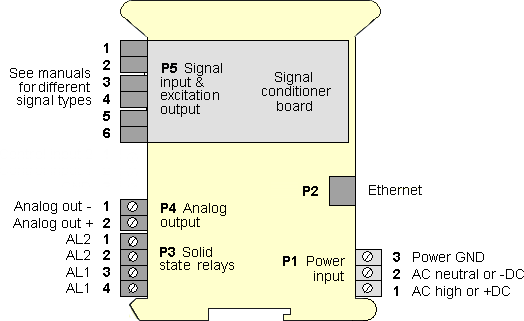
RTD hookup can be via 2, 3 or 4 wires to the J5 connector. The transmitter applies an excitation current of 196 µA (Pt 100 and Ni 120) or 5 mA (Cu 10).
 |
In 4-wire hookup, different pairs of leads are used to apply the excitation current and sense the voltage drop across the RTD, so that the IR drop across the excitation leads is not a factor. |
 |
In 3-wire hookup, the transmitter senses the combined voltage drop across the RTD plus two excitation leads. It also senses the voltage drop across one excitation lead, and then subtracts twice this voltage from the combined total. This technique effectively subtracts all lead resistance and compensates for ambient temperature changes if the two excitation leads are identical. |
 |
In 2-wire hookup, the transmitter senses the combined voltage drop across the RTD and both lead wires. The voltage drop across the lead wires can be measured by shorting out the RTD during transmitter setup, and this voltage is then automatically subtracted from the combined total. However, changing resistance of the lead wires due to ambient temperature changes will not be compensated. |
Free Instrument Setup Software for Series 2 Laureates
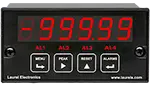
|
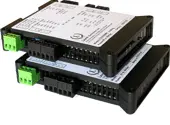
|
| 1/8 DIN Digital Panel Meters | DIN Rail Transmitters |
Free Downloadable Windows-based Instrument Setup (IS) software (Data Interface Board Required) for use with our programmable Digital Panel Meters, Scale Meters, Counters, Timers, Remote Displays, and Transmitters, are an easy method to set up Laureate 1/8 DIN digital panel meters, counters, timers, remote displays, and DIN-rail transmitters, as explained in the Instrument Setup Software Manual. Laureate 1/8 DIN instruments can also be set up from the front panel, as explained in their respective Owners Manuals. Instrument Setup software is of benefit whether or not the PC is connected to the instrument.
- When the PC is connected to the instrument, Instrument Setup software can retrieve the setup file from the instrument or open a default setup file or previously saved setup file from disk View Setup, then provides graphical user interface (GUI) screens with pull-down menus applicable to input, display, scaling, filtering, alarms, communications, analog output, and front panel lockouts. Fields that are not applicable to the instrument as configured are either left out or grayed out. Clicking on any item will bring up a detailed Help screen for that item. After editing, the setup file can be downloaded, uploaded to the instrument, or saved to a disk. The same setup file can then be downloaded into multiple instruments.
- When the PC is not connected to the instrument, the above GUI screens can be used to set up a virtual instrument. The setup file can then be saved to disk. Switching toView Menu then brings up a screen with the required front panel programming steps. This view can be printed out for use at the instrument site and to serve as a hard copy record.
Download Free Instrument Setup Software
Installation
Set User Account Control (UAC) of MS Windows to "Never notifiy me" so that Instrument Setup Software can create directories. The UAC change screen can be reached as follows:
- Under Windows 7, click on the Windows Start button in the lower left of the desktop and enter "UAC" in the search field.
- Under Windows 8, navigate to Control Panel, then to the "User Accounts and Family Safety" section, and click on "Change User Account Control Settings."
- Under Windows 10, click on the Windows Start button in the lower left of the desktop, then on "Settings", and enter "UAC" in the search field.
- Reboot your computer for the changed UAC setting to take effect.
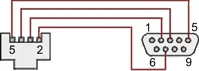
RJ11-to-DB9 cable with rear view of DB9 connector to PC
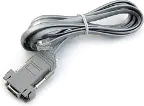
RS232 cable, meter to PC, P/N CBL01
Laureate 1/8 DIN Laureate instruments must be equipped with a serial communications board and be connected to the computer via a serial communications cable. The connection can be via RS232, RS485, USB or Ethernet. Following setup, the serial communications board may be removed from the instrument if desired. The wiring of the RS232 cable is illustrated above with end views of the two connectors.
Laureate LT Series transmitters come standard with a 3-wire serial interface, which can be jumpered for RS232 or RS485.
Laureate LTE Series transmitters come standard with an Ethernet interface.
Meter Setup Screens
Click on any of the reduced screens below for a full-size screen view, then click on the Back button of your browser to return to this page. The screens examples below are for a fully-loaded Series 2 Digital Panel Meter (DPM), which is connected to the PC via RS232. If the meter is a Series 1 meter (pre-2007), this is sensed by the software, and somewhat different screens are brought up. Please see Series 1 setup screens.

Welcome Screen
From the computer desktop, click on Start > Programs > IS2 > IS2. Or click on the IS icon on your desktop. This splash screen will be displayed for three seconds. The software revision number is in the lower right.


Communications Selection Screen
Specify your desired communication protocol and the serial communications bus type, which should match the jumper setup of the instrument. Select None if the PC is not connected to the instrument.

Establish Communications Screen
If you selected RS-232, you will be asked to specify the PC Com Port and Baud Rate, which should match the jumper setup of the instrument. Click on Establish. With the right settings, the Communications Established field will light up in green, and the Meter Type will be recognized. If so, click onMain Menu.

Main Menu Screen
Click on File > Default Setup to retrieve the default setup file from disk for your type of meter. Click on File > Open Setupto retrieve a previously saved setup file from disk or on File > Save Setup to save your edited setup file to disk. Click onDPM > Get Setup to retrieve the setup file from your meter or on DPM > Put Setup to download your edited setup file into the meter.

DPM Input + Display Setup Screen
From the Main Menu, click on View > Setup, then on theInput+Display tab. You can now specify the meter hardware, signal type, display mode, and functions of control inputs A and B. Clicking on any item brings up a pull-down menu with the available choices.

DPM Scaling Setup Screen
Click on the Scaling tab, which provides three scaling methods to relate the signal to the displayed reading: 1) Scale and Offset method, 2) Coordinates of two points method, and 3) Reading Coordinates of Two Points method. The last method uses actual high and low signals, and the computer will prompt you.

DPM Filter Setup Screen
Click on the Filter tab, which allows you to specify the digital filter time constant (if any), the adaptive filter threshold, and whether Peak / Valley values are filtered or unfiltered. As for all setup screens, clicking on the F1 key while an item is highlighted brings up a Help screen for that item, as illustrated.

DPM Relay Alarms Setup Screen
Click on the Relay Alarms tab, which allows you to set up Alarms 1 and 2 for the optional dual relay output board. Clicking on any of the four numeric fields changes these to green and brings up a special field to enter the desired numeric value, which is tied to the displayed reading.

DPM Communications Setup Screen
Click on the Communications tab so set up serial communications. In particular, you can special the Serial Protocol and the meter address if multiple meters are to be addressed on the same serial data line.

DPM Analog Output Setup Screen
Click on the Analog Out tab so set up the optional analog output board. Three output ranges are selectable, the endpoints of which can be tied to user-specified High and Low readings.

DPM Lockouts Setup Screen
Click on the Lockouts tab to check off menu items which will no longer be accessible from the front panel of the meter. This will simplify meter operation and prevent unintended setup changes.
Meter Setup Utilities

DPM Front Panel Setup Screen
As an aid to programming the meter from the front panel when a serial connection is not available, you can return to the Main Menu and click on View > Menu. The required sequence of front panel screens will then be displayed. Click on any step in the sequence for the meaning of each digit, as illustrated for the FILtEr step. For a hardcopy, simply press on Print.

DPM Jumper Setup Screen
Specify your desired communication protocol and the serial communications bus type, which should match the jumper setup of the instrument. Select None if the PC is not connected to the instrument.

DPM Jumper Setup Screens
Click on any of the displayed plug-in boards, and you will be presented with the jumper positions and electrical connections for your selected board. This minimizes the need to refer to the printed manual.

DPM Commands Screen
This page allows you set up external input, serial communications, an analog output proportional to the display (optional), and lockouts for Laureate digital counters. The grayed out area at the top right of the screen applies to Laureate remote displays.


Graphical Output Screens (not available with Ethernet)
From the Main Menu, click on Readings if your PC is connected to the meter. A pull-down menu then offers three choices: List, Plot and Graph.
- List presents the latest readings in a 20-row by 10-column table. Press Pause at any time to freeze the display. This is one method to capture peak readings.
- Plot generates a plot of readings vs. time in seconds. It effectively turns the DPM-PC combination into a printing digital oscilloscope.
- Graph generates a histogram where the horizontal axis is the reading and the vertical axis is the number of occurrences of readings. The display continually resizes itself as the number of readings increases.

DPM Calibration Screens
Click on the Scaling tab, which provides three scalClick on the Scaling tab, which provides three scaling methods to relate the signal to the displayed reading: 1) Scale and Offset method, 2) Coordinates of two points method, and 3) Reading Coordinates of Two Points method. The last method uses actual high and low signals, and the computer will prompt you.

Frequency Meter Calibration Screen
Calibration of the quartz crystal of the Laureate frequency meter requires the input of a known frequency from a calibrator. Apply the frequency, then enter the frequency in Hertz. Calibration will be automatic, with storage of the calibration factor stored in non-volatile memory.
Dimensions
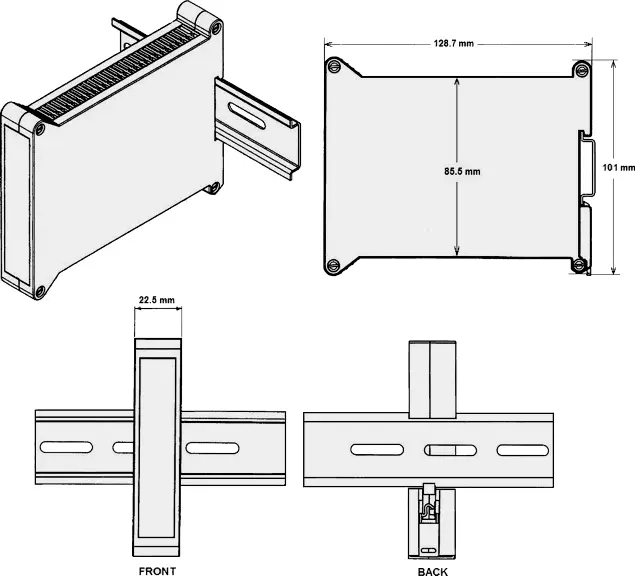
Dimensioned CAD assembly drawings in EPRT, STEP, x_t, .dwg, pdf file formats: Laureate-transmitter-case.zip (zipping prevents browser from opening CAD files as text files).


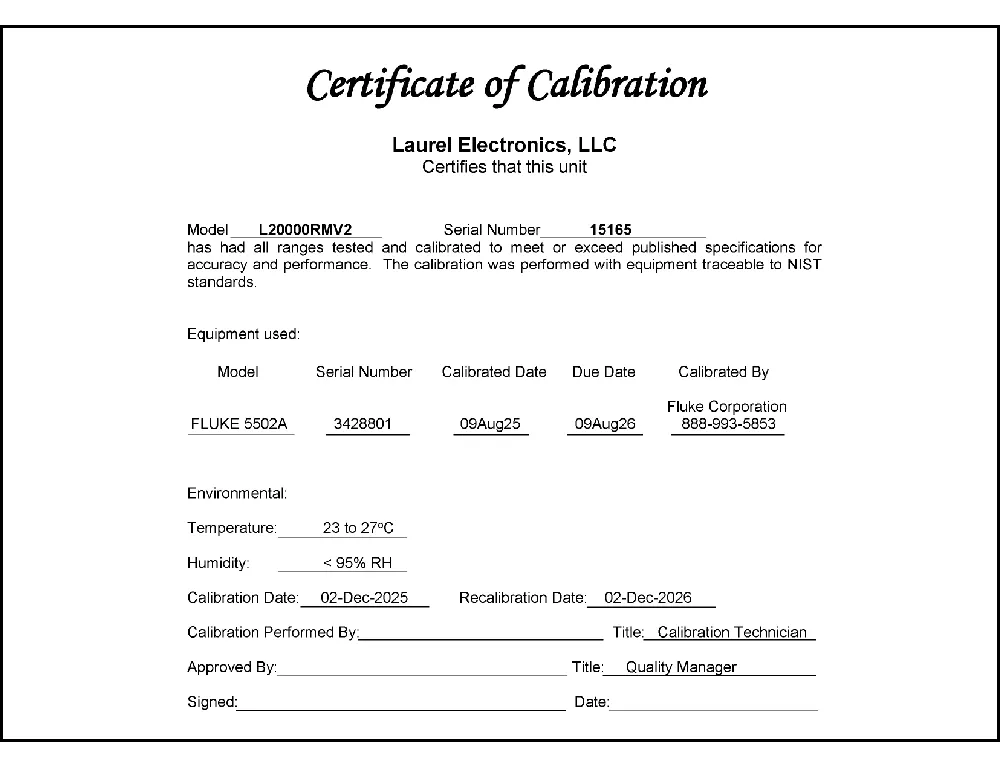
CAL-Analog
Certificate of Calibration
$65.00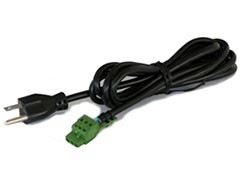

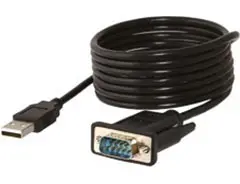
CBL02
USB-to-RS232 Adapter Cable
$47.00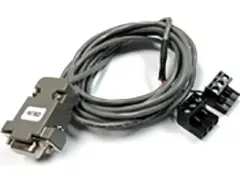
CBL04
RS232 Cable for LT Transmitters
$47.00CBL12
12-foot Power Cable
$47.00CBL6
6-foot Power Cable
$41.00What Is the LTE DIN Rail Analog Transmitter with Ethernet Communication for RTD Temperature?
In the realm of industrial automation and control, precision and reliability are paramount. The LTE Series DIN Rail Analog Transmitter with Ethernet Communication and Analog Outputs for RTD Temperature is designed to meet these demands, converting resistance readings from an RTD (Resistance Temperature Detector) sensor into both a standardized analog output and Ethernet-based digital data.
What Is an RTD, and How Does This Transmitter Read It?
An RTD measures temperature based on the predictable way a metal element's electrical resistance changes with temperature. This transmitter interfaces directly with 100Ω platinum RTDs (in either DIN alpha 0.00385 or ANSI alpha 0.00392 calibration), 120Ω nickel RTDs, and 10Ω copper RTDs, applying a small excitation current (196 µA for platinum and nickel, 5 mA for copper) and converting the resulting resistance into a linearized, highly accurate temperature reading — accurate to better than ±0.04°C (±0.07°F) ±0.01% of reading for a standard Pt100.
2-Wire, 3-Wire, and 4-Wire Lead Compensation
RTD connections can be made via 2, 3, or 4 wires, and the wiring choice directly affects how well the transmitter compensates for lead resistance. In a 4-wire hookup, separate lead pairs carry the excitation current and sense the voltage drop, so lead resistance isn't a factor at all. In a 3-wire hookup, the transmitter measures the combined RTD-plus-lead voltage drop, separately measures one excitation lead's drop, and subtracts twice that value — effectively canceling lead resistance and compensating for ambient temperature changes in the leads, provided both excitation leads are identical. In a 2-wire hookup, lead resistance is measured once (by shorting the RTD during setup) and subtracted as a fixed offset, but this doesn't compensate for later changes in lead resistance due to temperature — making 3- or 4-wire hookups the better choice for long cable runs or environments with significant temperature swings.
Selectable Range, Type, and Open Sensor Detection
The RTD type and temperature range — in °C or °F — are user-selectable, spanning the entire rated range of the chosen RTD type or narrowed as needed. Open sensor indication is standard and can be set to drive the output to either 0 mA or above 20 mA, so a broken RTD produces a clearly abnormal signal rather than resembling a valid reading. For RTDs whose resistance at 0°C differs from the nominal value, Instrument Setup Software allows user calibration via a resistance multiplier plus a degree offset.
Where Is This Transmitter Used?
Industrial Manufacturing
Allows accurate temperature measurement of processes such as extrusion, molding, and heating, with Ethernet integration enabling real-time data monitoring and control essential for consistent production standards and early detection of process deviations.
Building Management Systems
Facilitates accurate temperature monitoring within buildings for HVAC systems, ensuring energy efficiency and comfort, with analog outputs and Ethernet communication supporting integration into building management systems for optimized climate control.
Energy Management
Used in power plants, substations, and renewable energy facilities to measure and monitor temperature at critical points, helping prevent overheating, optimize energy use, and ensure safe equipment operation.
Process Automation
Deployed in processes such as chemical reactions, fermentation, and distillation, where real-time Ethernet communication allows seamless integration with process control systems, providing immediate feedback to maintain optimal conditions.
Environmental Monitoring
Used in applications such as weather stations and environmental control systems to measure and report temperature data, with Ethernet capability facilitating remote monitoring and data analysis.
Food and Beverage Industry
Monitors temperatures in processes like cooking, cooling, and storage, providing real-time data for quality assurance and regulatory compliance to help prevent spoilage and ensure food safety.
Pharmaceutical Industry
Helps maintain and monitor temperatures in processes such as drug manufacturing and storage, with Ethernet communication ensuring temperature data can be integrated into quality control systems and compliance records.
Conclusion
The LTE Series DIN Rail Analog Transmitter with Ethernet Communication and Analog Outputs for RTD Temperature is a versatile and reliable solution for industrial temperature measurement and control. Its ability to interface with multiple RTD types across 2-, 3-, or 4-wire configurations, provide accurate linearized analog outputs, and support Ethernet-based network integration makes it valuable across manufacturing, building management, energy, process automation, environmental monitoring, food and beverage, and pharmaceutical applications alike.
LTE RTD Temperature Transmitter Frequently Asked Questions
What's the difference between a DIN and ANSI Pt100 RTD, and does it matter which I connect?
DIN (alpha 0.00385) and ANSI (alpha 0.00392) Pt100 RTDs have slightly different resistance-versus-temperature curves, so the transmitter must be configured for the matching type; connecting a DIN RTD while configured for ANSI (or vice versa) will produce a plausible-looking but measurably wrong reading, since the two curves diverge as temperature rises.
Why does a 4-wire RTD connection eliminate lead resistance error entirely, while 3-wire only compensates for it?
In a 4-wire hookup, the excitation current and voltage-sensing paths use physically separate lead pairs, so no lead resistance appears in the voltage measurement at all. In a 3-wire hookup, lead resistance is still present in the measurement but is mathematically subtracted out, which works well only if both excitation leads have identical resistance and temperature behavior.
Does the Ethernet interface affect measurement accuracy or update rate?
No — accuracy and update rate come from the same signal conditioning used across the RTD product line; Ethernet only changes how the reading is transmitted digitally rather than over serial data.
When is a 2-wire RTD connection an acceptable choice?
2-wire connections are reasonable for short cable runs in stable-temperature environments, since lead resistance is measured once during setup and subtracted as a fixed value; it becomes less accurate on long runs or where ambient temperature causes the lead resistance itself to change after calibration.
Why does the copper RTD use a much higher excitation current (5 mA) than the platinum and nickel types (196 µA)?
Copper RTDs have a much lower nominal resistance (about 9 ohms at 0°C compared to 100 or 120 ohms for platinum and nickel), so a higher excitation current is needed to produce a measurable voltage signal from that lower resistance while still keeping self-heating of the sensor within acceptable limits.
Can this transmitter be configured for an RTD with a non-standard resistance at 0°C?
Yes — Instrument Setup Software provides for user calibration via a resistance multiplier plus a degree offset, allowing the transmitter to be matched to an individual RTD whose actual resistance at 0°C differs from the nominal value for its type.
What does open sensor indication actually do, and why is it configurable?
It drives the analog output to either 0 mA or above 20 mA if the RTD circuit opens, making a broken sensor clearly distinguishable from a valid low or high temperature reading. Which direction is configurable so it can be matched to how the downstream control system is set up to interpret a fault condition.
Does switching RTD type require different transmitter hardware?
No — the same signal conditioner board can be user-configured for any of the supported RTD types (Pt100 DIN, Pt100 ANSI, Ni120, Cu10) as well as °C or °F, so switching types is a configuration change through the setup software rather than a hardware swap.
Does this transmitter include an excitation output for other sensors, like the DC or load cell variants?
No — temperature signal conditioners (both RTD and thermocouple) are among the models that don't include the general-purpose isolated transducer excitation output, since RTD excitation is a fixed, purpose-built current source specific to the RTD measurement itself.
Can multiple RTD transmitters be networked together?
Yes — the transmitter supports up to 247 digital addresses via Modbus TCP, allowing many individually addressable transmitters to coexist on the same Ethernet network.
LTE RTD Temperature Transmitter Questions From the Field
My RTD reading is off by a consistent amount across the whole range — what should I check first?
A consistent offset across the full range often points to a lead resistance or wiring configuration mismatch — for example, using a 2-wire connection where the calibration assumed 3- or 4-wire — rather than a sensor fault; confirming the actual wiring matches what's configured in setup software is the standard first step.
My reading drifts when the ambient temperature around the cabinet or cable run changes, even though the process itself is stable — why?
This is a classic symptom of uncompensated lead resistance, most often seen with 2-wire connections on longer cable runs; switching to a 3- or 4-wire hookup, which actively compensates for lead resistance changes, typically resolves this kind of drift.
My transmitter isn't showing up on the network — what should I check first?
Confirming the transmitter's IP configuration matches what the network expects, and that the physical Ethernet cable and switch port are functioning, are the standard first checks before suspecting a transmitter fault.
My open-sensor alarm triggers intermittently rather than staying on or off — what does that suggest?
Intermittent open-sensor faults often point to a marginal or partially corroded connection at the RTD terminal block rather than a fully broken sensor; checking and reseating the screw-clamp connections is the standard first troubleshooting step before replacing the RTD itself.
Two RTDs of the same nominal type read slightly differently on the same transmitter setting — is that normal?
Some unit-to-unit variation is expected since individual RTDs have manufacturing tolerances around their nominal resistance curve; if the difference exceeds the transmitter's specified accuracy for that RTD type, using the user calibration feature to apply a resistance multiplier and offset for the specific RTD can correct for it.
Why would my reading be noisy specifically near VFDs, contactors, or other switching equipment?
RTD signals are relatively low-level and can pick up noise from nearby switching equipment; checking cable shielding, grounding, and physical separation from the noise source is the standard remedy, along with using the transmitter's digital filtering options in persistently noisy environments.
My reading seems accurate at moderate temperatures but diverges at the high end of the range — what's going on?
This can happen if the RTD alpha type (DIN vs. ANSI) configured in the transmitter doesn't match the physically connected RTD, since the two calibration curves diverge more as temperature increases; verifying the configured alpha type against the RTD's actual specification is the standard diagnostic step.
My Modbus TCP polling occasionally times out even though the transmitter appears connected — what's the likely cause?
Network congestion or too many devices polling the same transmitter simultaneously can cause intermittent timeouts; checking polling frequency from all connected clients and network traffic load is a common troubleshooting step.
