New Front Panel USB-C Port Coming Soon!
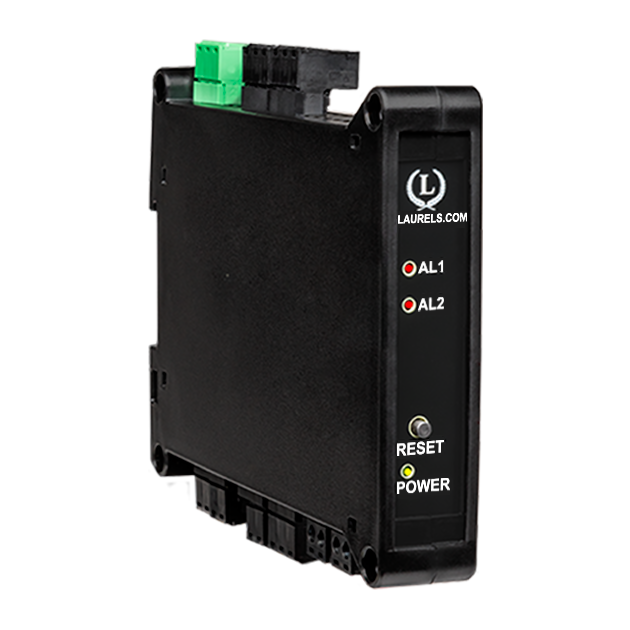
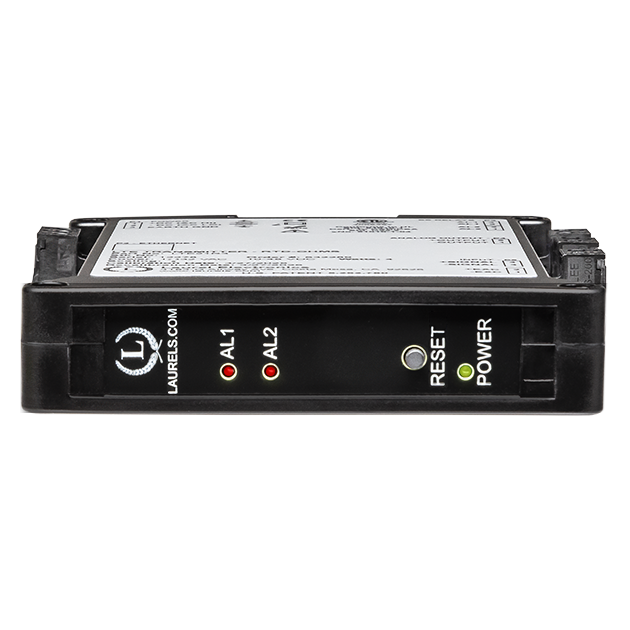
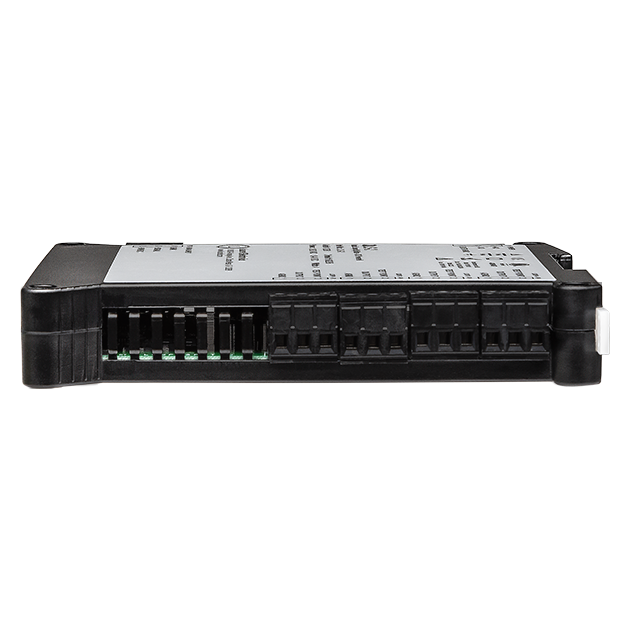
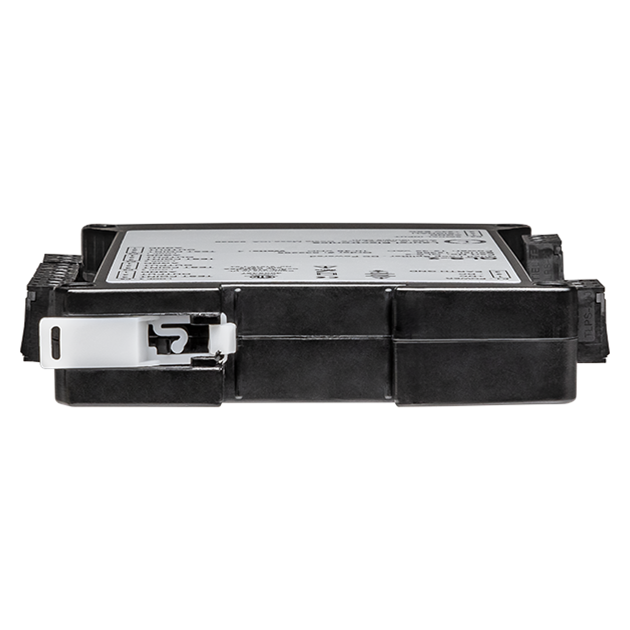
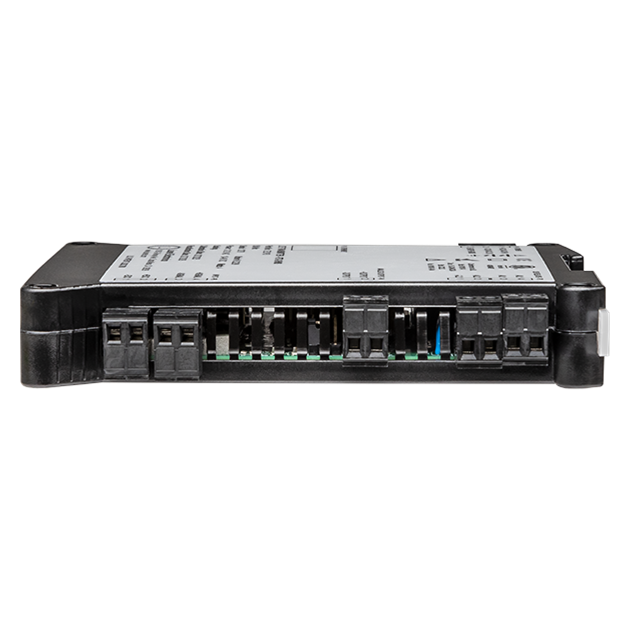
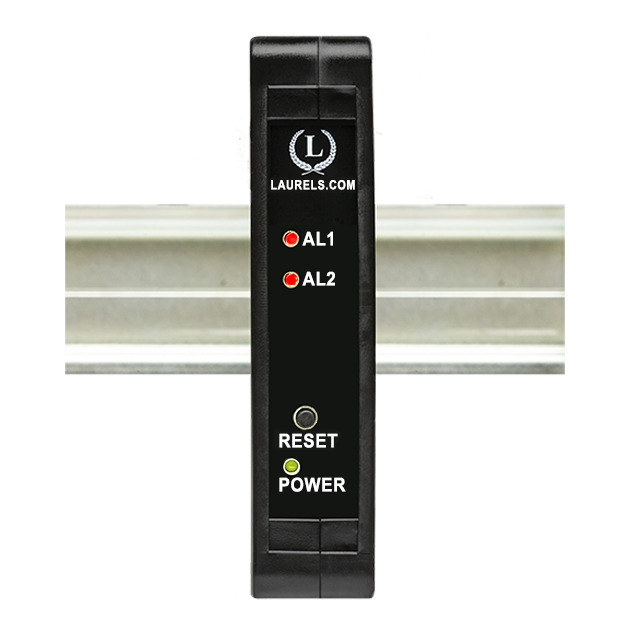
The Laureate 4-20 mA, 0-20 mA, 0-10V or -10V to +10V and RS232/RS485 output transmitter for ratio, product, sum or difference of 2 rates or totals accepts two independently scalable input channels A & B from a wide range of pulse sources, such as NPN or PNP proximity switches, contact closures, digital logic, magnetic pickups down to 12 mV, or AC voltages to 250 Vac. Input frequencies can range from 0.005 Hz to 1 MHz.
Arithmetic functions A+B, A-B, AxB, A/B or A/B-1 are made available by the Extended counter main board and can track the sum, difference, product, ratio, or draw of both input channels. These functions can be applied to scaled rates, scaled totals, square root of rates, totals after square root extraction, custom curve linearized rates, or totals after custom curve linearization.

The Extended Laureate computer board can display rate based on successive readings. It also allows exceptionally accurate custom curve linearization, for example to read out liquid volume or rate of flow in a horizontal cylindrical tank based on level reported by a 4-20 mA transmitter. For setup, up to 180 data points can be input into a computer spreadsheet or text file by the user. The computer then calculates spline-fit segments, which are downloaded into the transmitter.
Exceptional Accuracy and Stability. Laureate transmitters determine frequency by taking the inverse of period as measured with a calibrated quartz crystal time base. This results in extremely accurate and stable 6-digit internal readings (±999,999 counts), which are then processed in software. The analog output is generated by an ultra-linear 16-bit (65,536 step) digital-to-analog converter (DAC) for 0.02% output accuracy. The update rate of the transmitter output is a programmed gate time + 30 ms + 0-2 signal periods. For a 60 Hz signal, the update rate would be 20 per second. Such fast update rates are ideal for alarm and control.
The update rate of the transmitter output is a programmed gate time + 30 ms + 0-2 signal periods. For pulse rates of 60 Hz and above, the update rate would be 20 per second. Such fast update rates are ideal for alarm and control.
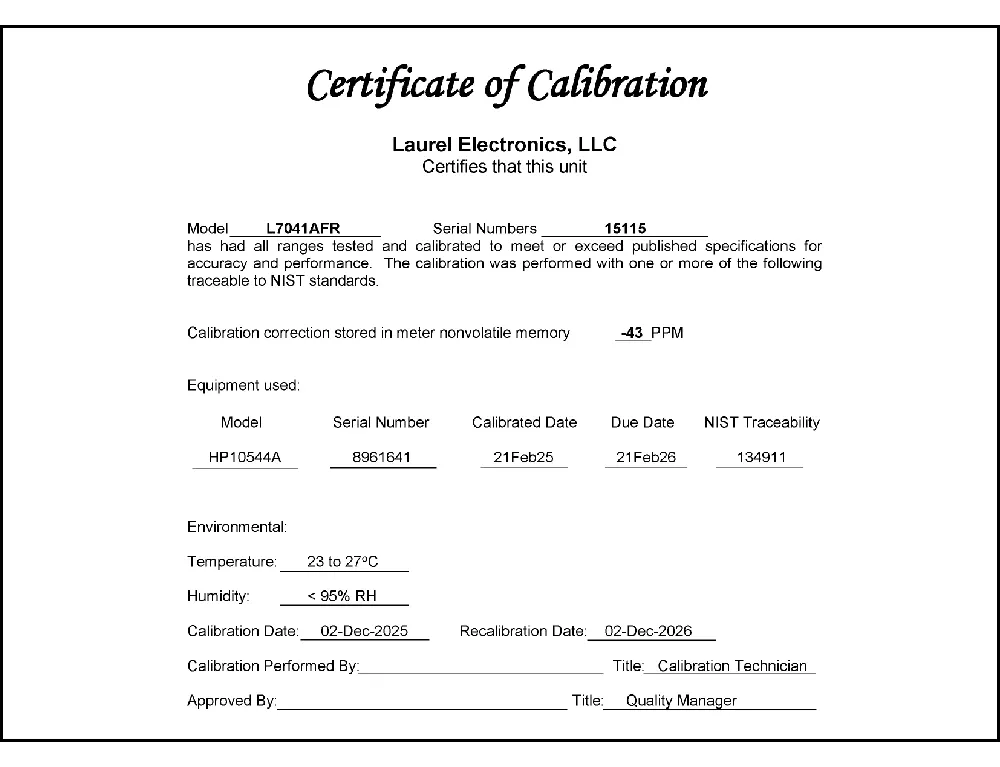
All signal conditioner board ranges are factory-calibrated, with calibration factors for each range securely stored in an onboard EEPROM. These factors can be scaled via software to accommodate external shunts, enabling field replacement of signal conditioner boards without necessitating recalibration of the associated transmitter. For optimal accuracy, factory recalibration is recommended annually. All Laurel Electronics instruments undergo factory calibration using the industry-leading Fluke calibrators, which are recalibrated yearly and certified traceable to national standards, ensuring the highest level of precision and reliability.
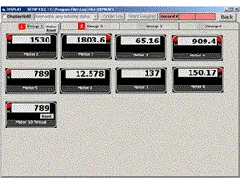
Easy USB-C Programming: Configure a Laureate transmitter through the front-panel USB-C port with Laurel’s free Instrument Setup Software for Windows. Configurations can be saved to the transmitter, a PC, a file server, or a USB thumb drive. Laurel’s free Instrument Setup Software can also be used for light-duty data collection.
Peak and valley values are automatically captured. These may be displayed via Laurel's free Instrument Setup Software, which runs on a PC under MS Windows or can be transmitted as serial data.
Two control inputs (CMOS/TTL levels, logic 0 = tied to digital ground, logic 1 = open) or dry contacts that can be set to control / activate 14 transmitter commands.
An (isolated) 5, 10, 12, or 24 Vdc excitation output is standard to power transducers or two-wire transmitters. Ratiometric operation, which automatically compensates for changes in the applied excitation, is jumper selectable for applications, such as bridges, where the signal to be measured is proportional to the excitation level.

LT series DIN rail Transmitters & signal conditioners can be interfaced to a wide range of sensors and transducers using one of seven available plug-in signal conditioner boards. The transmitters duplicate the high performance (high accuracy, high read rate) and extensive programmable features of Laureate 1/8 DIN digital panel meters, counters and timers. They utilize the same signal conditioners boards, much of the same firmware, and Laurel's free Windows-based Instrument Setup Software. They come in a compact DIN rail mount package with detachable screw-clamp connectors for easy wiring.
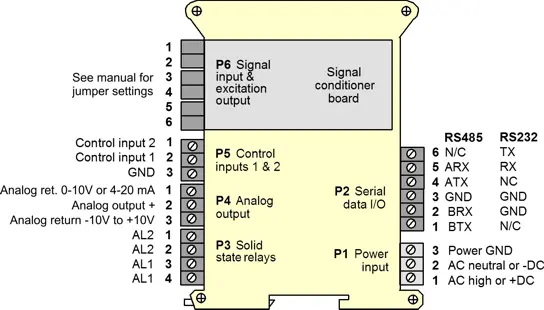
The LT series Transmitters accessible from this page include a 4-20 mA, 0-20 mA, 0-10V, or -10V to +10V analog output (isolated, user selectable), an RS232 or RS485 serial data interface (isolated, user selectable), and dual 120 mA solid state AC/DC relays (isolated). An (isolated) 5, 10, 12, or 24 Vdc transducer excitation output is included with all models other than those with a temperature or AC RMS signal conditioner.
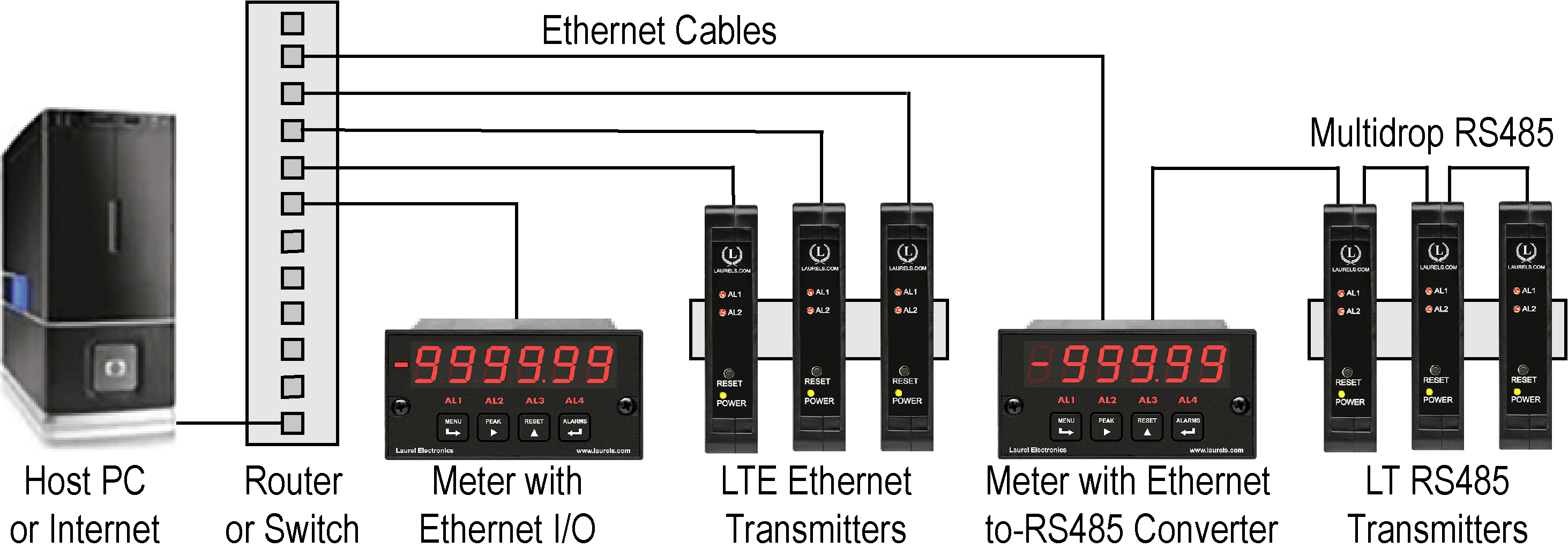
Up to 30 Laureate LT Transmitters and/or Digital Panel Meters can be configured for RS485 and daisy-chained to an LT Transmitter for seamless LAN integration. Alternatively, Laurel LTE series Ethernet transmitters can connect directly to a LAN via an Ethernet cable. Setup for both configurations is streamlined using Laurel’s free Instrument Setup Software, which simplifies node discovery and transmitter configuration.
Laureate Transmitters can be equipped with Laurel communication boards to support various interfaces and protocols. These include serial interfaces with ASCII or Modbus RTU protocols, and Ethernet interfaces with web access, ASCII, or Modbus TCP/IP protocols, ensuring versatile connectivity for your commercial applications.
| LT Transmitter Signal Input & Function | Model Series | Analog Output | RS232 & RS485 | Dual Relays | |
|---|---|---|---|---|---|
| 1 | DC Input Voltage and Current | LT-DC |  |
|
|
| 2 | AC RMS Voltage or Current | LT-RMS | |
|
|
| 3 | Process Voltage or Current | LT-P | |
|
|
| 4 | Weighing Applications | LT-WA | |
|
|
| 5 | Load Cell & Microvolt Signals | LT-WM | |
|
|
| 6 | Thermocouple (Types J, K, T, E, N, R, S) | LT-TC | |
|
|
| 7 | RTD Temperature | LT-RTD | |
|
|
| 8 | Resistance in Ohms | LT-R | |
|
|
| 9 | Frequency, Rate, Speed | LT-FR | |
|
|
| 10 | Pulse Input Totalizer | LT-FR | |
|
|
| 11 | Process Signal Totalizer | LT-VF | |
|
|
| 12 | Sum, Difference, Ratio, Product of 2 Inputs | LT-FR | |
|
|
| 13 | Batch Controller Pulse Input | LT-FR | |
|
|
| 14 | Batch Controller Analog Input | LT-FR | |
|
|
| 15 | On/Off Duty Cycle | LT-FR | |
|
|
| 16 | Stopwatch Timing for Single Events | LT-FR | |
|
|
| 17 | Average Time of Periodic Events | LT-FR | |
|
|
| 18 | AC Phase Angle and Power Factor | LT-FR | |
|
|
| 19 | Quadrature Position or Rate | LT-QD | |
|
|
| Pulse Input | ||||
|---|---|---|---|---|
| Signal Types | AC, pulses from NPN, PNP transistors, contact closures, magnetic | |||
| Signal Ground | pickups | |||
| Channel A Frequency | Common ground for channels A & B. | |||
| Channel B Frequency | 0.005 Hz to 1 MHz | |||
| Minimum Signal | 0.005 Hz to 250 kHz | |||
| Maximum Signal | Nine ranges from (-12 to +12 mV) to (+1.25 to +2.1V) | |||
| Noise Filter | 250 Vac | |||
| Contact Debounce | 1 MHz, 30 kHz, 250 Hz (selectable) | |||
| Time Base Accuracy | 0, 3, 50 ms (selectable) | |||
| Arithmetic Functions | Quartz crystal calibrated to ±2 ppm A+B, A-B, AxB, A/B, A/B-1 | |||
| Recalibration: All ranges are calibrated at the factory. Recalibration is recommended every 12 months. | ||||
| Analog Output (standard) | ||||
| Output Levels | 4-20 mA, 0-20 mA, 0-10 Vdc, -10 to +10Vdc (user selectable) | |||
| Compliance at 20 mA | 10V (0-500Ω load) | |||
| Compliance, 0-10V | 2 mA ( 5 kΩ or higher load ) | |||
| Output Resolution | 16 bits (65,536 steps) | |||
| Output Accuracy | ±0.02% of output span | |||
| Output Update Rate | Programmed gate time + 30 ms + 0-2 signal periods | |||
| Output Isolation | 250V rms working, 2.3 kV rms per 1 minute test | |||
| Serial Data Output (standard) | ||||
| Signal Types | RS232 or RS485 (half or full duplex), jumper selectable | |||
| Data Rates | 300, 600, 1200, 2400, 4800, 9600, 19200 baud | |||
| Output Isolation | 250V rms working, 2.3 kV rms per 1 min test | |||
| Serial Protocols | Modbus RTU, Modbus ASCII, Custom ASCII | |||
| Modbus Compliance | Modbus over Serial Line Specification V1.0 (2002) | |||
| RS232/RS485 Connector | Screw terminals for easy daisy chaining | |||
| Digital Addresses | 247 for Modbus, 31 for Custom ASCII | |||
| Dual Relay Output (standard) | ||||
| Relay Type | Two solid state relays, SPST, normally open, Form A | |||
| Load Rating | 120 mA at 140 Vac or 180 Vdc | |||
| Excitation Output (standard) | ||||
| 5 Vdc | 5 Vdc ± 5%, 100 mA (jumper selectable) | |||
| 10 Vdc | 10 Vdc ± 5%, 120 mA (jumper selectable) | |||
| 12 Vdc | 12 Vdc ± 5%, 100 mA (jumper selectable) | |||
| 24 Vdc | 24 Vdc ± 5%, 50 mA (jumper selectable) | |||
| Output Isolation | 50 Vdc from signal ground | |||
| Power Input | ||||
| Standard Power | 85-264 Vac or 90-300 Vdc | |||
| Low Power Option | 10-48 Vdc or 12-32 Vac | |||
| Power Frequency | DC or 47-63 Hz | |||
| Power Isolation | 250V rms working, 2.3 kV rms per 1 min test | |||
| Power Consumption at 24V | 1.5W typical, 3W with max excitation output | |||
| Environmental | ||||
| Operating Temperature | -40°C to 70°C (-40°F to 158°F) | |||
| Storage Temperature | -40°C to 85°C (-40°F to 185°F) | |||
| Relative Humidity | 95% at 40°C, non-condensing | |||
| Cooling Required | Mount transmitters with ventilation holes at top and bottom. Leave 6 mm (1/4") between transmitters, or force air with a fan. | |||
| Mechanical | ||||
| Enclosure | Rugged black polycarbonate housing material | |||
| Mounting | 35 mm rail per DIN EN 50022 | |||
| Dimensions | 129 x 104 x 22.5 mm case | |||
| Connectors | Detachable screw clamp connectors meet VDE / IEC / UL / CSA standards. RJ45 jack for Ethernet | |||
| Tightening Torque | Screw terminal connectors: 5 lb-in (0.56 Nm) | |||
| Weight | Complete transmitter: 183 g (6.5 oz) | |||
| Replacement Case Screws | ||||
| Size | 6 | |||
| Thread Pitch | 6-19 | |||
| Length | 1/2" | |||
| Head Style | Pan Head | |||
| Drive Style | Phillips | |||
| Head Diameter | 0.256-0.270 | |||
| Head Height | 0.087-0.097 | |||
| Full/Partial Thread | Full | |||
| Drive Size | 2 | |||
| Material | Steel | |||
| Finished | Black Oxide | |||
| General | ||||
| Programming | Utilize Laurel's free Instrument Setup Software, which runs on a PC under MS Windows. | |||
| Security | Lockout options available using Laurel's free Instrument Setup Software. | |||
| Warranty | 3 years parts & labor | Recalibration: All ranges are calibrated at the factory. Recalibration is recommended every 12 months. | ||
|
|
| 1/8 DIN Digital Panel Meters | DIN Rail Transmitters |
Free Downloadable Windows-based Instrument Setup (IS) software (Data Interface Board Required) for use with our programmable Digital Panel Meters, Scale Meters, Counters, Timers, Remote Displays, and Transmitters, are an easy method to set up Laureate 1/8 DIN digital panel meters, counters, timers, remote displays, and DIN-rail transmitters, as explained in the Instrument Setup Software Manual. Laureate 1/8 DIN instruments can also be set up from the front panel, as explained in their respective Owners Manuals. Instrument Setup software is of benefit whether or not the PC is connected to the instrument.
Set User Account Control (UAC) of MS Windows to "Never notifiy me" so that Instrument Setup Software can create directories. The UAC change screen can be reached as follows:
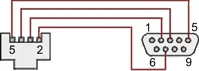
RJ11-to-DB9 cable with rear view of DB9 connector to PC
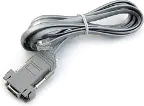
RS232 cable, meter to PC, P/N CBL01
Laureate 1/8 DIN Laureate instruments must be equipped with a serial communications board and be connected to the computer via a serial communications cable. The connection can be via RS232, RS485, USB or Ethernet. Following setup, the serial communications board may be removed from the instrument if desired. The wiring of the RS232 cable is illustrated above with end views of the two connectors.
Laureate LT Series transmitters come standard with a 3-wire serial interface, which can be jumpered for RS232 or RS485.
Laureate LTE Series transmitters come standard with an Ethernet interface.
Click on any of the reduced screens below for a full-size screen view, then click on the Back button of your browser to return to this page. The screens examples below are for a fully-loaded Series 2 Digital Panel Meter (DPM), which is connected to the PC via RS232. If the meter is a Series 1 meter (pre-2007), this is sensed by the software, and somewhat different screens are brought up. Please see Series 1 setup screens.


From the Main Menu, click on Readings if your PC is connected to the meter. A pull-down menu then offers three choices: List, Plot and Graph.


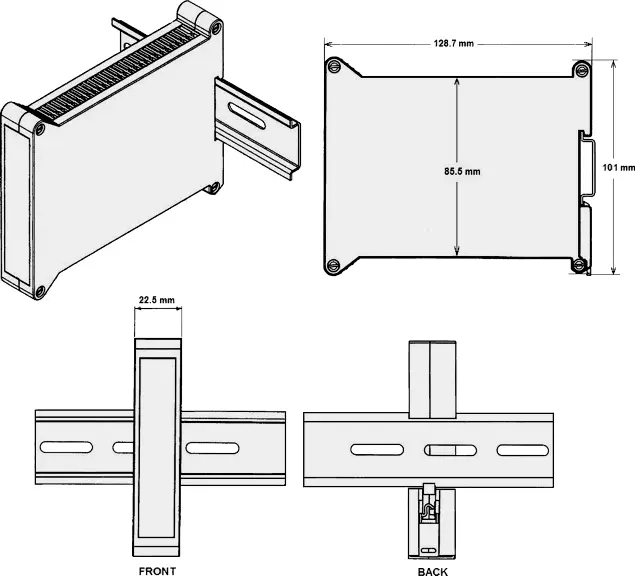
Dimensioned CAD assembly drawings in EPRT, STEP, x_t, .dwg, pdf file formats: Laureate-transmitter-case.zip (zipping prevents browser from opening CAD files as text files).
| Controlling the Mixing Ratio of Two Fluids | |
|---|---|
 |
Transmitting and alarming the input flow rate ratio of two fluids (gas or liquid) allows these to be mixed in a predetermined ratio in continuous processes. The sensing element is normally a turbine flow meter, which outputs pulses at a frequency proportional to flow rate. The A/B ratio can also be transmitted for totalized rate (or delivered volume). |
| Comparing Fluid Inflow & Outflow | |
 |
The ratio of the inflow and outflow rates of a tank is a measure of the relative filling or emptying rate. The same transmitter can also be programmed to transmit the net inflow or outflow rate in flow units, or to transmit totalized inflow our outflow in volume units. Any of these parameters can be alarmed using the dual relay board and be transmitted via 4-20 mA. |
| Controlling Coating Thickness on a Film | |
 |
In this application, Channel A measures the rate at which a coating material is applied, as measured by a flow meter, while Channel B measures the speed of the film based on pulses from a proximity switch. Transmitting and alarming the A/B ratio assures that an even thickness of coating material is applied as the speed of the film is varies. |
| Instrumenting a Pulsed Laser System | |
 |
The dual-channel Laureate transmitter can measure the speed of conveyor lines by using the output of proximity switches which sense gear teeth or spokes of rotating drive wheels. Transmitting the speed ratio of two lines allows line speeds to be adjusted so that material arrives at work stations when needed. |
| Measuring Draw for Elongation | |
 |
Draw (Ch A / Ch B - 1) can be used to indicate the elongation of films compressed between rollers, the shrinkage films, and the RPM difference of rollers whose speed is varied to maintain tension. The high resolution of Laureate dual channel transmitters is ideal for comparison of rates that are close to each other. |
CAL-Digital
Certificate of Calibration
$65.00DLS-XLOG2
XLog2 Data logging Software
$495.00CON01
CON01 Connector
$75.00CBL6
6-foot Power Cable
$41.00CBL12
12-foot Power Cable
$47.00CBL02
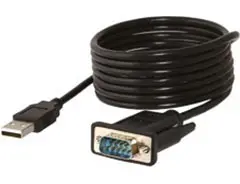
USB-to-RS232 Adapter Cable
$47.00CBL04
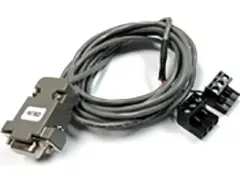
RS232 Cable for LT Transmitters
$47.00Some applications don't just need a single flow rate or speed measurement — they need to know how two of them relate to each other. This variant of the LT DIN Rail Transmitter takes two independently scalable pulse input channels and combines them arithmetically — as a sum, difference, product, ratio, or draw — before converting the result into an isolated 4-20 mA analog output and digital serial data.
The Extended counter main board makes five combinations of channels A and B available, applicable to scaled rates, scaled totals, square-root-extracted rates, or custom-curve-linearized values alike:
The Extended main board also supports custom curve linearization using up to 180 user-entered data points, processed into spline-fit segments — useful when either input channel's transducer output isn't linear, such as a turbine flow meter that behaves nonlinearly at low flow, before the arithmetic function is applied.
The LT DIN Rail Transmitter for ratio, product, sum, or difference of two rates or totals gives a panel builder a way to monitor and control the relationship between two pulse-based signals directly, rather than tracking each one separately and doing the comparison elsewhere. Whether the application is mixing two fluids in a fixed ratio, comparing tank inflow to outflow, holding coating thickness steady, synchronizing conveyor lines, or measuring material elongation between rollers, its five arithmetic functions and optional custom curve linearization make it a purpose-built fit for two-channel process comparison.
Computing the ratio directly in the transmitter provides a single, continuously updated value suited to automated alarming and control — a mixing process can react to ratio drift in real time rather than relying on an operator or external system to compare two separate readings and calculate the relationship themselves.
Yes — all five functions (A+B, A-B, AxB, A/B, A/B-1) can be applied to scaled totals just as they can to scaled rates, which is what makes it possible to compare two batch totals being mixed, not just their instantaneous flow rates.
Ratio (A/B) reports the raw proportion between the two channels, while draw (A/B-1) reports that same relationship shifted so that equal speeds read as zero — making small deviations from a 1:1 relationship, like the slight elongation of film between rollers, much easier to read directly rather than parsing a ratio value close to 1.0.
Turbine flow meters output a pulse train at a frequency proportional to flow rate, which matches directly with this transmitter's pulse-counting input channels; other flow-sensing technologies that don't produce a proportional pulse output would need additional signal conditioning before they could feed this transmitter's ratio function.
Yes — the computed arithmetic result (sum, difference, product, ratio, or draw) can be sent to the dual relay board for alarming, so a ratio drifting outside an acceptable band can trigger an alarm or control action directly from the combined value.
Linearization is applied per input channel based on that channel's own transducer characteristics, so it's entirely possible to linearize one channel (say, a nonlinear turbine meter) while leaving the other channel's linear-output sensor unlinearized, before the two are combined arithmetically.
When comparing two rates that are close to each other — like roller speeds with only slight tension-driven variation — a small absolute difference represents a large fraction of the meaningful signal; high resolution ensures that small, meaningful variation isn't lost in measurement noise or rounding.
The arithmetic functions are designed to combine two values of the same type — rate with rate, or total with total — rather than mixing a rate and a total directly in one arithmetic operation, since the units wouldn't otherwise be comparable.
Yes — up to 30 LT Transmitters and/or Digital Panel Meters can be daisy-chained on RS485 for LAN integration, or an LTE series Ethernet transmitter can be used instead for a direct Ethernet connection.
Low-flow drift in a ratio calculation often traces back to one channel's flow meter (commonly a turbine meter) behaving nonlinearly at low flow rather than a fault in the ratio calculation itself; applying custom curve linearization to the affected channel is the standard fix.
A small nonzero net flow reading with a visually stable tank level can simply reflect measurement resolution and normal sensor tolerance rather than an actual leak or fault; comparing the reported net flow rate against the tank's actual level trend over a longer period helps distinguish real net flow from measurement noise.
This usually points to the alarm deadband or response timing being too tight for the rate at which film speed changes during normal operation; widening the alarm deadband or adding a short delay before the alarm triggers typically resolves nuisance trips during expected speed transitions.
If the ratio reading itself is accurate, the drift is more likely in the downstream control loop adjusting line speed based on that ratio rather than in the measurement; verifying the control system is actually acting on the transmitted ratio value with appropriate responsiveness is the next troubleshooting step.
Because draw compares two rates that are intentionally close to each other, any noise on either channel is amplified in the relative comparison; checking each channel's raw signal quality independently (proximity switch alignment, cable shielding) before assuming a computation fault is the standard first step.
Yes — since the arithmetic functions combine both channels, noise or instability on either single channel propagates into the combined result; isolating and testing each channel independently is the standard way to determine which channel is actually the source of an unstable arithmetic reading.
Confirming both channels are scaled to consistent units before the ratio is computed is the first step, since a ratio calculated from totals in mismatched units (like gallons on one channel and liters on the other) will produce a result that doesn't match a manual calculation done in a single consistent unit.