New Front Panel USB-C Port Coming Soon!
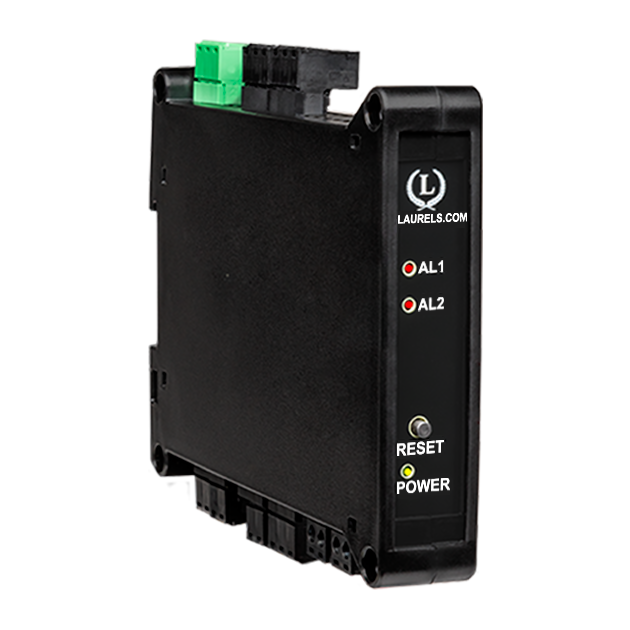
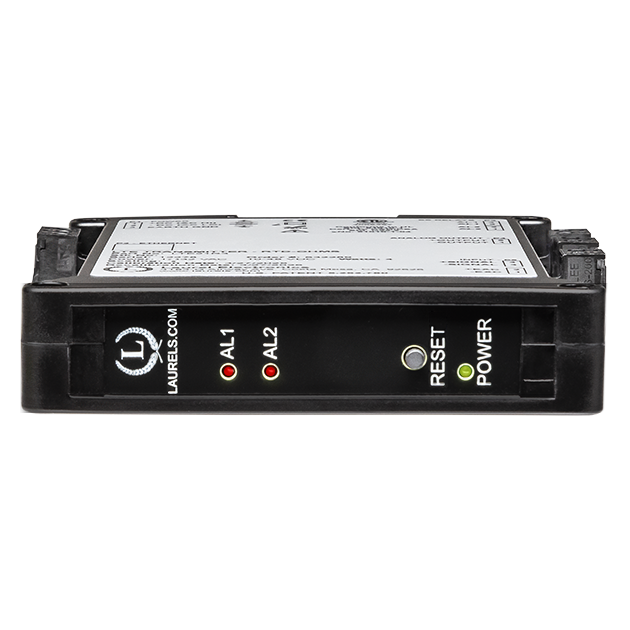
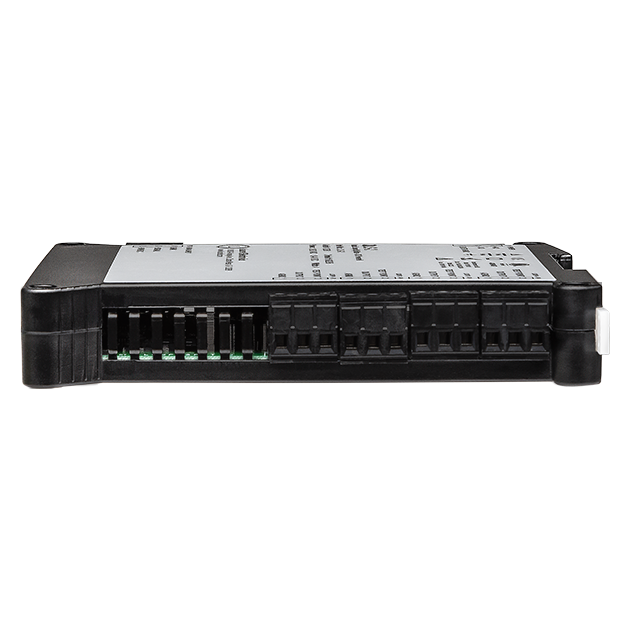
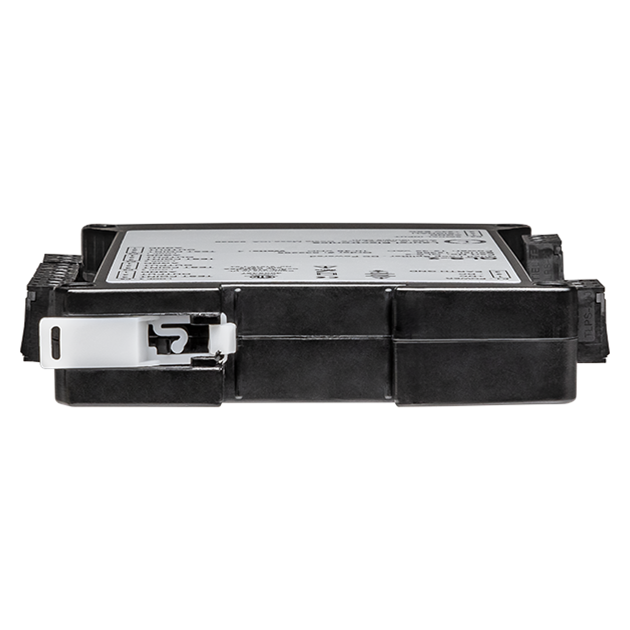
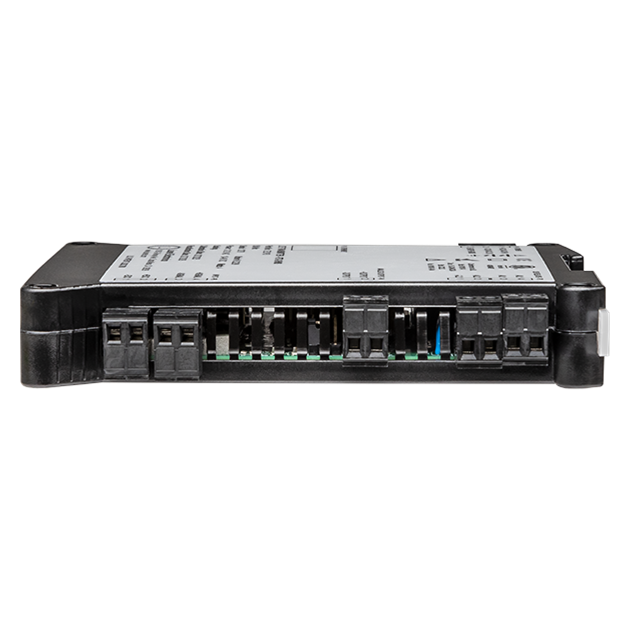
The Laureate 4-20 mA, 0-20 mA, 0-10V or -10V to +10V and ethernet output transmitter for batch controller is a low cost, powerful and highly accurate batching controller for repetitive fill operations. It can use the Laureate FR dual channel pulse input signal conditioner for use with turbine flow meters. Relay control can be provided by two or four 8A contact relays, or by two or four 120 mA AC/DC solid state relays. Fill operations are repeated continually with a programmable delay from 10 ms to 199.99 sec, or based on an external control input.
Three items are tracked by the batch control software. These can each be scaled to engineering units of total or flow rate and displayed by the controller's six-digit LED display: Item #1 is the current batch total, which can be set up to count up from zero to a preset limit, or down from a preset limit to zero. Item #2 can be assigned to grand total or number of batches. Item #3 is the flow rate.
The pulse-input batch controller utilizes the FR dual channel signal conditioner, which accepts pulses from turbine flow meters and most industrial transducers with a pulse output such as proximity switches with PNP or NPN output, TTL or CMOS logic, or magnetic pickup pulses down to 12 mV. The same signal is applied in parallel to the A and B input channels, which are used independently. Either channel can accept pulse rates from 0.005 Hz to 250 kHz, which exceeds the working range of turbine flow meters.
The Extended Laureate computer board can display rate based on successive readings. It also allows exceptionally accurate custom curve linearization, for example to read out liquid volume or rate of flow in a horizontal cylindrical tank based on level reported by a 4-20 mA transmitter. For setup, up to 180 data points can be input into a computer spreadsheet or text file by the user. The computer then calculates spline-fit segments, which are downloaded into the transmitter.
Exceptional Accuracy and Stability. Laureate transmitters determine frequency by taking the inverse of period as measured with a calibrated quartz crystal time base. This results in extremely accurate and stable 6-digit internal readings (±999,999 counts), which are then processed in software. The analog output is generated by an ultra-linear 16-bit (65,536 step) digital-to-analog converter (DAC) for 0.02% output accuracy. The update rate of the transmitter output is a programmed gate time + 30 ms + 0-2 signal periods. For a 60 Hz signal, the update rate would be 20 per second. Such fast update rates are ideal for alarm and control.
The update rate of the transmitter output is a programmed gate time + 30 ms + 0-2 signal periods. For pulse rates of 60 Hz and above, the update rate would be 20 per second. Such fast update rates are ideal for alarm and control.
All signal conditioner board ranges are factory-calibrated, with calibration factors for each range securely stored in an onboard EEPROM. These factors can be scaled via software to accommodate external shunts, enabling field replacement of signal conditioner boards without necessitating recalibration of the associated transmitter. For optimal accuracy, factory recalibration is recommended annually. All Laurel Electronics instruments undergo factory calibration using the industry-leading Fluke calibrators, which are recalibrated yearly and certified traceable to national standards, ensuring the highest level of precision and reliability.
Easy USB-C Programming: Configure a Laureate transmitter through the front-panel USB-C port with Laurel’s free Instrument Setup Software for Windows. Configurations can be saved to the transmitter, a PC, a file server, or a USB thumb drive. Laurel’s free Instrument Setup Software can also be used for light-duty data collection.
Peak and valley values are automatically captured. These may be displayed via Laurel's free Instrument Setup Software, which runs on a PC under MS Windows or can be transmitted as serial data.
Two control inputs (CMOS/TTL levels, logic 0 = tied to digital ground, logic 1 = open) or dry contacts that can be set to control / activate 14 transmitter commands.
An (isolated) 5, 10, 12, or 24 Vdc excitation output is standard to power transducers or two-wire transmitters. Ratiometric operation, which automatically compensates for changes in the applied excitation, is jumper selectable for applications, such as bridges, where the signal to be measured is proportional to the excitation level.

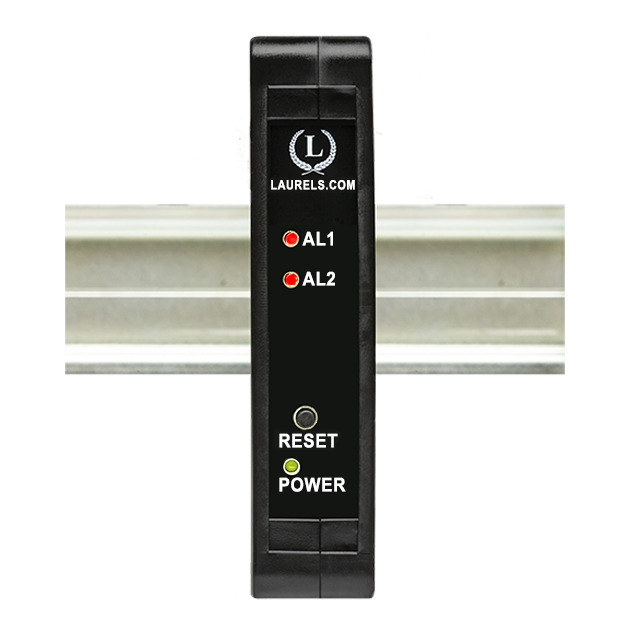
LTE series DIN rail Transmitters & signal conditioners can be interfaced to a wide range of sensors and transducers using one of seven available plug-in signal conditioner boards. The transmitters duplicate the high performance (high accuracy, high read rate) and extensive programmable features of Laureate 1/8 DIN digital panel meters, counters and timers. They utilize the same signal conditioners boards, much of the same firmware, and Laurel's free Windows-based Instrument Setup Software. They come in a compact DIN rail mount package with detachable screw-clamp connectors for easy wiring.
The LTE series Transmitters accessible from this page include a 4-20 mA, 0-20 mA, 0-10V, or -10V to +10V analog output (isolated, user selectable), an RS232 or RS485 serial data interface (isolated, user selectable), and dual 120 mA solid state AC/DC relays (isolated). An (isolated) 5, 10, 12, or 24 Vdc transducer excitation output is included with all models other than those with a temperature or AC RMS signal conditioner.
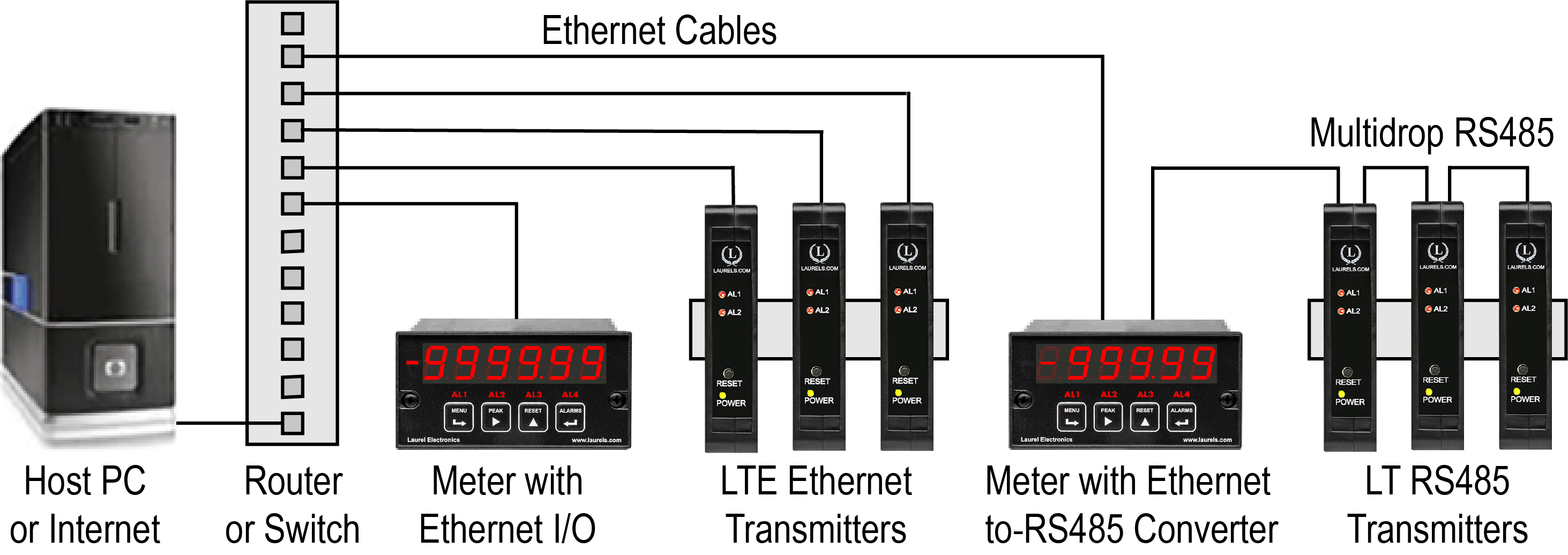
Laurel LTE series Ethernet transmitters can connect directly to a LAN via an Ethernet cable. Up to 30 Laureate LT Transmitters and/or Digital Panel Meters can be configured for RS485 and daisy-chained to an LT Transmitter for seamless LAN integration. Setup for both configurations is streamlined using Laurel’s free Instrument Setup Software, which simplifies node discovery and transmitter configuration.
Laureate Transmitters can be equipped with Laurel communication boards to support various interfaces and protocols. These include serial interfaces with ASCII or Modbus RTU protocols, and Ethernet interfaces with web access, ASCII, or Modbus TCP/IP protocols, ensuring versatile connectivity for your commercial applications.
| LT Transmitter Signal Input & Function | Model Series | Analog Output | RS232 & RS485 | Dual Relays | |
|---|---|---|---|---|---|
| 1 | DC Input Voltage and Current | LT-DC |  |
|
|
| 2 | AC RMS Voltage or Current | LT-RMS | |
|
|
| 3 | Process Voltage or Current | LT-P | |
|
|
| 4 | Weighing Applications | LT-WA | |
|
|
| 5 | Load Cell & Microvolt Signals | LT-WM | |
|
|
| 6 | Thermocouple (Types J, K, T, E, N, R, S) | LT-TC | |
|
|
| 7 | RTD Temperature | LT-RTD | |
|
|
| 8 | Resistance in Ohms | LT-R | |
|
|
| 9 | Frequency, Rate, Speed | LT-FR | |
|
|
| 10 | Pulse Input Totalizer | LT-FR | |
|
|
| 11 | Process Signal Totalizer | LT-VF | |
|
|
| 12 | Sum, Difference, Ratio, Product of 2 Inputs | LT-FR | |
|
|
| 13 | Batch Controller Pulse Input | LT-FR | |
|
|
| 14 | Batch Controller Analog Input | LT-FR | |
|
|
| 15 | On/Off Duty Cycle | LT-FR | |
|
|
| 16 | Stopwatch Timing for Single Events | LT-FR | |
|
|
| 17 | Average Time of Periodic Events | LT-FR | |
|
|
| 18 | AC Phase Angle and Power Factor | LT-FR | |
|
|
| 19 | Quadrature Position or Rate | LT-QD | |
|
|
| Pulse Inputs (FR signal conditioner) | ||||
|---|---|---|---|---|
| Signal Types | AC, pulses from NPN, PNP transistors, contact closures,magnetic pickups. | |||
| Ch A Frequency, Max | 1 MHz | |||
| Ch B Frequency, Max | 250 kHz | |||
| Signal Ground | Common ground for channels A & B | |||
| Minimum Signal | Nine ranges from (-12 to +12 mV) to (+1.25 to +2.1V) | |||
| Maximum Signal | 250 Vac | |||
| Maximum Frequency | 1 MHz, 30 kHz, 250 Hz (selectable) | |||
| Conversion Technique | Inverse period | |||
| Delay between batches | Selectable 10 ms to 199.99 s | |||
| Recalibration: All ranges are calibrated at the factory. Recalibration is recommended every 12 months. | ||||
| Power Supply Boards (one required) | ||||
| Voltage, standard | 85-264 Vac or 90-300 Vdc | |||
| Voltage, optional | 12-32 Vac or 10-48 Vdc | |||
| Frequency | DC or 47-63 Hz | |||
| Power consumption | 1.2W @ 120 Vac, 1.5W @ 240 Vac, 1.3W @ 10 Vdc, 1.4W @ 20 Vdc, | |||
| (typical, base meter) | 1.55W @ 30 Vdc, 1.8W @ 40 Vdc, 2.15W @ 48 Vdc | |||
| Power Isolation | 250V rms working, 2.3 kV rms per 1 min test | |||
| Excitation Output (standard) | ||||
| 5 Vdc | 5 Vdc ± 5%, 100 mA (jumper selectable) | |||
| 10 Vdc | 10 Vdc ± 5%, 120 mA (jumper selectable) | |||
| 12 Vdc | 12 Vdc ± 5%, 100 mA (jumper selectable) | |||
| 24 Vdc | 24 Vdc ± 5%, 50 mA (jumper selectable) | |||
| Output Isolation | 50 Vdc from signal ground | |||
| Analog Output Boards (one optional) | ||||
| Output Levels | 4-20 mA, 0-20 mA, 0-10V, -10 to +10V (single-output option) | |||
| Current compliance | 4-20 mA, 0-20 mA, 0-10V (dual-output option) | |||
| Voltage compliance | 2 mA at 10V ( > 5 kΩ load) | |||
| Scaling | 12V at 20 mA ( < 600 Ω load) | |||
| Resolution | Zero and full scale adjustable from -99999 to +99999 16 bits (0.0015% of full scale) | |||
| Isolation | 250V rms working, 2.3 kV rms per 1 min test (dual analog outputs share the same ground) | |||
| Relay Output Boards (one required for batch control) | ||||
| Dual magnetic relays | 2 Form C, 8A max, 440Vac or 125Vdc max, 2500VA or 300W | |||
| Quad magnetic relays | 4 Form A (NO), 8A max, 440Vac or 125Vdc max, 2500VA or 300W | |||
| Dual solid state relays | 2 Form A (NO), AC or DC, 0V - 400V, 120Ma, 35Ohms (max at On-State) | |||
| Quad solid state relays | 4 Form A (NO), AC or DC, 0V - 400V, 120Ma, 35Ohms (max at On-State) | |||
| Relay commons | Isolated commons for dual relays or each pair of quad relays | |||
| Relay isolation | 250V rms working, 2.3 kV rms per 1 minute test | |||
| Relay latching modes | Latching or non-latching | |||
| Relay active modes | Active on or off, active high or low | |||
| Hysteresis modes | QA passband mode, split hysteresis, span hysteresis | |||
| Communication Boards (one optional) | ||||
| Board Selections | RS232, RS485 with dual RJ11 connectors, RS485 with dual RJ45 connectors, USB, High-Speed Ethernet, USB-to-RS485 gateway, High-Speed Ethernet-to-RS485 gateway, WiFi with built-in antenna plus USB & RS485, WiFi with external antenna plus USB & RS485 | |||
| Protocols | Laurel Custom ASCII (serial), Modbus RTU (serial), Modbus TCP (Ethernet or WiFi) | |||
| Digital Addresses | 247 (Modbus), 31 (Laurel ASCII), | |||
| Isolation | 250V rms working, 2.3 kV rms per 1 min test | |||
| Environmental | ||||
| Operating Temperature | -40°C to 70°C (-40°F to 158°F) | |||
| Storage Temperature | -40°C to 85°C (-40°F to 185°F) | |||
| Relative Humidity | 95% at 40°C, non-condensing | |||
| Protection | NEMA-4X (IP-65) when panel mounted | |||
| Signal Connections | ||||
 |
||||
| Mechanical | ||||
| Enclosure | Rugged black polycarbonate housing material | |||
| Mounting | 35 mm rail per DIN EN 50022 | |||
| Dimensions | 129 x 104 x 22.5 mm case | |||
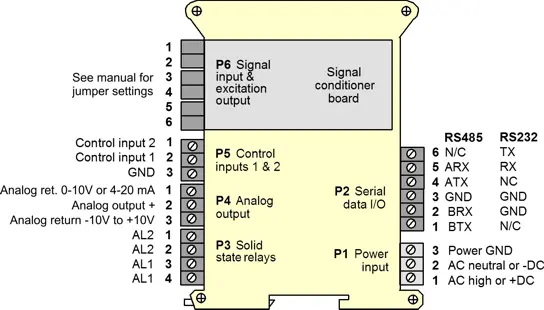
| Connectors | Detachable screw clamp connectors meet VDE / IEC / UL / CSA standards. RJ45 jack for Ethernet | |||
| Tightening Torque | Screw terminal connectors: 5 lb-in (0.56 Nm) | |||
| Weight | Complete transmitter: 183 g (6.5 oz) | |||
| Replacement Case Screws | ||||
| Size | 6 | |||
| Thread Pitch | 6-19 | |||
| Length | 1/2" | |||
| Head Style | Pan Head | |||
| Drive Style | Phillips | |||
| Head Diameter | 0.256-0.270 | |||
| Head Height | 0.087-0.097 | |||
| Full/Partial Thread | Full | |||
| Drive Size | 2 | |||
| Material | Steel | |||
| Finished | Black Oxide | |||
| General | ||||
| Programming | Utilize Laurel's free Instrument Setup Software, which runs on a PC under MS Windows. | |||
| Security | Lockout options include using the front panel buttons, the free Instrument Setup Software, or a hardware jumper. | |||
| Warranty | 3 years parts & labor | |||
| Recalibration: All ranges are calibrated at the factory. Recalibration is recommended every 12 months. | ||||
|
|
| 1/8 DIN Digital Panel Meters | DIN Rail Transmitters |
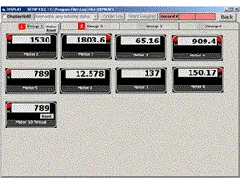
Free Downloadable Windows-based Instrument Setup (IS) software (Data Interface Board Required) for use with our programmable Digital Panel Meters, Scale Meters, Counters, Timers, Remote Displays, and Transmitters, are an easy method to set up Laureate 1/8 DIN digital panel meters, counters, timers, remote displays, and DIN-rail transmitters, as explained in the Instrument Setup Software Manual. Laureate 1/8 DIN instruments can also be set up from the front panel, as explained in their respective Owners Manuals. Instrument Setup software is of benefit whether or not the PC is connected to the instrument.
Set User Account Control (UAC) of MS Windows to "Never notifiy me" so that Instrument Setup Software can create directories. The UAC change screen can be reached as follows:
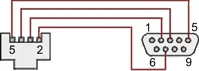
RJ11-to-DB9 cable with rear view of DB9 connector to PC
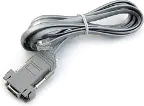
RS232 cable, meter to PC, P/N CBL01
Laureate 1/8 DIN Laureate instruments must be equipped with a serial communications board and be connected to the computer via a serial communications cable. The connection can be via RS232, RS485, USB or Ethernet. Following setup, the serial communications board may be removed from the instrument if desired. The wiring of the RS232 cable is illustrated above with end views of the two connectors.
Laureate LT Series transmitters come standard with a 3-wire serial interface, which can be jumpered for RS232 or RS485.
Laureate LTE Series transmitters come standard with an Ethernet interface.
Click on any of the reduced screens below for a full-size screen view, then click on the Back button of your browser to return to this page. The screens examples below are for a fully-loaded Series 2 Digital Panel Meter (DPM), which is connected to the PC via RS232. If the meter is a Series 1 meter (pre-2007), this is sensed by the software, and somewhat different screens are brought up. Please see Series 1 setup screens.


From the Main Menu, click on Readings if your PC is connected to the meter. A pull-down menu then offers three choices: List, Plot and Graph.


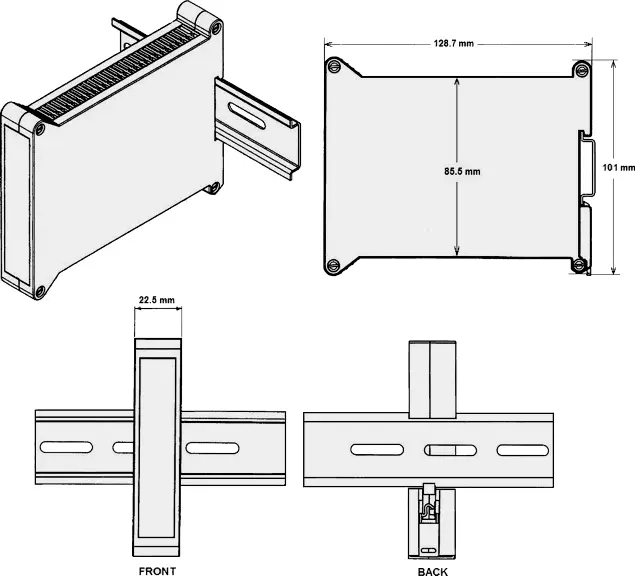
Dimensioned CAD assembly drawings in EPRT, STEP, x_t, .dwg, pdf file formats: Laureate-transmitter-case.zip (zipping prevents browser from opening CAD files as text files).
| Up/Down Totalizing | |
|---|---|
 |
Up/down totalizing is provided by a mode of the Extended totalizing transmitter where pulses are either added or subtracted on Channel A based on a direction input on Channel B. The unit can also be programmed so that counting by Channel A is inhibited by an input on Channel B. |
| Combining Two Totals | |
 |
A+B, A-B, A/B and AxB arithmetic functions are available with the Extended totalizing transmitter. A+B can sum two totals, while A-B subtracts the outflow total from inflow total. A/B ratio applied to two totals helps assure the proper mixing of components. |
| Up or Down Counting with Preset | |
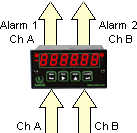 |
A single Laureate dual-channel totalizing transmitter will handle two repetitive fill operations by counting from zero up to a preset, or down from a preset to zero. The dual relay option is required. |
| Machine ON Time and Utilization | |
 |
An easy way to measure the ON time of machines is to count AC line cycles and scale the total to hours. To display machine utilization or duty cycle in percent, use the Extended totalizing transmitter. Connect Channel A to switched AC and Channel B to the AC line, and apply a 100 multiplier to the A/B ratio. |
| Custom Curve Linearization | |
 |
The Extended version of the Laureate dual channel totalizing transmitter can transmit scaled rate or total for the same channel at the push of a button, and alarm both the rate and total. The Extended version can also do curve linearization, thereby extending the working range and accuracy of flow transducers. |
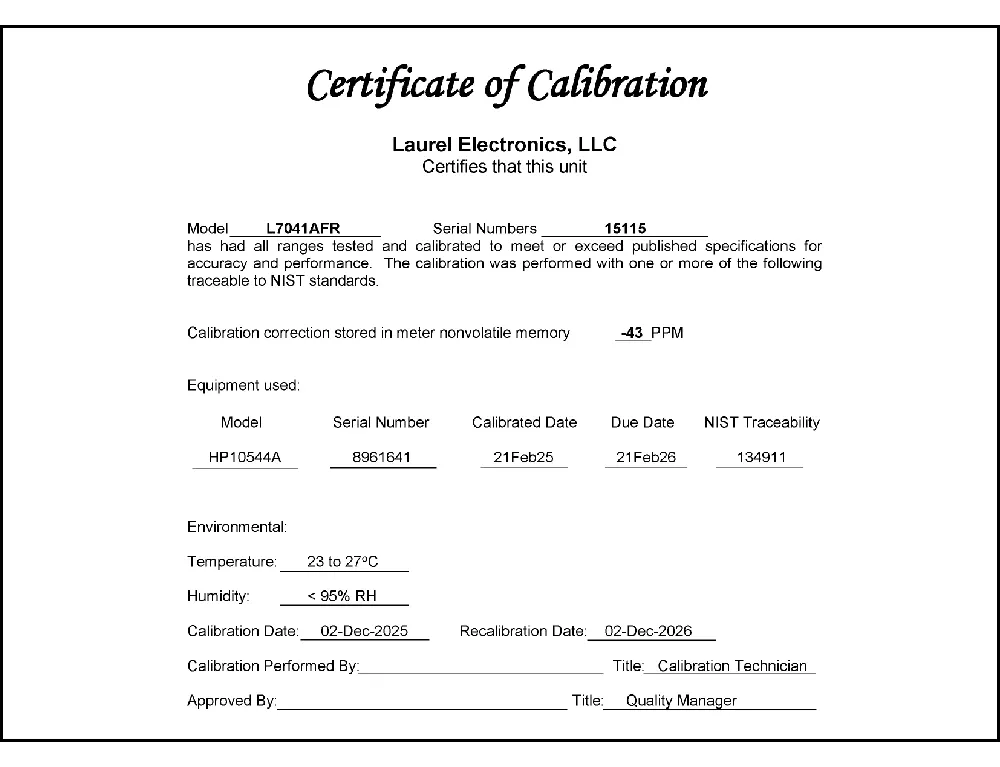
CAL-Digital
Certificate of Calibration
$65.00DLS-XLOG2
XLog2 Data logging Software
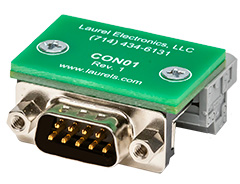
$495.00CON01
CON01 Connector
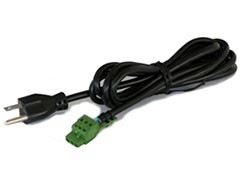
$75.00CBL6
6-foot Power Cable
$41.00CBL12
12-foot Power Cable
$47.00CBL02
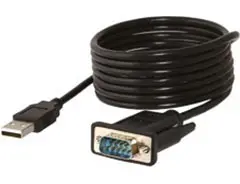
USB-to-RS232 Adapter Cable
$47.00CBL04
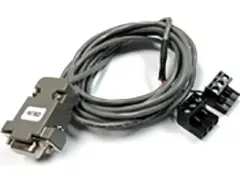
RS232 Cable for LT Transmitters
$47.00A rate meter tells you how fast liquid is flowing; a totalizer tells you how much has flowed. A batch controller needs both at once, plus the ability to repeat a fill operation automatically, over and over, without an operator resetting anything between cycles. This LTE DIN Rail Transmitter is purpose-built for exactly that — a low-cost, highly accurate controller for repetitive fill operations using a turbine flow meter or similar pulse-output transducer, communicating over Ethernet.
A batch controller is a specialized function used in process automation to precisely control the amount of material — liquids, powders, or granules — dispensed into a container or process during filling, dosing, or mixing operations. It ensures the correct quantity is delivered in each batch, helping maintain consistency, reduce waste, and improve overall efficiency.
The same pulse signal from the flow meter is applied in parallel to both input channels, but each channel does a different job. Channel A handles totalizing — the running total scaled mathematically into engineering units like liters. Channel B handles rate, using the inverse-period timing technique found throughout the Laureate line: the pulse frequency is measured by timing an integral number of periods over a selectable gate time, then inverting that period, giving far better accuracy and faster updates (up to 25 per second) than a conventional pulse-counting rate meter. Because both channels read the same physical signal, the controller displays and controls on rate and total simultaneously rather than switching between the two.
The batch control software tracks three items at once, each independently scalable to engineering units and shown on the six-digit LED display: the current batch total (which can count up from zero to a preset limit, or down from a preset limit to zero), a second item assignable to either grand total or number of batches completed, and the instantaneous flow rate.
Fill operations repeat continuously, either on a programmable delay between batches (selectable from 10 ms to 199.99 seconds) or triggered by an external control input — so the controller can run unattended through a sequence of identical fills rather than needing to be manually restarted after each one.
A relay output board is required for batch control and can be specified as two or four 8A magnetic relays, or two or four 120 mA solid state relays, with hysteresis modes including QA passband, split hysteresis, and span hysteresis available depending on how the fill and shutoff logic needs to behave.
The LTE DIN Rail Digital Transmitter for batch controller pulse input applications gives a panel builder a self-contained way to automate repetitive fill operations directly from a turbine flow meter or similar pulse source over Ethernet — tracking batch total, grand total or batch count, and flow rate simultaneously from a single input signal, with configurable relay control and cycle timing built in, so the controller runs the batching sequence itself rather than relying on external PLC logic to stitch together separate rate and total measurements.
Channel A and Channel B are configured to process the identical signal differently — one for totalizing, one for rate — since the transmitter's internal counting and inverse-period timing logic for these two functions are handled independently; feeding both channels the same signal in parallel lets both calculations run simultaneously from a single flow meter.
Counting up from zero displays the accumulating batch progress toward a target, while counting down from a preset to zero shows the remaining amount needed to complete the batch; the choice is a display preference, since both track the same underlying quantity and can trigger the fill-complete relay action at the same point.
Yes — the second item is independently assignable to either grand total (a cumulative sum across all batches) or number of batches completed, so the same hardware can be configured for whichever of those two summary values matters more for a given application.
The delay (10 ms to 199.99 s) provides a pause after one batch completes before the next one starts, useful for allowing a valve to fully close, a container to be swapped, or a brief settling period, rather than starting the next fill cycle immediately upon completion of the previous one.
No — accuracy and update rate come from the same quartz-referenced signal conditioning used across the batch controller product line; Ethernet only changes how the reading is transmitted digitally rather than over serial data.
Solid state relays are rated for lower current (120 mA) but switch faster and have no moving parts to wear out over repeated cycles, which matters in high-cycle-count batch applications; magnetic relays handle higher current (8A) directly but are better suited to lower-cycle-count applications given their mechanical wear characteristics.
It defines an acceptable band around a target value where the relay behaves differently inside versus outside that band, which can be used to distinguish a batch that completed within tolerance from one that over- or under-filled, rather than only detecting a single pass/fail threshold.
No — the transmitter connects directly to a LAN via its own RJ45 jack over Modbus TCP, without requiring a separate RS485-to-Ethernet gateway.
Each channel independently accepts pulse rates up to 250 kHz on Channel B (used for rate) and up to 1 MHz on Channel A (used for totalizing), which comfortably exceeds the working frequency range of typical turbine flow meters.
Yes — the transmitter supports up to 247 digital addresses via Modbus TCP, or a high-speed Ethernet or WiFi communication board can be used for network connectivity.
A consistent, repeatable overshoot or undershoot usually points to valve or fill mechanism lag rather than a measurement error — the flow meter registers the actual delivered volume, but the physical shutoff isn't instantaneous; adjusting the preset target to account for known dispense lag, or introducing a setpoint offset if supported, is the standard fix.
Since rate and total are calculated independently from the same underlying pulse signal but with different scaling factors configured on each channel, an apparent inconsistency usually traces to a scaling mismatch between the two channels rather than a genuine conflict in the measured signal; verifying both channels are scaled consistently for the same physical flow meter is the standard check.
Confirming the transmitter's IP configuration matches what the network expects, and that the physical Ethernet cable and switch port are functioning, are the standard first checks before suspecting a transmitter fault.
This is commonly the same physical dispense lag issue seen in overshoot/undershoot troubleshooting — the relay itself typically responds quickly, but the valve and any material already in transit downstream of the sensor take a moment to fully stop; verifying relay response against the raw pulse count timing (rather than assuming the valve itself is slow) helps isolate whether the lag is electronic or mechanical.
Confirming whether the second tracked item is actually configured for grand total (rather than batch count) is the first step, since a unit configured to display batch count instead of grand total won't accumulate volume at all, which would explain a mismatch against manually summed batch volumes.
Yes — electrical noise misread as legitimate pulses can add false counts to either channel, causing a batch to appear to complete earlier than the true delivered volume; checking cable shielding, grounding, and the selected noise filter setting is the standard remedy for unexplained early batch completion.
Network congestion or too many devices polling the same transmitter simultaneously can cause intermittent timeouts; checking polling frequency from all connected clients and network traffic load is a common troubleshooting step.
Confirming the configured delay units and value in setup software match what's actually intended (since the range spans milliseconds to just under 200 seconds) is the first step, as a delay value entered in the wrong units or magnitude would produce a timing discrepancy that looks like a fault but is actually a configuration mismatch.